Why this works
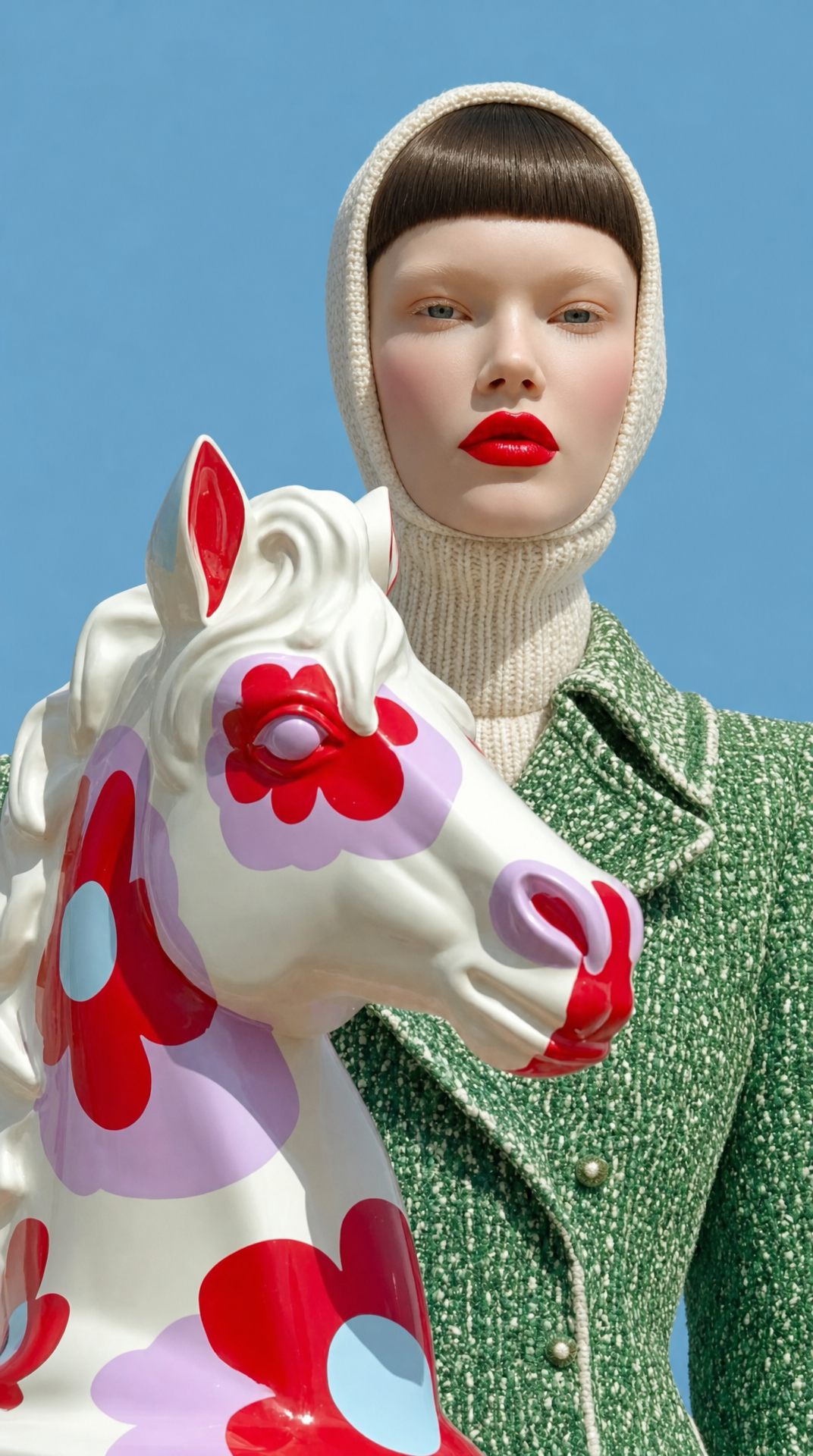
The portrait-closeup framing makes the model’s blunt dark-brown bangs, textured green tweed coat, cream knit hood, and the horse sculpture’s red-and-pink floral pattern carry the image at intimate scale. “Clean neutral studio background in cool tones” supplies the blue-leaning negative space, while “glossy white” and “bold red and pink floral patterns” create controlled contrast against the green coat. The bold luxury mood comes from the specific combination of “high-end editorial lighting with crisp highlights and controlled shadows,” “glossy white decorative horse sculpture,” and “surreal editorial luxury,” which keeps the image polished rather than whimsical.
FAQ
→How do I make the horse sculpture more central and prominent?
Replace “posed beside a glossy white decorative horse sculpture” with “model partially behind a large glossy white decorative horse sculpture, the horse’s head and floral body dominating the foreground,” and replace “portrait-closeup” with “tight two-subject portrait framing.” Keep “bold red and pink floral patterns” to preserve its visual emphasis.
→How do I shift this from cool luxury to a warmer, more dramatic mood?
Replace “clean neutral studio background in cool tones” with “deep burgundy studio background with warm amber undertones,” and change “crisp highlights and controlled shadows” to “directional warm spotlighting with deep sculptural shadows.” Swap the dominant blue emphasis for “burgundy, emerald green, and saturated crimson” while retaining the green tweed coat.
→How do I create a consistent series of variations from this prompt?
Keep “pale fashion model,” “dark brown blunt bangs,” “green tweed coat,” “cream knit hood,” “high-end editorial lighting,” and “surreal editorial luxury” unchanged as identity anchors. Vary only the sculpture description, such as replacing “glossy white decorative horse sculpture” with “glossy white swan sculpture” or “glossy white porcelain lion sculpture,” and change the floral colors from “bold red and pink” to a fixed alternate palette across the series.
Learn the technique behind this
- Why can't AI spell, and how do I get readable text in an image? — Older diffusion models had no character-level representation of text, so they produced letterform-shaped texture instead of words.
- How should a prompt be structured, and does word order matter? — A prompt that behaves predictably names one subject first, then what it is doing, then where, then the light, then the lens or medium, then the style.
- Do negative prompts work, and what should go in one? — Negative prompts work on models that support a separate negative conditioning channel — mainly Stable Diffusion and FLUX-family models.
Related prompts
Teal fashion editorial in monster-filled lift
Cobalt Boots in Sleek Studio Edit
Silhouette Influencer by Sunlit Window
Sunlit editorial on striped beach towel