Why this works
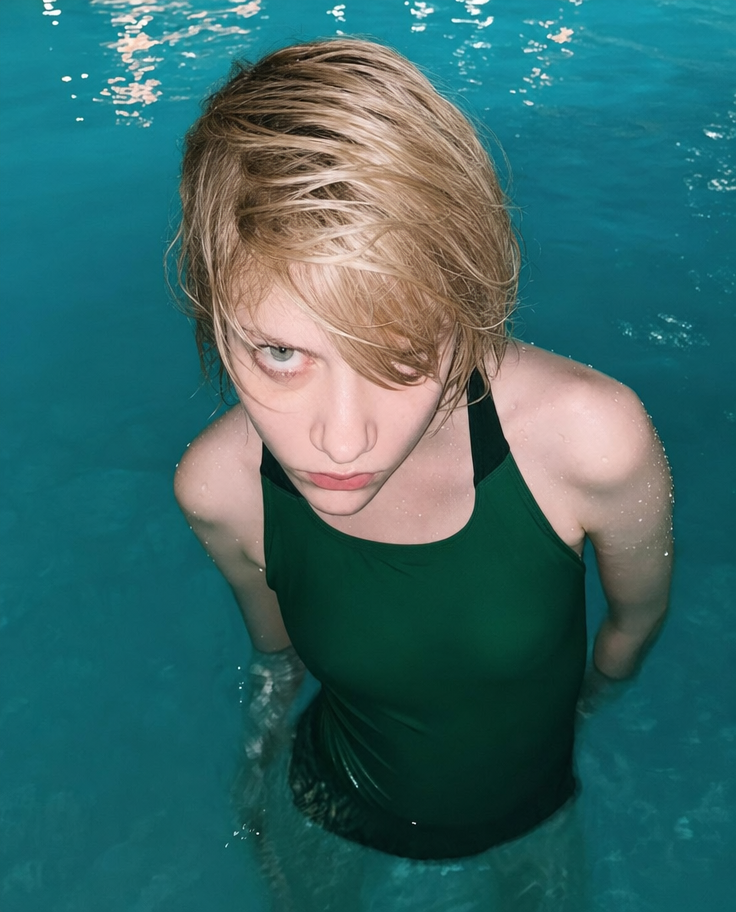
The overhead fashion-editorial angle turns the clear pool into a graphic backdrop, while the close portrait framing keeps the wet, side-swept blonde hair and deep emerald-green swimsuit visually dominant. “Direct flash photography with harsh highlights” supplies the intense, hard-edged mood, and “high-contrast moody styling” reinforces it through sharp separation between the green suit, beige skin tones, and pale water. “Realistic skin texture” keeps the image photographic rather than overly polished, while “cinematic poolside atmosphere” adds context without competing with the close-up subject.
FAQ
→How do I make the swimsuit and torso more central in the composition?
Replace “portrait-closeup” with “tight overhead crop centered on the torso and swimsuit,” and change “wet blonde hair swept to the side” to “wet blonde hair cropped near the frame edge.” Keep “deep emerald-green one-piece swimsuit” unchanged so the green remains the visual anchor.
→How do I change the mood from moody and intense to bright, clean summer editorial?
Replace “direct flash photography with harsh highlights” with “soft diffused midday sunlight with gentle highlights,” and replace “high-contrast moody styling” with “bright, airy editorial styling with low contrast.” You can also change “cinematic poolside atmosphere” to “fresh sunlit resort atmosphere” while keeping “realistic skin texture.”
→How do I build a matching series with different pool colors and swimsuit looks?
Keep “overhead fashion editorial portrait,” “clear swimming pool water,” “realistic skin texture,” and the same lighting phrase for consistency, then swap “deep emerald-green one-piece swimsuit” for colors such as “cobalt-blue one-piece swimsuit,” “coral-red one-piece swimsuit,” or “cream ribbed one-piece swimsuit.” For coordinated compositions, replace the pool description with “clear turquoise pool water,” “pale beige pool water,” or “deep cobalt pool water” to create deliberate color pairings.
Learn the technique behind this
- Why can't AI spell, and how do I get readable text in an image? — Older diffusion models had no character-level representation of text, so they produced letterform-shaped texture instead of words.
- How should a prompt be structured, and does word order matter? — A prompt that behaves predictably names one subject first, then what it is doing, then where, then the light, then the lens or medium, then the style.
- Do negative prompts work, and what should go in one? — Negative prompts work on models that support a separate negative conditioning channel — mainly Stable Diffusion and FLUX-family models.
Related prompts
Teal fashion editorial in monster-filled lift
Cobalt Boots in Sleek Studio Edit
Silhouette Influencer by Sunlit Window

Sunlit editorial on striped beach towel