Why this works
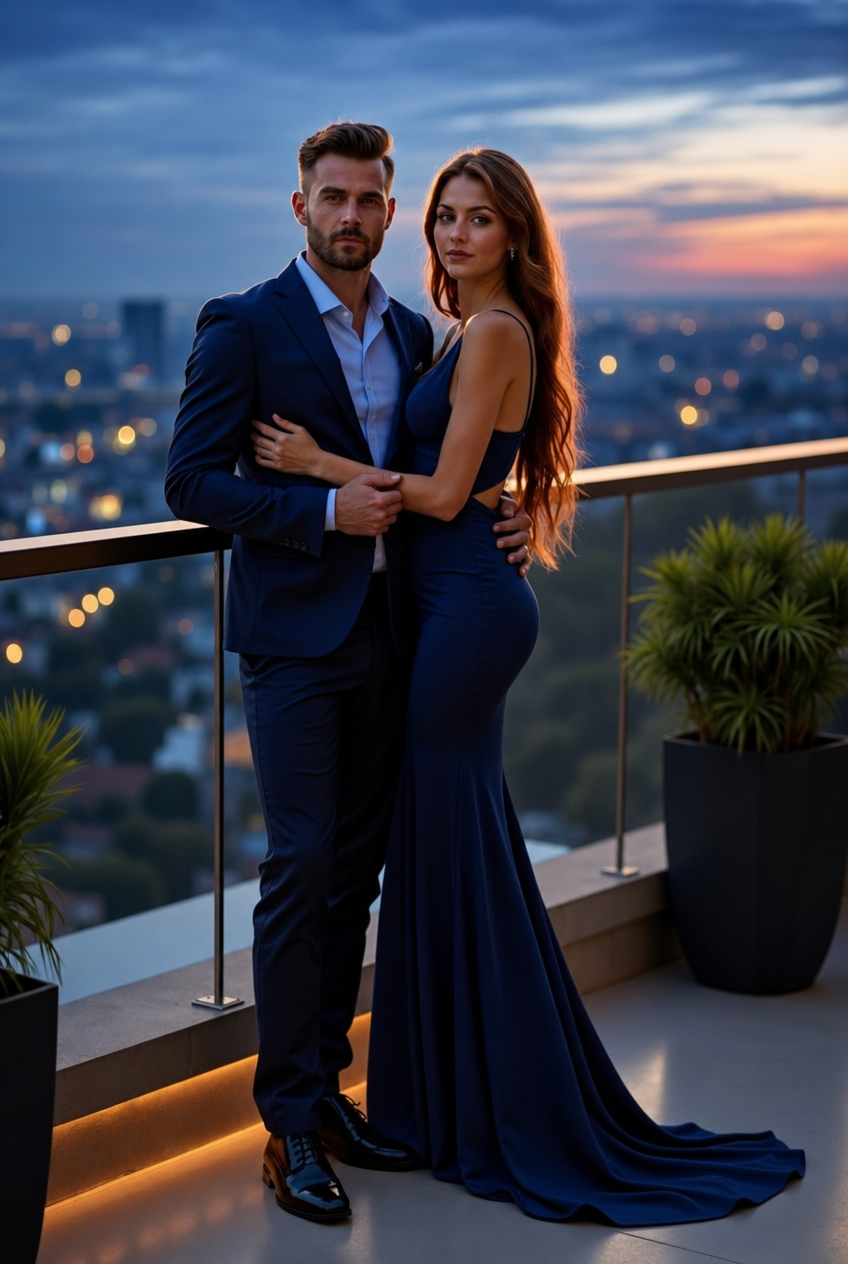
The intimate mood comes from “standing close together,” “intimate pose,” and “confident expressions,” while “cool twilight ambient light with subtle rim highlights” gives the romance a composed, blue-hour restraint rather than warmth. “Coordinated navy evening looks,” reinforced by the dominant navy, black, and brown palette, creates visual harmony across the couple and balcony setting. “Portrait-full-body” keeps the tailored suit, fitted gown, and “graceful, shorter train” readable, while “shallow depth of field” and “soft city skyline bokeh” separate them from the high-rise context without losing the sense of luxury scale.
FAQ
→How do I change this prompt for a warmer, more romantic mood?
Replace “cool twilight ambient light with subtle rim highlights” with “warm golden-hour backlight with soft amber rim light,” and change “cool blue-hour twilight” to “glowing sunset light.” Keep “intimate pose” and “standing close together” so the warmer tone does not remove the couple’s closeness.
→How do I make the woman’s gown and train more visually prominent?
Replace “portrait-full-body” with “full-length portrait framing with the gown and train occupying the lower foreground,” and change “graceful, shorter train” to “long flowing train cascading across the balcony floor.” Reduce the background distraction by replacing “soft city skyline bokeh” with “minimal distant skyline bokeh,” while retaining “shallow depth of field.”
→How do I build a series of variations from this couple and setting?
Keep the core phrases “a sleek couple in coordinated navy evening looks,” “luxury high-rise balcony,” and “photorealistic fashion editorial photography,” then swap one controlled element per version: replace “blue hour” with “night skyline illumination” or “overcast late afternoon,” change “glass railing” to “marble terrace balustrade,” and vary “intimate pose” with “walking side by side” or “the woman leaning against the railing.”
Learn the technique behind this
- Why can't AI spell, and how do I get readable text in an image? — Older diffusion models had no character-level representation of text, so they produced letterform-shaped texture instead of words.
- Do negative prompts work, and what should go in one? — Negative prompts work on models that support a separate negative conditioning channel — mainly Stable Diffusion and FLUX-family models.
- Why does AI get hands and faces wrong, and how do I fix it? — Hands fail because they're small in frame, extremely variable in pose, and self-occluding — the model has less usable signal per pixel than for any other body part.
Related prompts
Teal fashion editorial in monster-filled lift
Cobalt Boots in Sleek Studio Edit
Silhouette Influencer by Sunlit Window
Sunlit editorial on striped beach towel