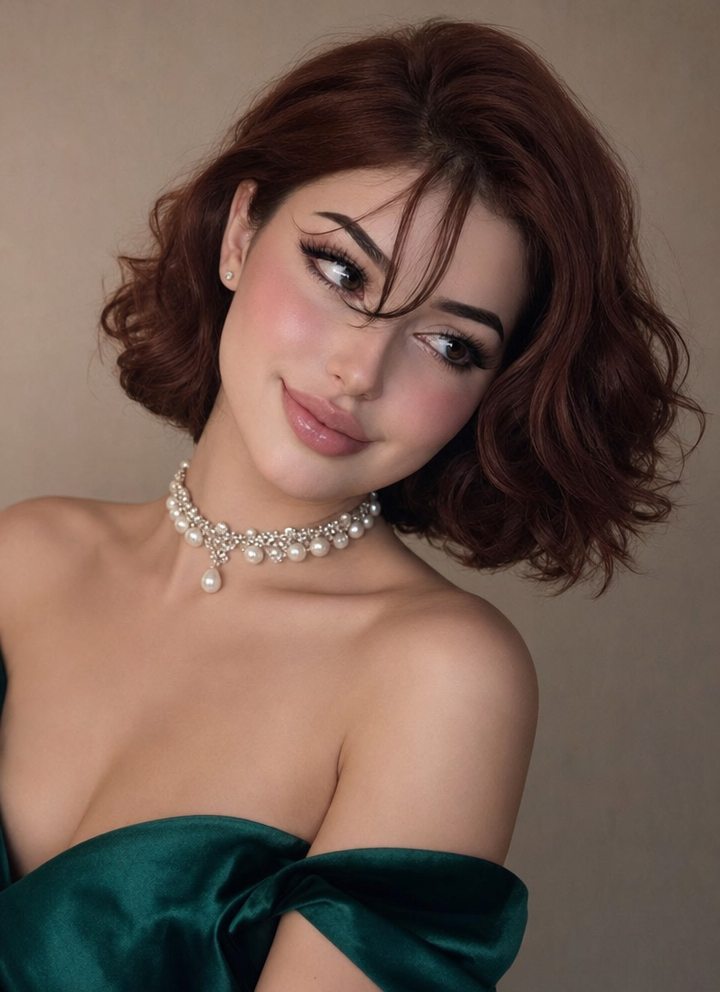
Why this works
The phrase “monumental Stalinist-style skyscraper from the Seven Sisters dominating the background” gives the full-body portrait a strong vertical anchor and a clear sense of Moscow scale, reinforced by “layered city architecture and distant buildings for scale and depth.” “Deep navy cropped top” and the blue-gray palette harmonize with the “overcast-soft daylight,” while “shallow depth of field with soft background blur” separates the model without losing the “detailed skyline”; “50mm fast lens” and “no distortion” keep the fashion pose and architecture naturally proportioned.
FAQ
→How do I make the model more visually dominant than the skyscraper?
Replace “with a monumental Stalinist-style skyscraper from the Seven Sisters dominating the background” with “the model dominating the frame, with a distant Seven Sisters-style skyscraper reduced in scale behind her,” and change “detailed skyline” to “subtle, softly blurred skyline.” Keep “crisp subject detail” and “shallow depth of field” to preserve attention on the clothing and pose.
→How do I shift this from polished and atmospheric to a sharper, more dramatic editorial mood?
Replace “overcast-soft daylight” with “hard directional late-afternoon sunlight,” and replace “polished atmospheric color grading” with “high-contrast editorial grading with deep shadows and restrained highlights.” Change “smooth tonal transitions” to “graphic tonal separation” if you want the clothing and building edges to read more boldly.
→How do I create a series of variations while keeping the same visual identity?
Keep “50mm fast lens,” “natural perspective,” “cinematic editorial fashion photography,” and the “Seven Sisters-style Stalinist skyscraper” anchor unchanged. Make controlled swaps to “deep navy cropped top, high-waisted light-wash denim shorts” by using options such as “burgundy tailored coat and black trousers,” “silver slip dress and dark leather boots,” or “cream knitwear and wide-leg denim,” while changing the pose phrase from “confident pose” to “walking toward camera,” “seated on the terrace edge,” or “profile stance.”
Learn the technique behind this
- Why can't AI spell, and how do I get readable text in an image? — Older diffusion models had no character-level representation of text, so they produced letterform-shaped texture instead of words.
- How should a prompt be structured, and does word order matter? — A prompt that behaves predictably names one subject first, then what it is doing, then where, then the light, then the lens or medium, then the style.
- Why does the model ignore parts of my prompt? — Ignored instructions are almost always conflicts, counts, or spatial relationships — three things current models handle badly — rather than the model failing to read you.
Related prompts
Teal fashion editorial in monster-filled lift
Cobalt Boots in Sleek Studio Edit
Silhouette Influencer by Sunlit Window
Sunlit editorial on striped beach towel