Why this works
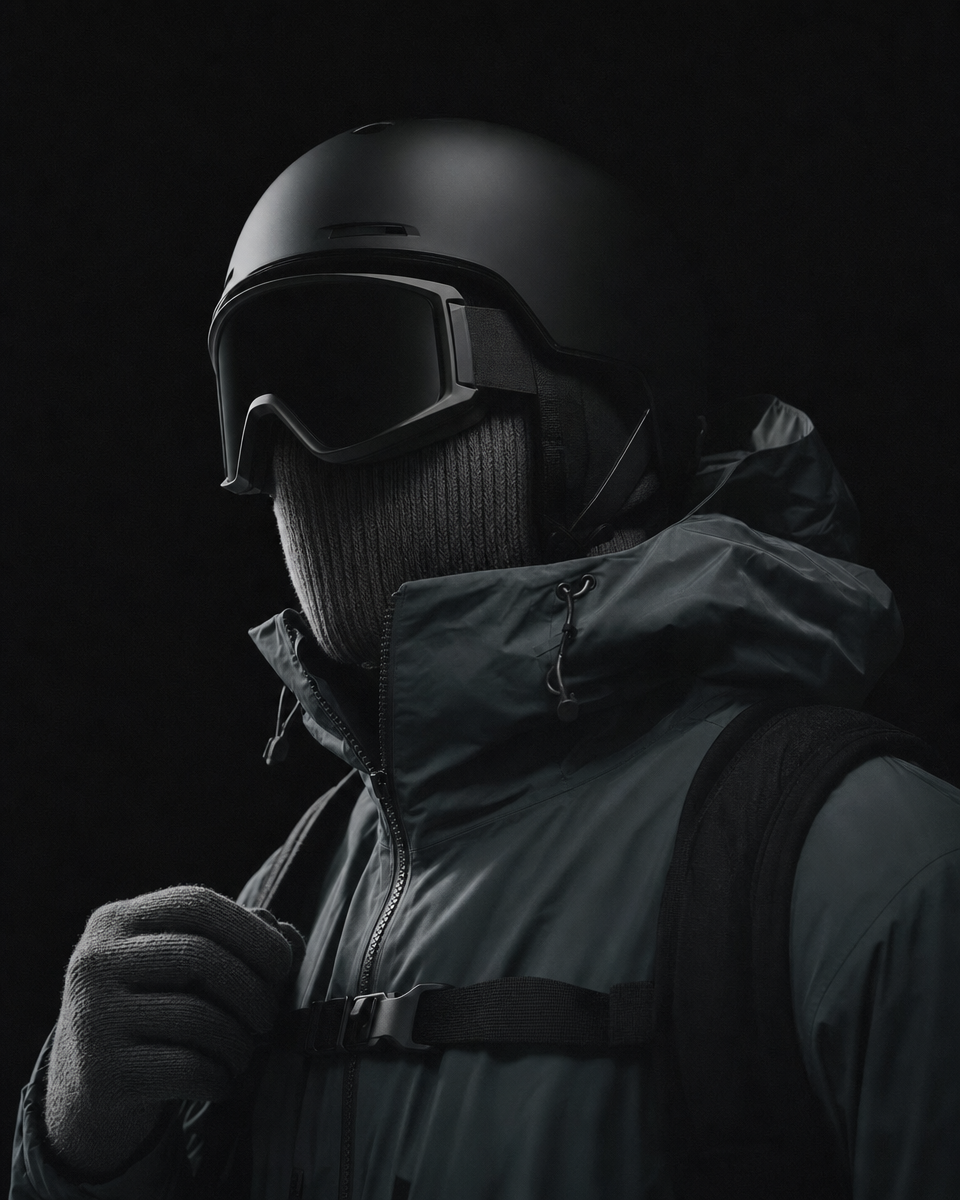
“Close-up portrait” makes the face and helmet the immediate subject, while “shallow depth of field” pushes the dark, textured winter background into soft atmospheric context. The mood comes from the specific combination of “low-key cinematic lighting with strong contrast” and “black-and-white cinematic photography,” which also explains the image’s dominant gray range. “Crisp facial-edge detail” and “highly detailed, realistic photography” preserve tactile definition in the matte helmet, knit gloves, and insulated parka despite the subdued palette.
FAQ
→How do I make the helmet and facial expression more central than the clothing?
Replace “close-up portrait” with “extreme close-up portrait focused on the eyes and helmet,” and change “crisp facial-edge detail” to “razor-sharp detail in the eyes, cheekbones, and helmet vents.” Replace “lightweight insulated parka in dark teal/charcoal tones, and knit gloves” with “only the upper collar and helmet visible at the frame edges” to reduce apparel emphasis.
→How do I make this feel colder and more severe without losing the realistic photography look?
Replace “dark textured background suggesting snow-covered night air” with “near-black blizzard haze with windblown snow particles,” and change “low-key cinematic lighting with strong contrast” to “hard, icy side-lighting with deep facial shadows and bright rim light on the helmet.” Add “frost crystals on the parka collar and helmet vents” after “subtle ventilation” for visible cold detail.
→How do I build a matching action-oriented variation from this portrait?
Replace “close-up portrait” with “dynamic three-quarter action portrait while carving down a steep slope,” and change “dark textured background suggesting snow-covered night air” to “snow spray and blurred mountain lights at night.” Keep “black-and-white cinematic photography,” “shallow depth of field,” and “crisp facial-edge detail” so the variation retains the same gray, high-contrast visual identity.
Learn the technique behind this
- Why can't AI spell, and how do I get readable text in an image? — Older diffusion models had no character-level representation of text, so they produced letterform-shaped texture instead of words.
- How should a prompt be structured, and does word order matter? — A prompt that behaves predictably names one subject first, then what it is doing, then where, then the light, then the lens or medium, then the style.
- Why does the model ignore parts of my prompt? — Ignored instructions are almost always conflicts, counts, or spatial relationships — three things current models handle badly — rather than the model failing to read you.
Related prompts

Teal fashion editorial in monster-filled lift
Cobalt Boots in Sleek Studio Edit
Silhouette Influencer by Sunlit Window
Sunlit editorial on striped beach towel