Why this works
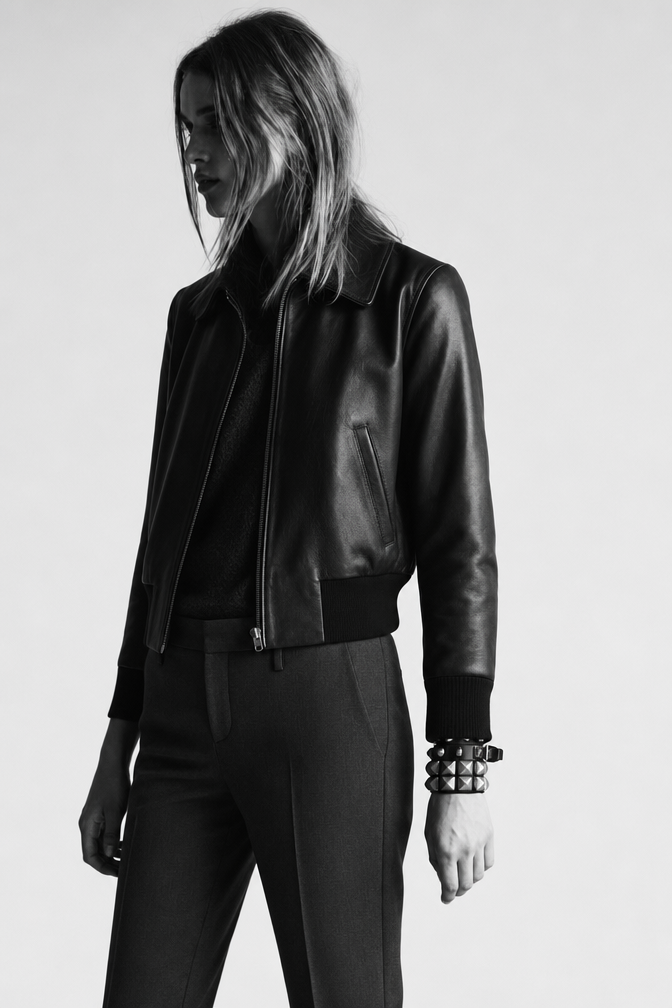
“Model in profile” and “portrait-full-body” establish a clean vertical read, keeping the jacket silhouette and slim trousers legible from head to foot. The “soft off-white/very light gray seamless background” supplies the dominant gray-white field, while “matte black leather,” “crisp monochrome tonal range,” and “deep shadows” create the stark separation that makes the figure graphic. “Sharper side highlights” selectively catches the leather and “subtle silver hardware details,” adding controlled visual accents without disrupting the minimal editorial composition.
FAQ
→How do I make the jacket the central visual element?
Replace “portrait-full-body” with “three-quarter fashion portrait framed from mid-thigh upward,” and change “model in profile” to “model in a strong three-quarter pose with shoulders angled toward camera.” Add “jacket-dominant composition, emphasis on collar, seams, and silver hardware” so the bomber receives more visual attention than the trousers.
→How do I shift this from moody monochrome to a softer, more approachable mood?
Replace “moody, minimal, high-contrast editorial lighting with sharper side highlights and deep shadows” with “soft diffused frontal studio lighting with gentle shadow transitions.” Change “crisp high-contrast monochrome tonal range” to “low-contrast grayscale with luminous midtones,” while keeping the “soft off-white/very light gray seamless background” to preserve the restrained studio setting.
→How do I create a coordinated series of variations from this prompt?
Keep “black-and-white editorial fashion photography,” “clean, fashion-magazine composition,” and “crisp monochrome tonal range” fixed as the series anchors. Vary only the subject garment and pose in controlled swaps, such as replacing “matte black leather bomber jacket and slim charcoal trousers” with “structured ivory wool coat and tailored black trousers,” then changing “posed against” to “standing, seated, or walking against” while retaining the same “seamless background” and side-lighting language.
Learn the technique behind this
- Why can't AI spell, and how do I get readable text in an image? — Older diffusion models had no character-level representation of text, so they produced letterform-shaped texture instead of words.
- How should a prompt be structured, and does word order matter? — A prompt that behaves predictably names one subject first, then what it is doing, then where, then the light, then the lens or medium, then the style.
- Which aspect ratio should I use, and how does it change the image? — Aspect ratio determines what the model composes, not how it's cropped afterwards.
Related prompts
Teal fashion editorial in monster-filled lift
Cobalt Boots in Sleek Studio Edit
Silhouette Influencer by Sunlit Window
Sunlit editorial on striped beach towel