Why this works
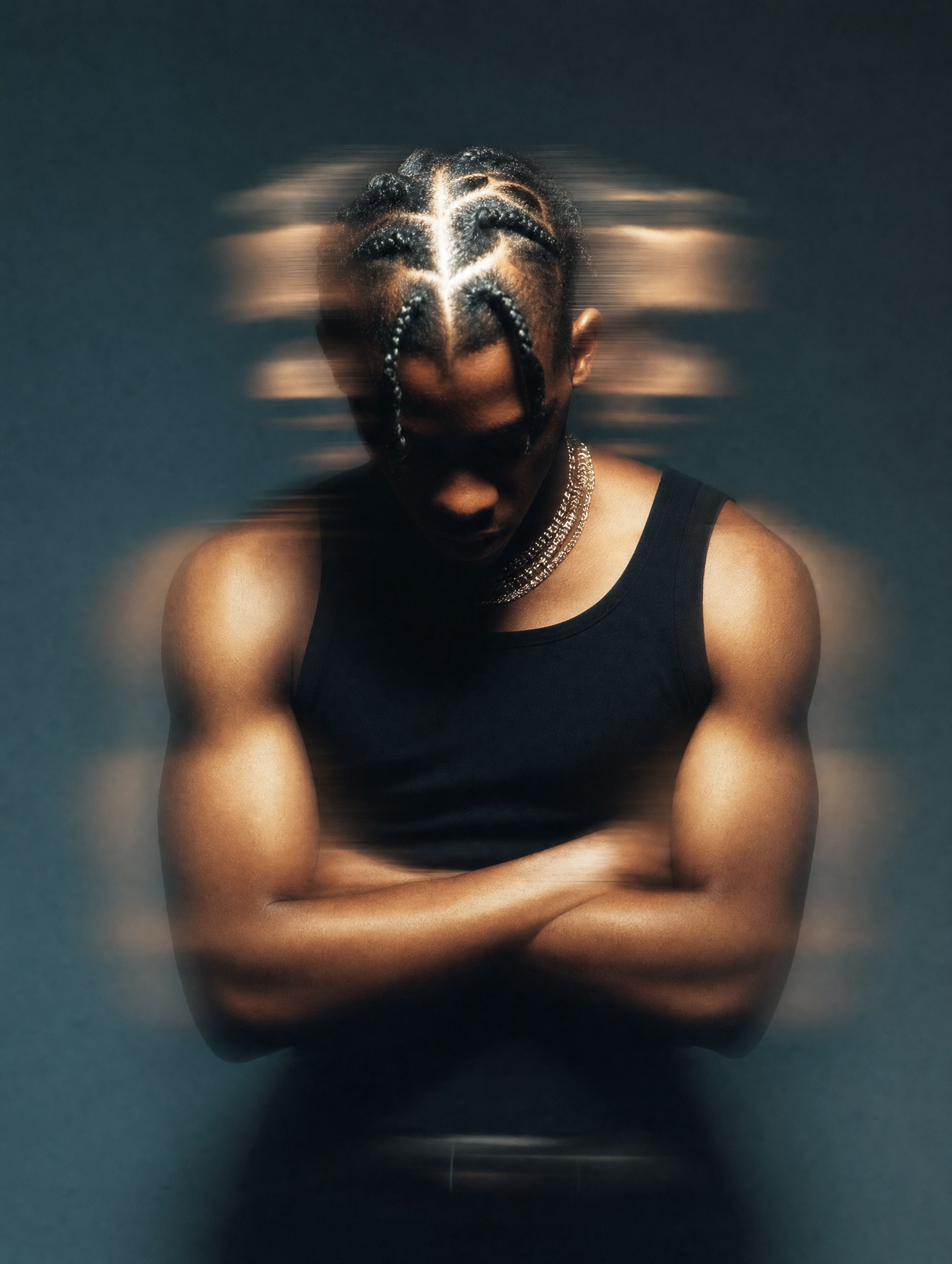
The phrase “motion-blur style that multiplies and streaks his silhouette” supplies the kinetic effect, while “strong sense of forward movement and power” directs those streaks into an assertive pose rather than random blur. “Moody studio lighting with crisp highlights” creates the intense contrast between the brown-gray tonal range and the black tank top, and “dark textured background” keeps the portrait grounded. “Fashion editorial portrait framing with shallow depth of field” preserves the subject as the visual anchor even as the multiplied silhouette expands through the full-body composition.
FAQ
→How do I make the braided hair and face more prominent while keeping the motion effect?
Replace “fashion editorial portrait framing with shallow depth of field” with “tight head-and-shoulders editorial crop, face and braided hair in razor-sharp focus,” and change “multiplies and streaks his silhouette” to “motion blur confined to the shoulders and lower body.” Keep “braided hair” unchanged so the hairstyle remains central.
→How do I shift this from moody and intense to a brighter, more energetic campaign image?
Replace “moody studio lighting with crisp highlights” with “bright white key light with clean fill and crisp rim highlights,” and replace “dark textured background” with “light gray seamless studio background.” Change “high-contrast look” to “clean luminous fashion-editorial color grading” while retaining “kinetic forward streaking blur.”
→How do I build a coordinated series of variations from this portrait?
Keep “fashion editorial photography,” “young man,” “braided hair,” and “motion-blur silhouette multiplication” fixed, then swap “black tank top” for consistent wardrobe variants such as “white mesh top,” “structured leather vest,” or “oversized gray knit.” For location-based variations, replace “moody studio with a dark, textured background” with “concrete parking structure,” “industrial stairwell,” or “warm amber-lit backstage corridor,” while preserving “portrait-full-body” framing.
Learn the technique behind this
- Why can't AI spell, and how do I get readable text in an image? — Older diffusion models had no character-level representation of text, so they produced letterform-shaped texture instead of words.
- How should a prompt be structured, and does word order matter? — A prompt that behaves predictably names one subject first, then what it is doing, then where, then the light, then the lens or medium, then the style.
- Why does the model ignore parts of my prompt? — Ignored instructions are almost always conflicts, counts, or spatial relationships — three things current models handle badly — rather than the model failing to read you.
Related prompts
Teal fashion editorial in monster-filled lift
Cobalt Boots in Sleek Studio Edit
Silhouette Influencer by Sunlit Window
Sunlit editorial on striped beach towel