Why this works
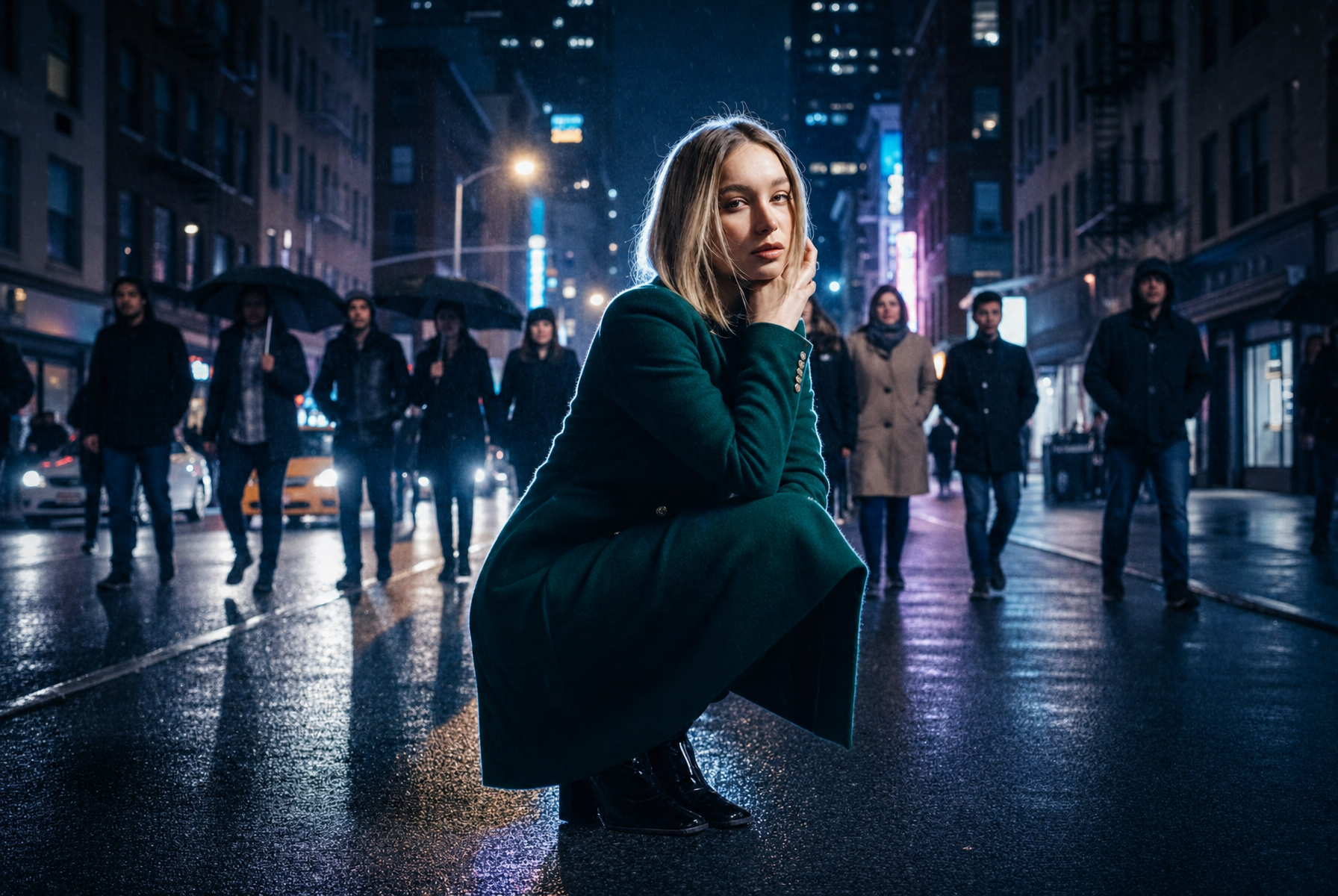
The phrase “stylish woman crouching in the middle of a wet city street” gives the image its candid-action composition and places the subject directly at the visual center, while “close editorial fashion framing” keeps the pose and coat dominant. “Dramatic cinematic lighting with stronger cool rim light and cooler highlights” produces the cool, moody separation against the gray-black street, and “neon-lit background bokeh” adds controlled color without competing with the deep emerald coat. “Shallow depth of field” turns the umbrella-carrying pedestrians and reflective pavement into atmospheric context, while “realistic skin texture” and “photorealistic editorial fashion photography” preserve the fashion-editorial finish.
FAQ
→How do I make the woman’s emerald coat more prominent in the image?
Replace “close editorial fashion framing” with “medium close-up framing centered on the coat and upper body,” and add “deep emerald green coat as the dominant color, crisp fabric texture, gold buttons sharply visible.” Keep “shallow depth of field,” but change “blurred pedestrians with umbrellas” to “heavily defocused pedestrians and umbrellas” so the background recedes further.
→How do I make the scene feel warmer and less coldly cinematic?
Replace “stronger cool rim light and cooler highlights” with “warm amber key light and soft golden rim light,” and change “neon-lit urban background” to “warm amber and magenta storefront neon.” Retain “reflective wet pavement,” which will mirror the warmer colors while preserving the rainy nighttime setting.
→How do I create a series of variations while keeping the same fashion-editorial identity?
Keep “photorealistic editorial fashion photography,” “realistic skin texture,” “shallow depth of field,” and “deep emerald green fitted coat with subtle gold buttons” unchanged. Build variations by replacing only “crouching in the middle of a wet city street” with poses such as “standing beneath a neon awning,” “walking through the rain,” or “leaning against a parked taxi,” and swap “blurred pedestrians carrying umbrellas” for setting-specific background action.
Learn the technique behind this
- Why can't AI spell, and how do I get readable text in an image? — Older diffusion models had no character-level representation of text, so they produced letterform-shaped texture instead of words.
- How should a prompt be structured, and does word order matter? — A prompt that behaves predictably names one subject first, then what it is doing, then where, then the light, then the lens or medium, then the style.
- Why does AI get hands and faces wrong, and how do I fix it? — Hands fail because they're small in frame, extremely variable in pose, and self-occluding — the model has less usable signal per pixel than for any other body part.
Related prompts
Teal fashion editorial in monster-filled lift
Cobalt Boots in Sleek Studio Edit
Silhouette Influencer by Sunlit Window
Sunlit editorial on striped beach towel