Why this works
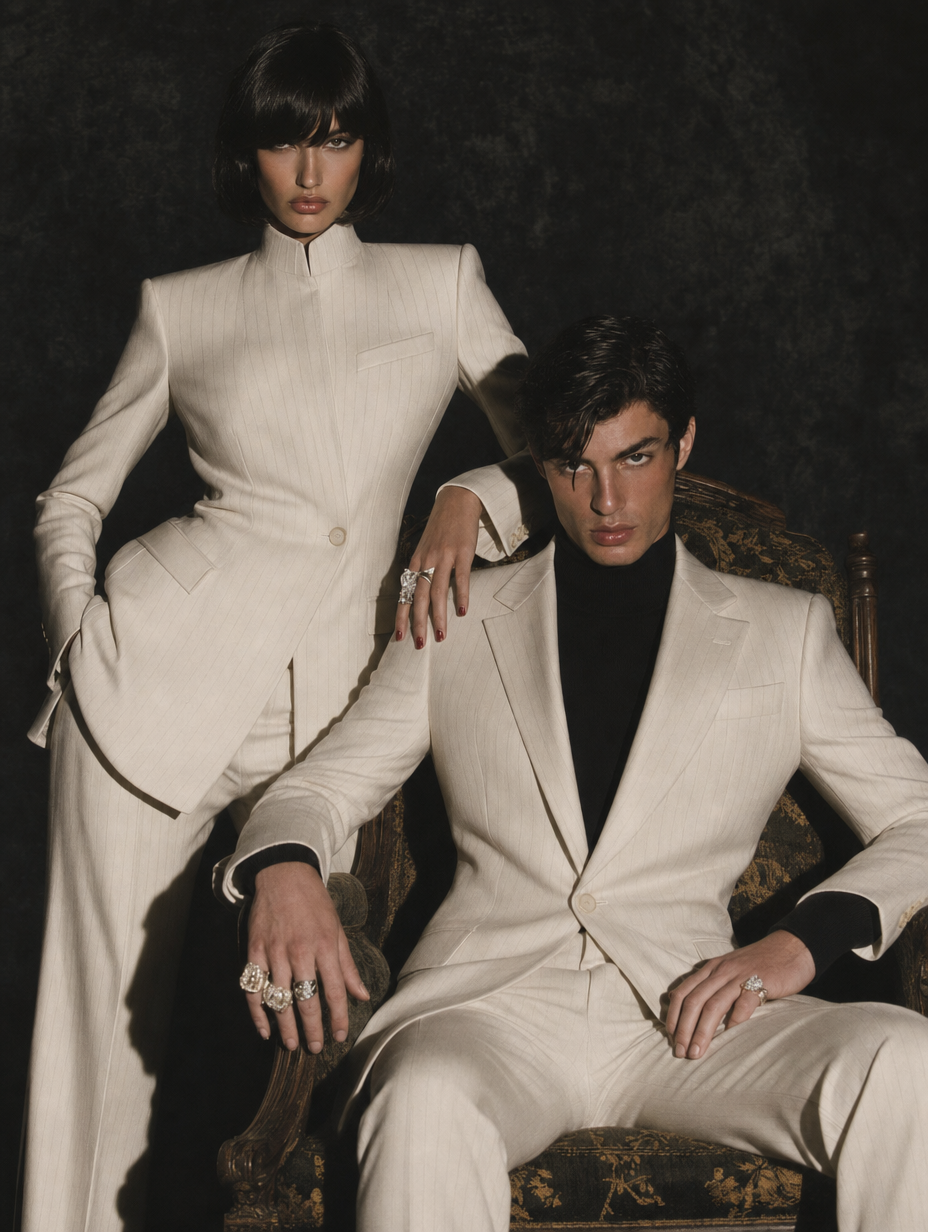
“Two stylish fashion models posed together” establishes the paired, full-body editorial composition, while “seated in an ornate vintage chair” gives the portrait a strong central anchor and visible sense of scale. The “tailored off-white tones with subtle pinstripe texture” create the dominant beige contrast against the “deeper, velvety charcoal background,” and “cinematic studio lighting with a low key profile, rich shadows” supplies the moody gray-and-cream tonal harmony. “Shallow depth of field” isolates the models and chair from the background, while “high-collar blazer,” “structured shoulders,” and “dark turtleneck” provide the precise fashion details that keep the image tailored rather than bridal or conventional suiting.
FAQ
→How do I make the woman the clear visual focus while keeping both models in the portrait?
Replace “two stylish fashion models posed together” with “a female fashion model as the dominant foreground subject, with a male model positioned slightly behind her,” and change “posed together” to “the woman seated centrally, the man standing in a supporting three-quarter pose.” Add “slightly brighter key light on the woman’s face” to reinforce the hierarchy without removing the paired composition.
→How do I make this prompt feel brighter and less somber?
Replace “deeper, velvety charcoal background” with “soft warm gray studio background,” and change “low key profile, rich shadows” to “high-key cinematic studio lighting with gentle controlled shadows.” Keep “tailored off-white tones” but add “warm ivory highlights and luminous skin tones” to shift the beige-and-gray palette toward a lighter luxury editorial look.
→How do I build a different setting variation while preserving the same fashion language?
Replace “seated in an ornate vintage chair” and “dark, velvety charcoal background” with “standing in a grand Art Deco hotel lobby with polished stone and brass details.” Retain “matching tailored off-white suits,” “subtle pinstripe texture,” “high-collar blazer,” and “dark turtleneck,” then change “portrait-full-body” to “full-length editorial fashion photograph” so the new architecture remains visible.
Learn the technique behind this
- Why can't AI spell, and how do I get readable text in an image? — Older diffusion models had no character-level representation of text, so they produced letterform-shaped texture instead of words.
- How should a prompt be structured, and does word order matter? — A prompt that behaves predictably names one subject first, then what it is doing, then where, then the light, then the lens or medium, then the style.
- Why does AI get hands and faces wrong, and how do I fix it? — Hands fail because they're small in frame, extremely variable in pose, and self-occluding — the model has less usable signal per pixel than for any other body part.
Related prompts
Teal fashion editorial in monster-filled lift
Cobalt Boots in Sleek Studio Edit
Silhouette Influencer by Sunlit Window
Sunlit editorial on striped beach towel