Why this works
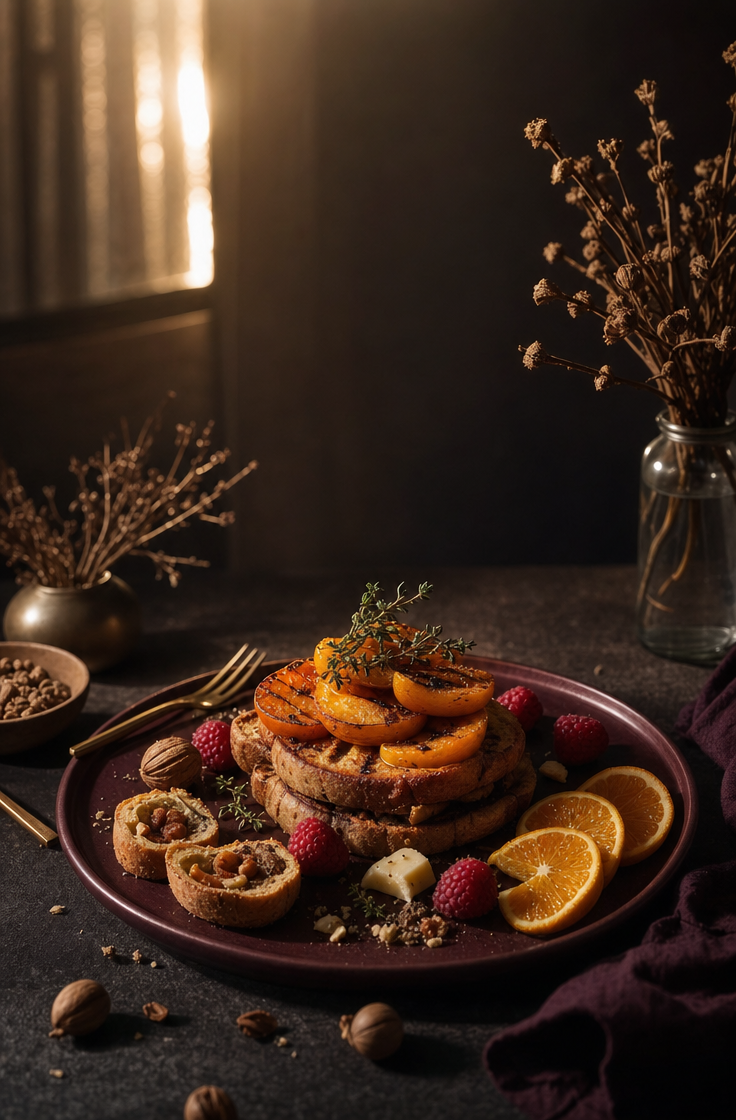
The phrase 'deep shadows with dramatic back-lighting creating chiaroscuro effect' is what actually produces the brown-gold-amber palette and the sense of hidden depth, since backlighting rims the apricot slices and thyme in gold while the burgundy plate and charcoal tablecloth sink into shadow. 'Deep burgundy ceramic plate' against 'deep charcoal tablecloth' is the load-bearing color pairing that keeps the warm food tones from looking cheerful instead of moody. The scattered elements - raspberries, orange slices, mini tarts - named individually rather than as a generic garnish list are what give the overhead flatlay its textured, editorial clutter instead of a clean centered shot. 'Cinematic still life composition' is doing the work of justifying the overhead framing choice itself, nudging it away from a straight product shot toward something staged like a film frame.
FAQ
→How do I make this feel warmer and more inviting instead of moody and dramatic?
Swap 'deep shadows with dramatic back-lighting creating chiaroscuro effect' for 'soft golden hour side-lighting with warm ambient fill' and change 'deep charcoal tablecloth' to 'warm linen tablecloth in cream or terracotta.' Dropping 'chiaroscuro style' from the style modifiers list is also necessary since that term alone will keep pulling the render back toward heavy shadow.
→How do I make the mini tarts the main subject instead of the toast stack?
Move 'mini tarts' to the front of the subject line and describe them with detail, like 'a cluster of glazed mini tarts with berry filling, front and center,' then demote the toast to 'with a stack of toasted bread and grilled apricot slices arranged behind.' You'll also want to adjust the camera line from 'overhead-flatlay' framing toward something like 'close-up three-quarter angle' so the tarts read as the focal point rather than one item among equals in a flat spread.
→How do I turn this into a series with different fruits or seasons?
Keep the lighting and style modifiers exactly as written ('deep shadows with dramatic back-lighting,' 'chiaroscuro style,' 'rich textures') since those are what create the consistent moody thread across a set. Then just swap the fruit and topping words: replace 'grilled apricot slices' with 'roasted fig halves' or 'blood orange segments,' and swap 'raspberries, orange slices, and mini tarts' for a matching seasonal trio like 'pomegranate seeds, dried orange wheels, and mini pear tarts' for a winter version.
Learn the technique behind this
- Why can't AI spell, and how do I get readable text in an image? — Older diffusion models had no character-level representation of text, so they produced letterform-shaped texture instead of words.
- How should a prompt be structured, and does word order matter? — A prompt that behaves predictably names one subject first, then what it is doing, then where, then the light, then the lens or medium, then the style.
- Do negative prompts work, and what should go in one? — Negative prompts work on models that support a separate negative conditioning channel — mainly Stable Diffusion and FLUX-family models.
Related prompts
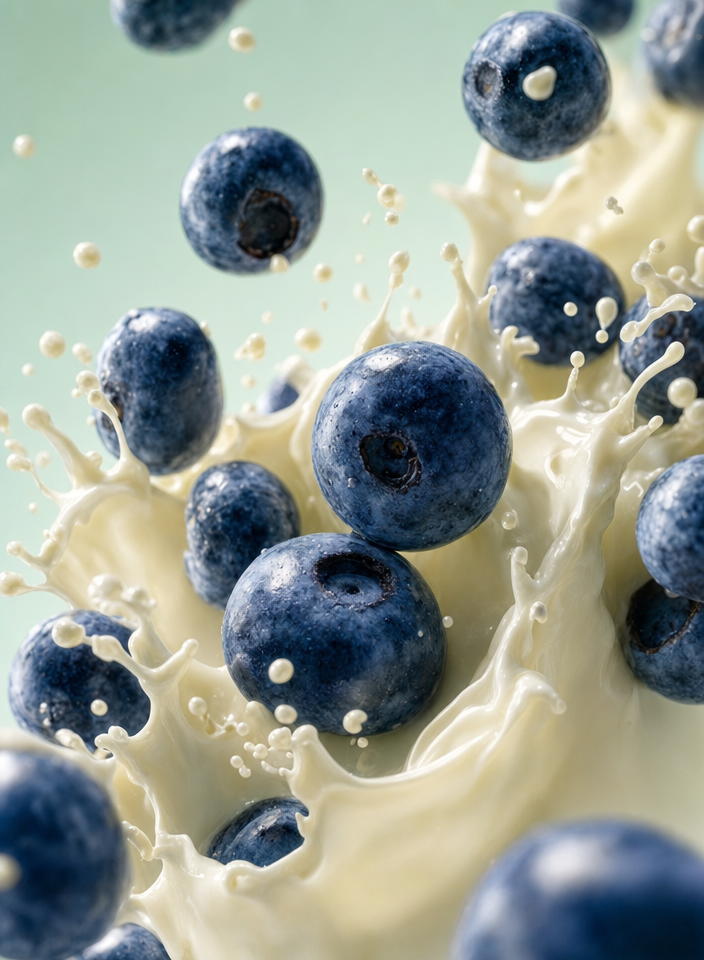
Blueberries Bursting Into Vanilla Cream
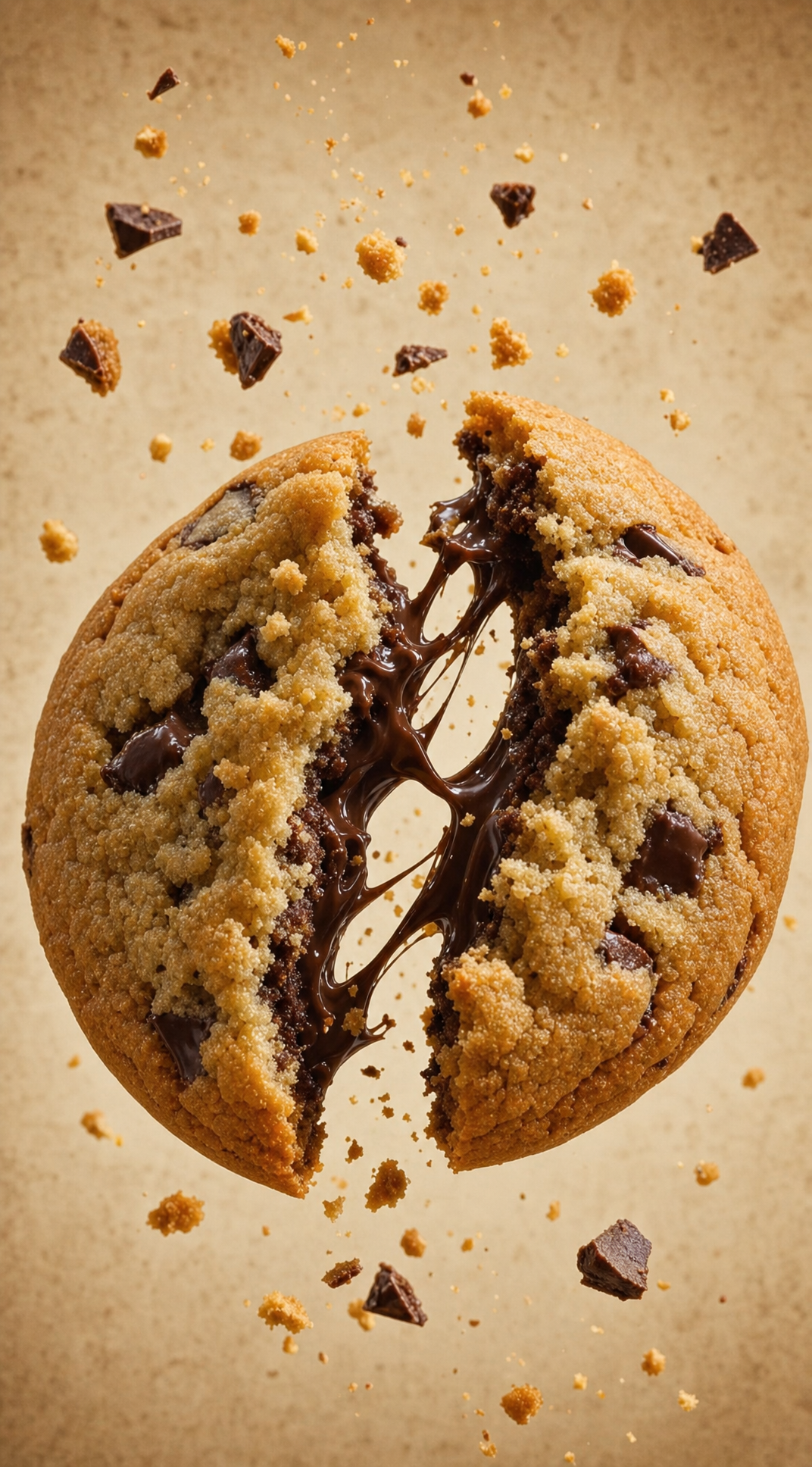
Chocolate Filled Cookie Splitting Midair With Dark Drip
Partially Peeled Banana on Blue
Banana slices in cool milk splash background