Why this works
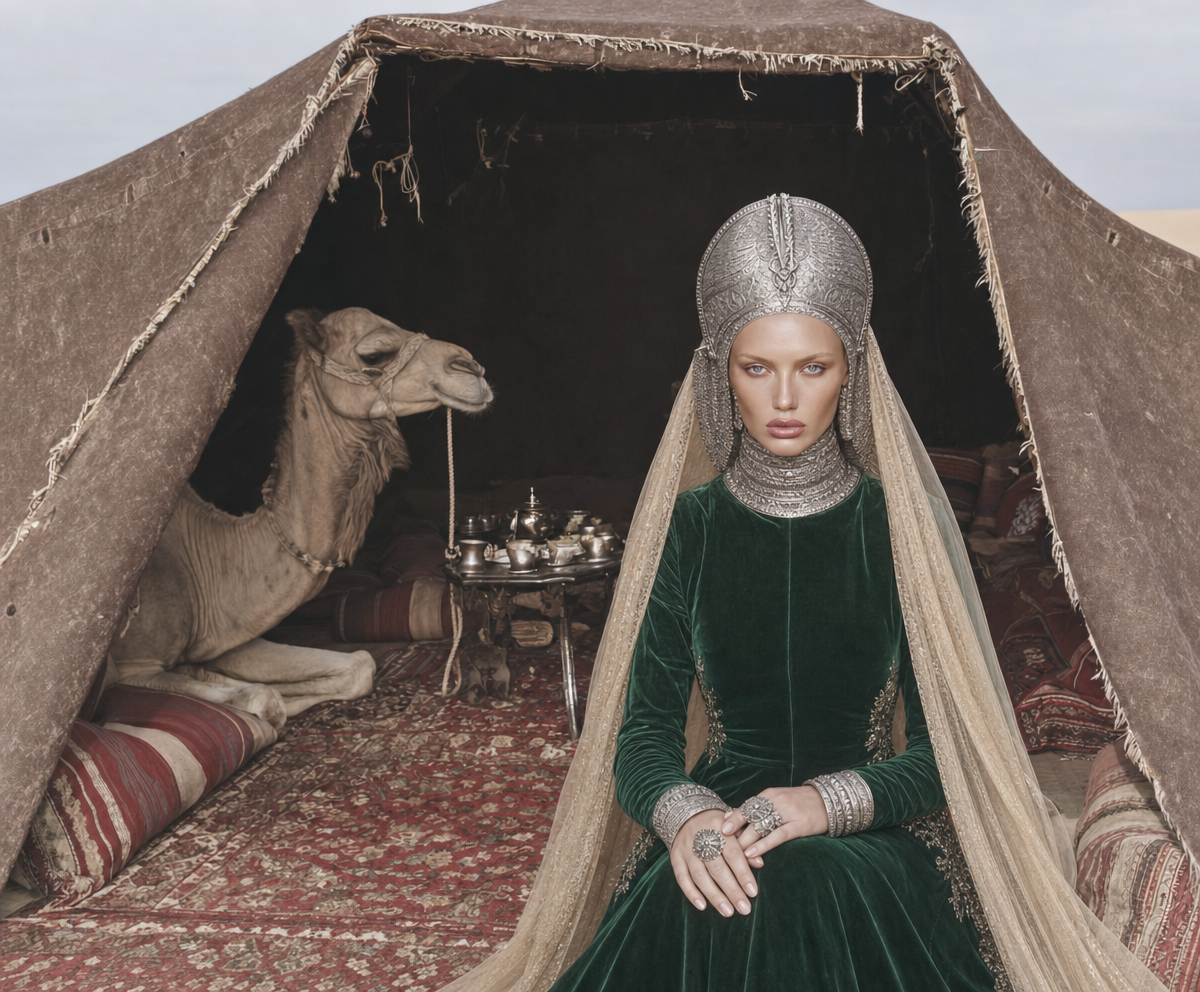
The centered cinematic editorial framing makes the seated model the clear anchor, while “shallow depth of field” pushes the resting camel and tent details into a supporting role. “Emerald velvet gown,” “silver-toned headdress,” and “pale-gold veil” create a controlled green, gray, and beige palette, with the richly patterned rugs supplying the red accents visible in the image. “Soft diffused natural light filters through the tent fabric” gives the scene its calm, regal mood by placing gentle highlights on the model’s realistic skin, velvet, and veil rather than using hard studio contrast.
FAQ
→How do I make the model’s face and headdress more prominent?
Replace “centered cinematic composition” with “tight three-quarter portrait framing, face and silver-toned headdress dominant in the upper center,” and change “shallow depth of field” to “very shallow depth of field with the eyes and headdress in razor-sharp focus.” Keep the gown and camel as secondary details by adding “cropped lower body, background elements softly blurred.”
→How do I shift this from calm regal luxury to a darker, more dramatic mood?
Replace “Soft diffused natural light filters through tent fabric” with “dramatic directional shafts of warm light cutting through the tent, deep cool shadows, controlled chiaroscuro.” Change “calmly” in “a camel rests calmly” to “a camel sits alertly in the shadowed background,” and replace “pale-gold veil” with “smoky bronze veil with translucent shadowed folds.”
→How do I build a matching series with different desert settings?
Keep “photorealistic editorial fashion photography,” “luxury fashion magazine styling,” “emerald velvet gown,” and “silver-toned headdress” unchanged for visual continuity. Swap “traditional desert nomadic tent interior with richly patterned rugs” for a specific location such as “wind-carved sandstone canyon at sunset,” “desert market courtyard with woven awnings,” or “salt-flat camp under an overcast sky,” and replace “a camel resting in the shaded background” with one setting-specific secondary element.
Learn the technique behind this
- Why can't AI spell, and how do I get readable text in an image? — Older diffusion models had no character-level representation of text, so they produced letterform-shaped texture instead of words.
- How should a prompt be structured, and does word order matter? — A prompt that behaves predictably names one subject first, then what it is doing, then where, then the light, then the lens or medium, then the style.
- Why does the model ignore parts of my prompt? — Ignored instructions are almost always conflicts, counts, or spatial relationships — three things current models handle badly — rather than the model failing to read you.
Related prompts

Teal fashion editorial in monster-filled lift
Cobalt Boots in Sleek Studio Edit
Silhouette Influencer by Sunlit Window

Sunlit editorial on striped beach towel