Why this works
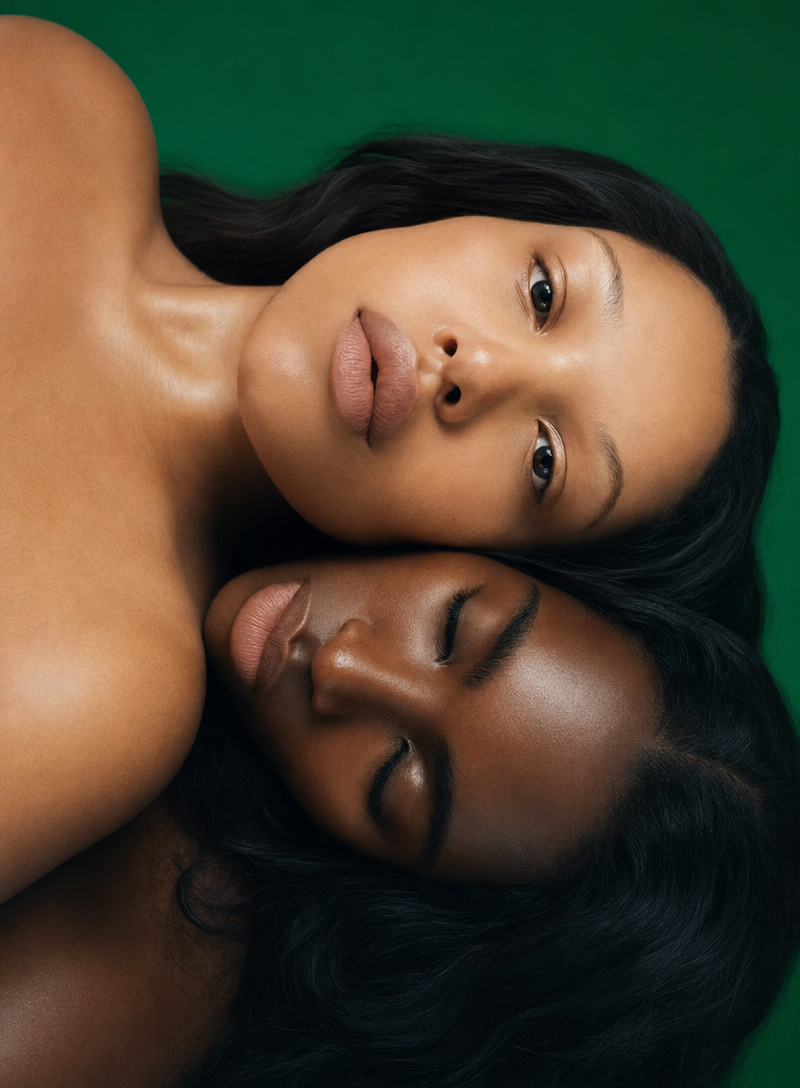
The phrase 'mirrored head-to-head in symmetrical composition' is what forces the eye to the vertical center line, turning two faces into one graphic shape rather than a portrait of a person. 'Dramatic studio lighting' is doing the heavy lifting on the tan-and-black palette the image actually rendered, carving out contrast on the skin while letting shadow do the work instead of color. 'Vivid saturated emerald green background' is meant to be the loudest element in the frame, and it's the flat, unbroken color that lets 'clean minimalist composition' and 'sharp focus' actually register, since there's no texture competing with the faces. 'Natural makeup with matte nude lips' keeps the skin the visual anchor so the symmetry trick doesn't turn into a horror-mirror effect.
FAQ
→How do I make the background color more dominant in the final image instead of just a backdrop?
Move it earlier in the prompt and give it weight, something like 'vivid saturated emerald green background filling the frame, faces lit to glow against it' rather than tacking it on at the end. You can also drop 'dramatic studio lighting' down to 'soft even studio lighting' so the contrast doesn't pull focus away from the green.
→How do I shift the mood from bold and editorial to something softer or more dreamlike?
Swap 'dramatic studio lighting creating bold contrast and dimension' for 'soft diffused lighting with gentle falloff' and change 'vivid saturated emerald green' to a muted tone like 'pale sage green' or 'dusty lavender'. Dropping 'sharp focus' to 'soft focus with slight glow' will also pull it away from the crisp high-fashion look.
→How do I build a series of variations from this same prompt without losing the symmetrical concept?
Keep 'two faces mirrored head-to-head in symmetrical composition' fixed as the anchor phrase, then cycle the background color word (emerald green to cobalt blue to blood red) and the hair descriptor ('long flowing waves' to 'sleek wet-look hair' to 'cropped platinum hair'). Changing just those two variables per version keeps the framing identical while giving each shot a distinct identity.
Learn the technique behind this
- Why can't AI spell, and how do I get readable text in an image? — Older diffusion models had no character-level representation of text, so they produced letterform-shaped texture instead of words.
- How should a prompt be structured, and does word order matter? — A prompt that behaves predictably names one subject first, then what it is doing, then where, then the light, then the lens or medium, then the style.
- Which aspect ratio should I use, and how does it change the image? — Aspect ratio determines what the model composes, not how it's cropped afterwards.
Related prompts
Teal fashion editorial in monster-filled lift
Cobalt Boots in Sleek Studio Edit
Silhouette Influencer by Sunlit Window
Sunlit editorial on striped beach towel