Why this works
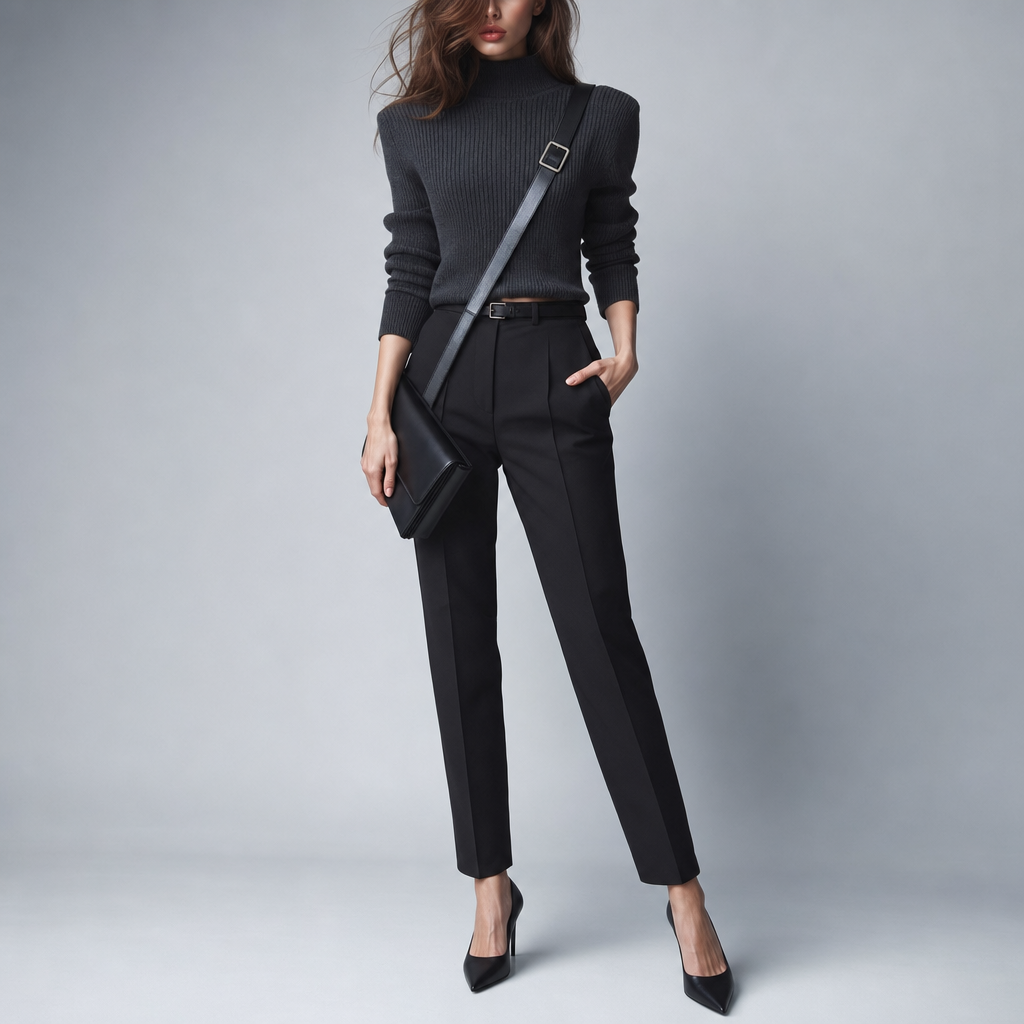
The full-body framing comes directly from “full-body composition,” giving the tailored trousers, ankle length, crossbody strap, and clutch equal visual importance rather than cropping the styling into a bust portrait. The restrained mood is anchored by “sleek minimalist gray background,” “all-black outfit,” and “clean soft lighting,” while “crisp skin tones” prevents the gray-and-black palette from flattening the subject. “Structured shoulders,” “single metal buckle,” and “structured black leather clutch” supply sharp geometric accents that keep the minimalist styling visually deliberate.
FAQ
→How do I make the clutch and waist details more prominent?
Replace “full-body composition” with “three-quarter composition, waist and hands prominent,” and change “she holds a structured black leather clutch in one hand” to “she holds a structured black leather clutch centered at the waist, clearly visible.” Expand “a small belt detail at the waist” to “a prominent sculptural belt detail with a polished metal buckle at the waist.”
→How do I shift this from a cool minimalist mood to a warmer, more dramatic editorial portrait?
Replace “sleek minimalist gray background” with “warm taupe studio background with subtle tonal gradient,” and replace “clean soft lighting” with “directional warm side-lighting with controlled shadows.” Keep “all-black outfit,” but add “deep charcoal highlights and rich leather texture” to preserve the monochrome fashion focus while increasing contrast.
→How can I build a coordinated series of variations from this prompt?
Keep the fixed elements “photorealistic editorial studio fashion photography,” “all-black outfit,” “gray background,” and “full-body composition,” then swap one controlled variable per image. Replace “charcoal-gray mock-neck knit sweater” with options such as “black satin blouse,” “cropped black leather jacket,” or “long black wool coat,” and vary the pose with “standing front-facing,” “walking in profile,” or “seated on a minimalist cube.”
Learn the technique behind this
- Why can't AI spell, and how do I get readable text in an image? — Older diffusion models had no character-level representation of text, so they produced letterform-shaped texture instead of words.
- Why does AI get hands and faces wrong, and how do I fix it? — Hands fail because they're small in frame, extremely variable in pose, and self-occluding — the model has less usable signal per pixel than for any other body part.
- How should a prompt be structured, and does word order matter? — A prompt that behaves predictably names one subject first, then what it is doing, then where, then the light, then the lens or medium, then the style.
Related prompts
Teal fashion editorial in monster-filled lift
Cobalt Boots in Sleek Studio Edit
Silhouette Influencer by Sunlit Window
Sunlit editorial on striped beach towel