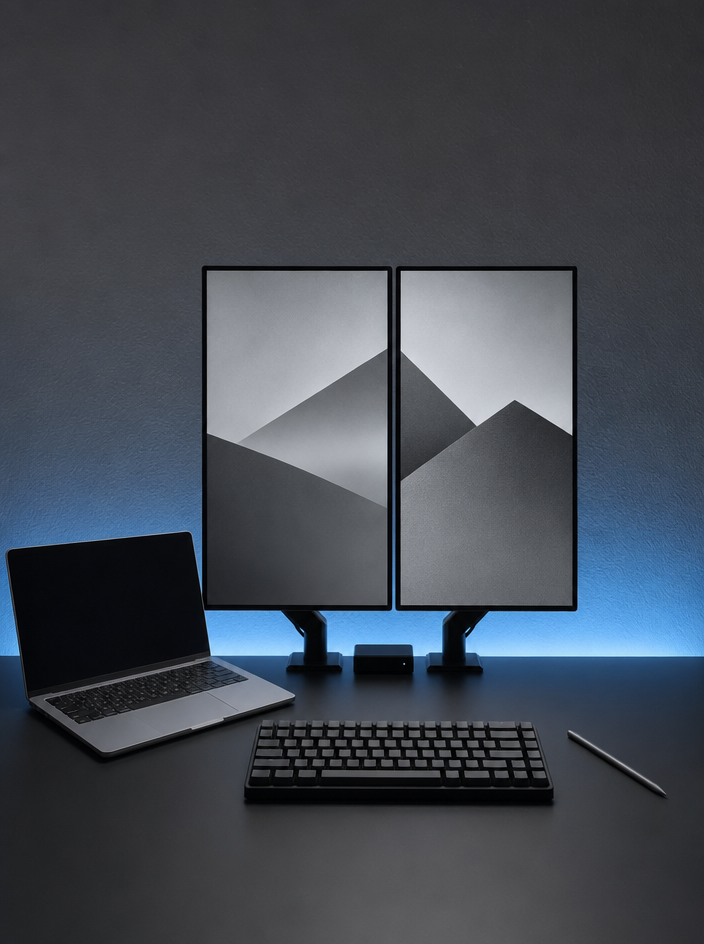
Why this works
The dominant black and sky-blue palette in the actual render traces directly back to 'cool blue-tinted ambient light' and 'dark charcoal desk surface' — those two phrases are what lock the color story, not any generic mention of minimalism. Sharp contrast lighting' and 'casting subtle shadows across the workspace' are the load-bearing words for the sense of depth and quiet drama, giving the flat desk objects actual dimension instead of looking like a catalog photo. The centered composition comes from 'positioned to the left' and 'arranged methodically' working together: the laptop offset left is the sole asymmetry, while everything else (keyboard, trackpad, stylus) is described as methodically arranged, which keeps the eye anchored on the monitor pair in the middle. 'Serene monochromatic grayscale geometric wallpapers' is what stops the monitors from becoming a distracting focal point of their own — it keeps them calm and secondary to the overall mood.
FAQ
→How do I make the monitors and their wallpaper the main focal point instead of the whole desk?
Move the monitor description to the front of the prompt and add specificity, like 'extreme close-up on dual narrow monitors displaying vivid, high-contrast geometric wallpapers,' and drop or shorten the keyboard/trackpad/stylus list so it reads as background clutter rather than a co-equal subject.
→How do I shift this from a calm late-night mood to something more energetic or alarming?
Swap 'cool blue-tinted ambient light' for 'harsh red-tinted ambient light' or 'flickering neon-pink light,' and change 'serene monochromatic grayscale geometric wallpapers' to 'glitchy, high-saturation abstract wallpapers.' Also replace 'late night atmosphere' with 'frantic all-nighter atmosphere' to push the mood word choice in the same direction.
→How do I turn this single prompt into a series of variations?
Keep the structure identical but cycle the lighting phrase through a palette: try 'warm amber-tinted ambient light,' then 'cool green-tinted ambient light,' then 'stark white fluorescent light,' while leaving 'dark charcoal desk surface' and the object list untouched so the set reads as one series shot under different lighting conditions.
Learn the technique behind this
- Why can't AI spell, and how do I get readable text in an image? — Older diffusion models had no character-level representation of text, so they produced letterform-shaped texture instead of words.
- How do I keep one consistent style across a whole set of images? — Style consistency is more achievable than character consistency because style lives in describable attributes.
- Do negative prompts work, and what should go in one? — Negative prompts work on models that support a separate negative conditioning channel — mainly Stable Diffusion and FLUX-family models.
Related prompts
Open-Frame Futuristic PC With Blue LEDs
Magenta-Cyan Hands Nearly Touch

Magenta-Cyan Holographic Control Room

Blue holographic cube on server room pedestal