Why this works
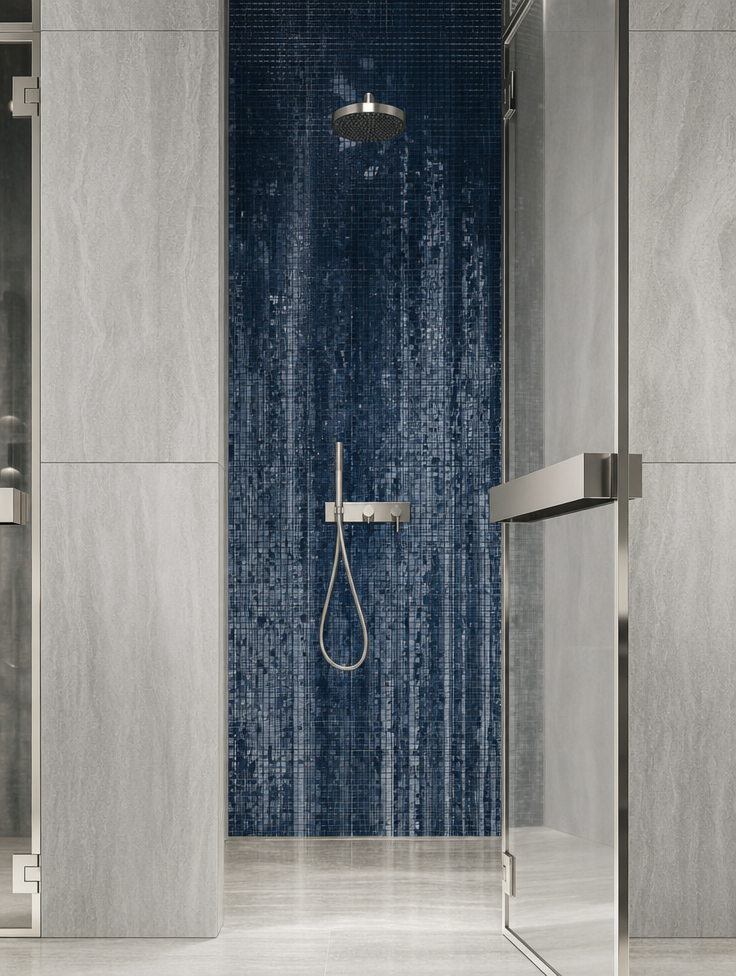
The centered, eye-level symmetrical composition makes the tall shower niche and fixture set read as the architectural anchors, while “sharp focus on fixtures and niche textures” preserves their fine detail. “Light gray stone wall panels,” “deep blue mosaic tile,” and a “brushed stainless-steel set with a cool-toned finish” establish the restrained gray-white palette with a precise blue accent, and “soft ambient lighting” plus “clean, realistic reflections on wet stone and tile” supplies the calm, polished spa mood. “Ultra-realistic materials and surface texture” is load-bearing for the convincing stone, mosaic, metal, and wet-surface finish rather than mere decorative realism.
FAQ
→How do I make the blue mosaic niche more visually prominent?
Replace “deep blue mosaic tile” with “vivid cobalt-blue glass mosaic tile with high contrast grout,” and add “the niche is the primary focal point.” To reinforce its position, change “symmetrical composition” to “centered composition with the niche occupying the upper central frame.”
→How do I make this shower feel warmer and less clinically cool?
Replace “brushed stainless-steel set with a cool-toned finish” with “brushed aged brass shower fixture and handheld wand,” and change “soft ambient lighting” to “warm diffused ambient lighting at 3000K.” Keep “light gray stone wall panels” if you want warmth without losing the contemporary neutral structure.
→How do I build a matching series of bathroom variations from this prompt?
Keep the fixed language “photorealistic,” “symmetrical composition,” “eye-level perspective,” and “sharp focus on fixtures and niche textures,” then swap only the material block. For example, replace “light gray stone wall panels” with “white travertine wall panels,” “deep blue mosaic tile” with “sage green zellige mosaic tile,” and “brushed stainless-steel set” with “matte black shower fixture set” for a clearly related but distinct variation.
Learn the technique behind this
- Why can't AI spell, and how do I get readable text in an image? — Older diffusion models had no character-level representation of text, so they produced letterform-shaped texture instead of words.
- Do negative prompts work, and what should go in one? — Negative prompts work on models that support a separate negative conditioning channel — mainly Stable Diffusion and FLUX-family models.
- Which aspect ratio should I use, and how does it change the image? — Aspect ratio determines what the model composes, not how it's cropped afterwards.
Related prompts
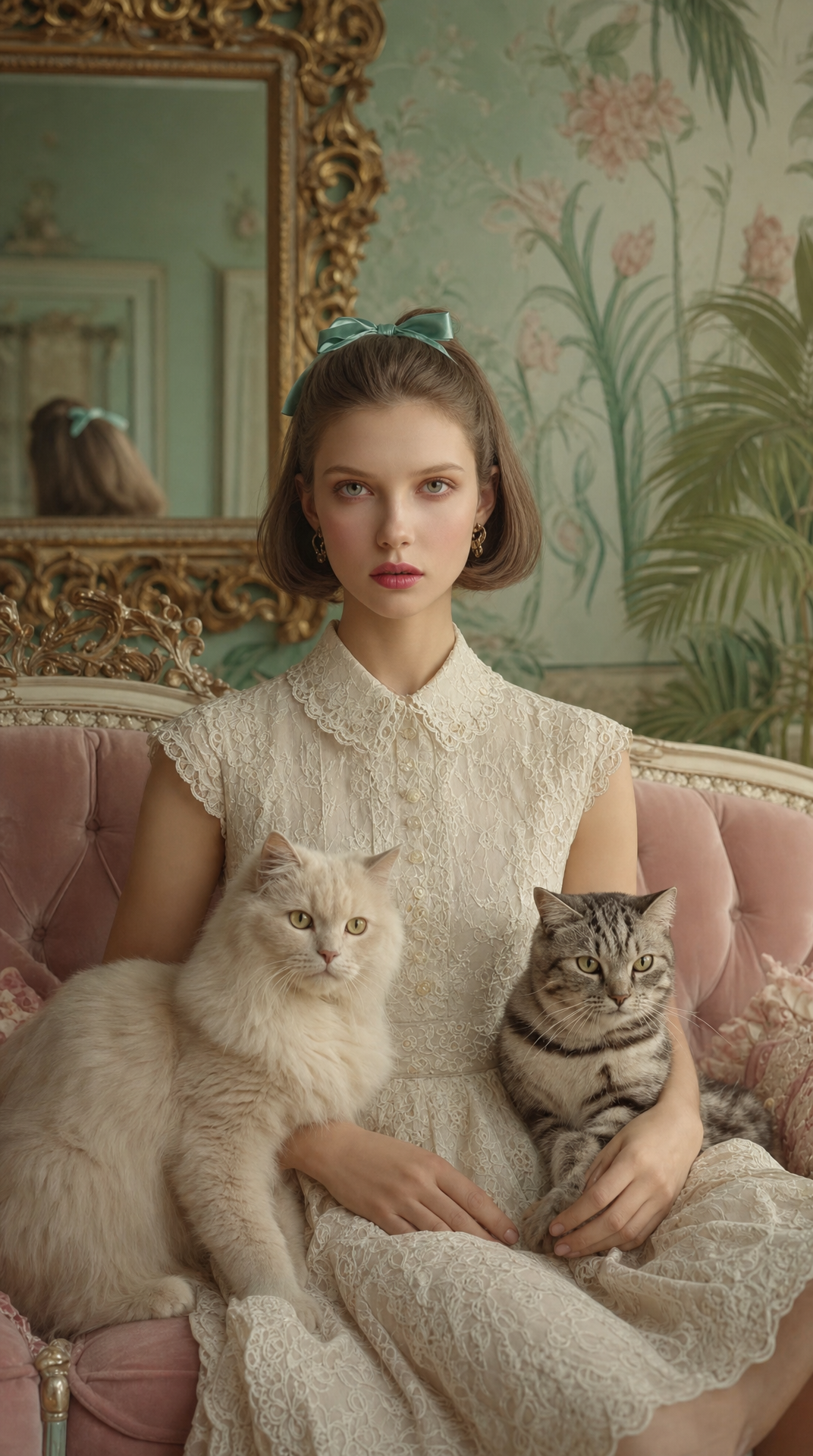
Young woman with two cats
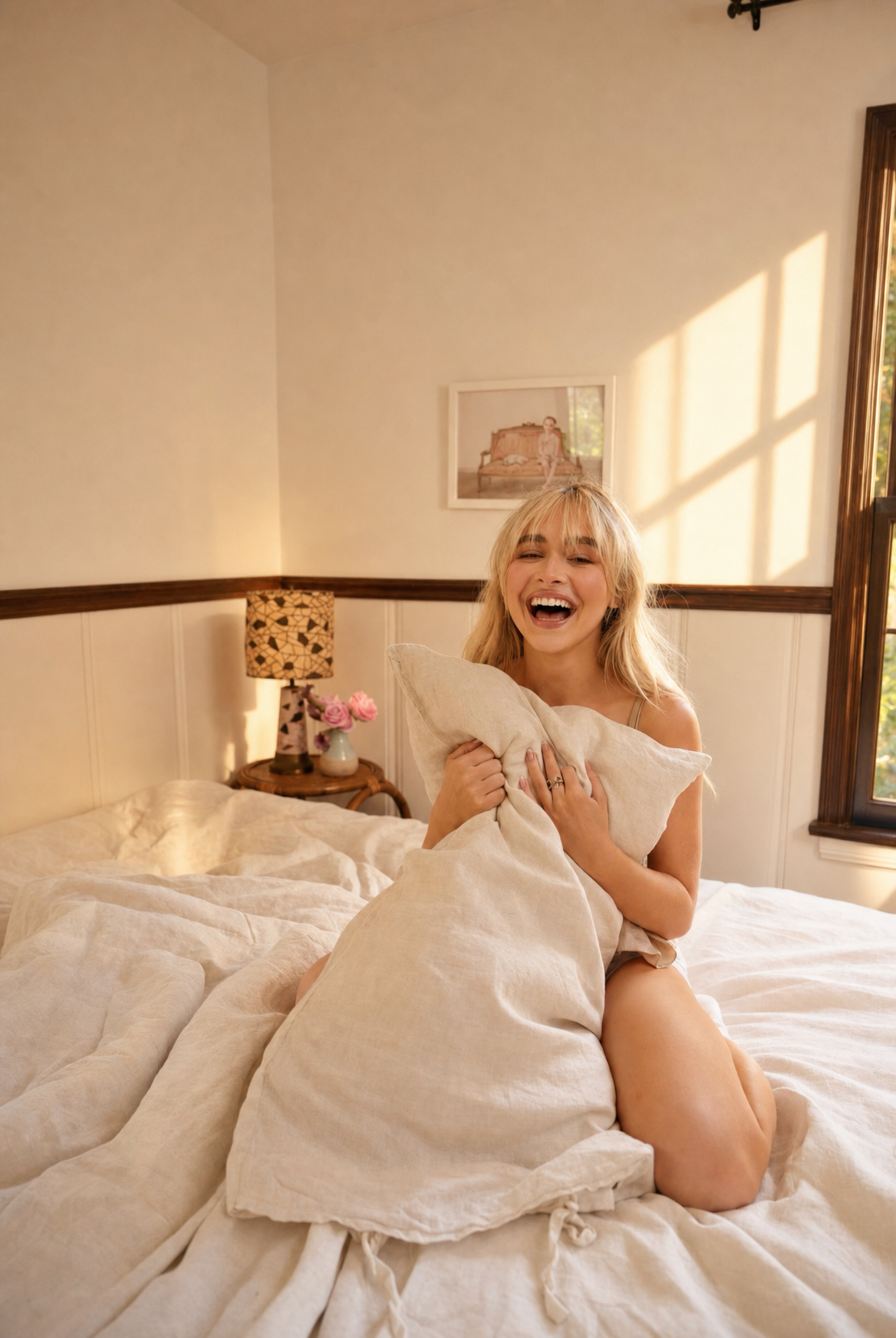
Blonde woman hugging beige pillow on off-white bed
Cozy Winter Living Room in Sage
Young woman holding teal corded phone on pastel bed