Why this works
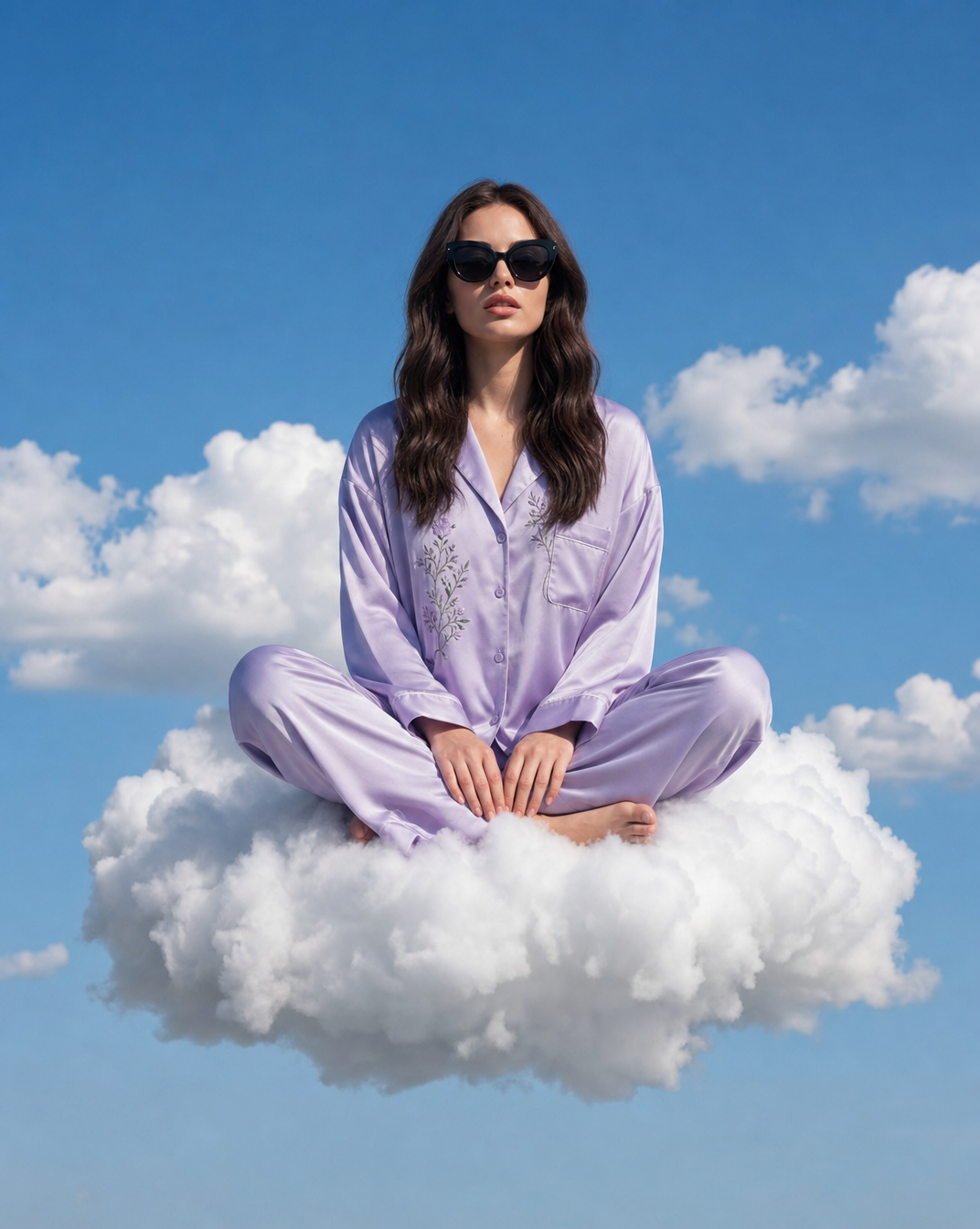
The phrase “woman with dark brown hair sitting cross-legged on a fluffy white cloud” supplies the surreal premise while keeping the figure readable as the single subject. “Centered composition” makes her and the cloud the visual anchor, and “pastel lavender satin pajama set” against the “clear blue sky” establishes the soft white-purple palette reflected in the image. “Dreamy editorial lighting” and “clean pastel color palette” reinforce the airy, whimsical mood, while “high-detail photorealistic editorial conceptual photography” keeps the fantasy grounded in fashion imagery rather than illustration.
FAQ
→How do I make the sunglasses the main focal point?
Replace “oversized round-lens cat-eye sunglasses” with “dramatic oversized black cat-eye sunglasses dominating the foreground, sharp reflections on the lenses,” and add “tight head-and-shoulders crop” after “centered composition.” This reduces the cloud’s visual role and gives the eyewear stronger scale and contrast.
→How do I make the scene feel darker and more mysterious?
Replace “clear blue sky with soft cumulus clouds” with “deep indigo twilight sky with layered storm clouds,” and change “dreamy editorial lighting” to “low-key moonlit editorial lighting with cool rim light and deep shadows.” Replace “clean pastel color palette” with “muted lavender, charcoal, and silver palette” to preserve the subject’s color identity while removing the bright daytime mood.
→How do I create a series of variations without losing the editorial concept?
Keep “surreal photorealistic editorial fashion portrait,” “centered composition,” and “high-detail whimsical conceptual photography” unchanged, then swap the setting and outfit as matched pairs: use “a woman seated on a floating moss-covered rock above a misty forest” with “sage green satin suit,” or “a woman reclining on a crescent moon above a city at night” with “midnight blue silk pajamas.” Retain “oversized round-lens cat-eye sunglasses” as the recurring accessory so the images read as one series.
Learn the technique behind this
- Why can't AI spell, and how do I get readable text in an image? — Older diffusion models had no character-level representation of text, so they produced letterform-shaped texture instead of words.
- How should a prompt be structured, and does word order matter? — A prompt that behaves predictably names one subject first, then what it is doing, then where, then the light, then the lens or medium, then the style.
- Which aspect ratio should I use, and how does it change the image? — Aspect ratio determines what the model composes, not how it's cropped afterwards.
Related prompts
Teal fashion editorial in monster-filled lift
Cobalt Boots in Sleek Studio Edit
Silhouette Influencer by Sunlit Window
Sunlit editorial on striped beach towel