Why this works
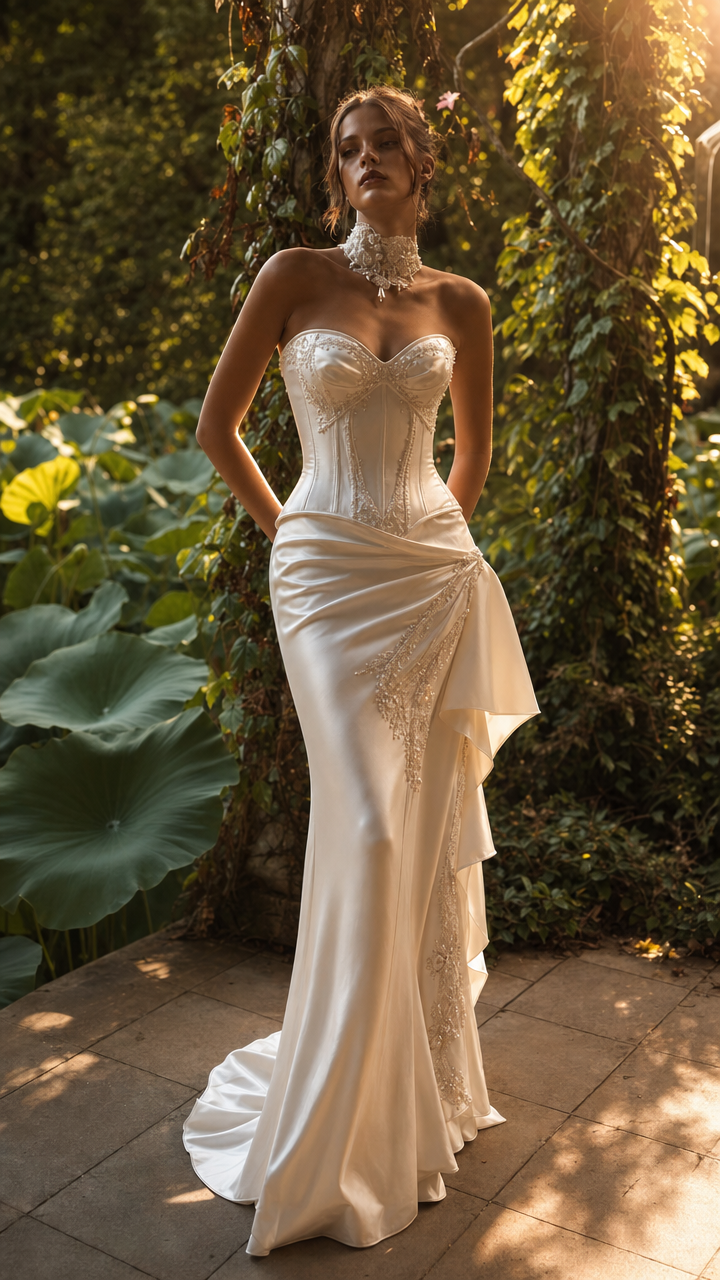
“Editorial full-length fashion portrait” establishes the entire figure as the composition’s anchor, while “sculpted corset bodice” and “flowing layered skirt” give the silhouette readable structure from top to hem. The “lush tropical garden with dense green foliage” supplies the dominant green backdrop, and “brighter late-afternoon golden-hour light filtering through leaves” adds the warm gold cast that harmonizes with the gown’s “warm ivory satin.” The romantic tension comes from the explicit “romantic, elegant, moody atmosphere,” while “shallow depth of field,” “crisp subject focus,” and “cinematic background bokeh” keep the bride sharply separated from the softened garden.
FAQ
→How do I make the bride’s face and bodice more central than the full gown?
Replace “Editorial full-length fashion portrait” with “three-quarter bridal fashion portrait framed from mid-thigh up,” and change “crisp subject focus” to “pin-sharp focus on the bride’s face and sculpted corset bodice.” Replace “flowing layered skirt” with “cropped lower skirt visible at the bottom edge” to reduce its visual weight.
→How do I make the image brighter and less moody while keeping the tropical setting?
Replace “romantic, elegant, moody atmosphere” with “radiant, airy, joyful bridal atmosphere,” and change “brighter late-afternoon golden-hour light filtering through leaves” to “clear luminous afternoon sunlight with soft warm highlights.” Keep “dense green foliage,” but add “high-key exposure and gentle pastel contrast” to lift the shadows.
→How do I build a coordinated variation with a different setting but the same bridal editorial look?
Replace “lush tropical garden with dense green foliage” with a specific environment such as “sunlit Mediterranean courtyard with pale stone walls and climbing jasmine.” Retain “photorealistic fashion editorial photography,” “warm ivory satin,” “realistic fabric texture and beadwork detail,” and “editorial full-length fashion portrait” so the subject, material detail, and composition remain consistent across the series.
Learn the technique behind this
- Why can't AI spell, and how do I get readable text in an image? — Older diffusion models had no character-level representation of text, so they produced letterform-shaped texture instead of words.
- How should a prompt be structured, and does word order matter? — A prompt that behaves predictably names one subject first, then what it is doing, then where, then the light, then the lens or medium, then the style.
- Why does the model ignore parts of my prompt? — Ignored instructions are almost always conflicts, counts, or spatial relationships — three things current models handle badly — rather than the model failing to read you.
Related prompts
Cobalt Boots in Sleek Studio Edit

Teal fashion editorial in monster-filled lift

Sunlit editorial on striped beach towel
Silhouette Influencer by Sunlit Window