Why this works
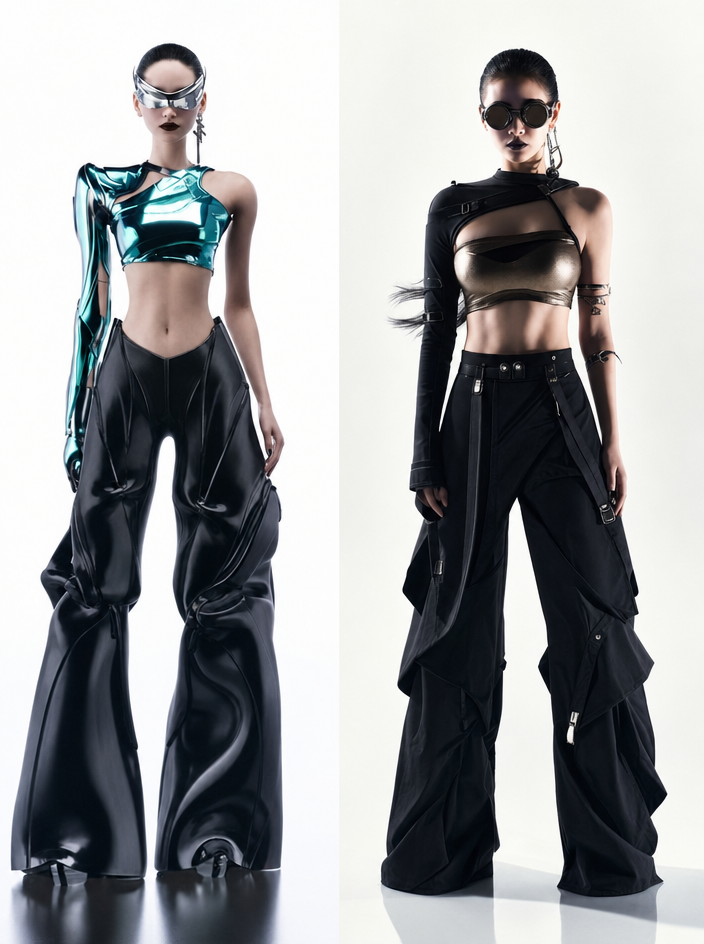
The full-body view and “two fashion models standing in a clean studio” establish a portrait-oriented runway composition, while the “minimalist off-white studio surface” explains the image’s dominant white field and keeps attention on the silhouettes. The contrast between Model A’s “iridescent teal holographic crop top” and Model B’s “matte black techwear jacket” supplies the main color and material separation, while “high-contrast directional lighting” and “crisp rim highlights along the garments” sharpen the glossy reflections and dramatic mood. “Sculptural high-waisted wide-leg pants,” “exaggerated asymmetrical wide-leg pants,” and “round tinted goggles” give the otherwise restrained framing its avant-garde shape language.
FAQ
→How do I make Model B more visually central?
Change “two fashion models standing” to “Model B in the foreground, centered and larger than Model A, with Model A positioned slightly behind,” and add “strongest rim light concentrated on Model B’s jacket and goggles.” Keep “full-body view” if the entire asymmetrical silhouette should remain visible.
→How do I shift the image from a stark studio mood to a darker cyberpunk tone?
Replace “minimalist off-white studio surface” with “dark industrial studio with smoked glass panels and deep graphite walls,” and replace “high-contrast directional lighting” with “cold blue and magenta neon side-lighting with hard shadows.” Retain “sleek glossy textures” and “detailed fabric reflections” to preserve the material-focused fashion look.
→How do I create a coordinated series of outfit variations from this prompt?
Keep the fixed structure, including “two fashion models,” “full-body view,” “editorial fashion photography,” and “clean minimalist studio,” then replace the garment color phrases with a controlled palette such as “holographic violet and silver” or “acid green and polished black.” Swap “avant-garde futuristic outfits” for a series theme like “liquid-metal tailoring,” “transparent technical layers,” or “architectural white couture,” while preserving “crisp rim highlights” for visual consistency.
Learn the technique behind this
- Why can't AI spell, and how do I get readable text in an image? — Older diffusion models had no character-level representation of text, so they produced letterform-shaped texture instead of words.
- Why does the model ignore parts of my prompt? — Ignored instructions are almost always conflicts, counts, or spatial relationships — three things current models handle badly — rather than the model failing to read you.
- Which aspect ratio should I use, and how does it change the image? — Aspect ratio determines what the model composes, not how it's cropped afterwards.
Related prompts
Teal fashion editorial in monster-filled lift
Cobalt Boots in Sleek Studio Edit
Silhouette Influencer by Sunlit Window
Sunlit editorial on striped beach towel