Why this works
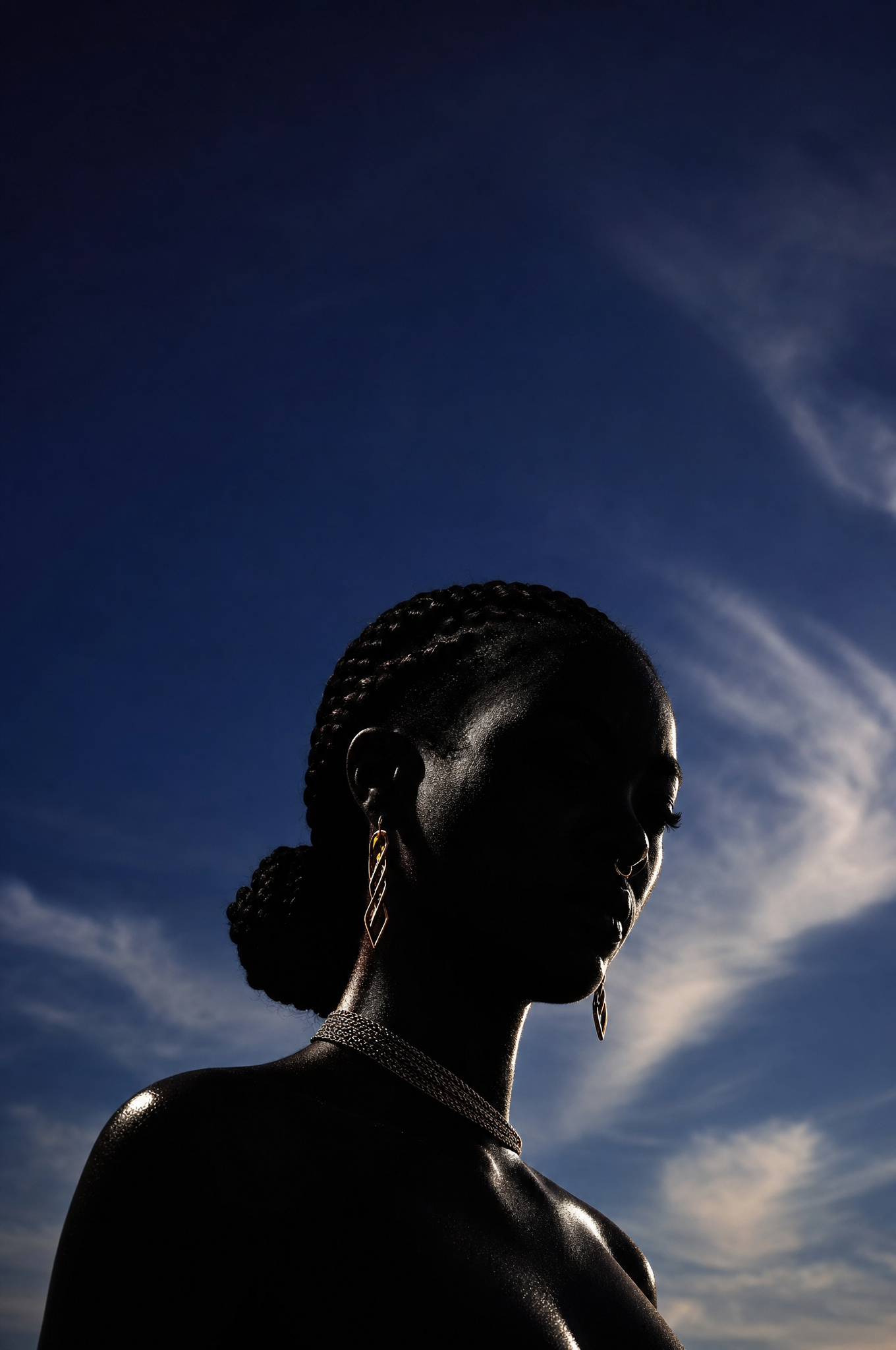
“Dramatic low-angle” and “cinematic wide-lens perspective” make the woman feel imposing in the portrait-closeup, while “strong backlighting and high-contrast cinematic framing” preserves a readable silhouette against the deep indigo sky. The blue, gray, and white palette comes directly from “deep indigo evening sky” and “wispy pale clouds,” creating a restrained color harmony rather than a colorful fashion image. “Subtle glossy specular highlights on her facial contours and shoulders” and “small rim lights” keep the braided crown, low bun, and elongated earrings legible without weakening the silhouette edges.
FAQ
→How do I make the woman’s face and jewelry more prominent instead of keeping the image mostly silhouetted?
Replace “woman in silhouette” with “woman with a partially illuminated face and clearly visible eyes,” and change “strong backlighting and high contrast” to “controlled three-quarter key light with soft back rim light.” Expand “small rim lights” to “bright, defined rim lights outlining the elongated geometric drop earrings,” while keeping “subtle glossy specular highlights” for facial and shoulder detail.
→How do I shift this from moody blue editorial drama to a warmer, more glamorous cover image?
Replace “deep indigo evening sky” with “dusky rose and amber sunset sky,” and “wispy pale clouds” with “soft peach clouds catching warm light.” Change “strong cinematic backlighting” to “warm golden backlighting with luminous haze,” and replace “dramatic, striking, moody” with “glamorous, radiant, sophisticated” while retaining “high-contrast silhouette edges.”
→How do I build a series of variations while preserving the same fashion identity?
Keep “sleek braided crown with a low bun” and “elongated geometric drop earrings” unchanged, then vary only the setting and pose: replace “standing against a deep indigo evening sky” with “standing on a rain-slick rooftop at blue hour,” “inside a stark white studio,” or “in a desert landscape at dusk.” Pair each version with a matching background phrase such as “reflective city lights,” “hard graphic shadows,” or “windblown sand,” while retaining “low-angle editorial composition” and “cinematic wide-lens perspective” for visual continuity.
Learn the technique behind this
- Why can't AI spell, and how do I get readable text in an image? — Older diffusion models had no character-level representation of text, so they produced letterform-shaped texture instead of words.
- Which aspect ratio should I use, and how does it change the image? — Aspect ratio determines what the model composes, not how it's cropped afterwards.
- How should a prompt be structured, and does word order matter? — A prompt that behaves predictably names one subject first, then what it is doing, then where, then the light, then the lens or medium, then the style.
Related prompts
Teal fashion editorial in monster-filled lift
Cobalt Boots in Sleek Studio Edit
Silhouette Influencer by Sunlit Window
Sunlit editorial on striped beach towel