Why this works
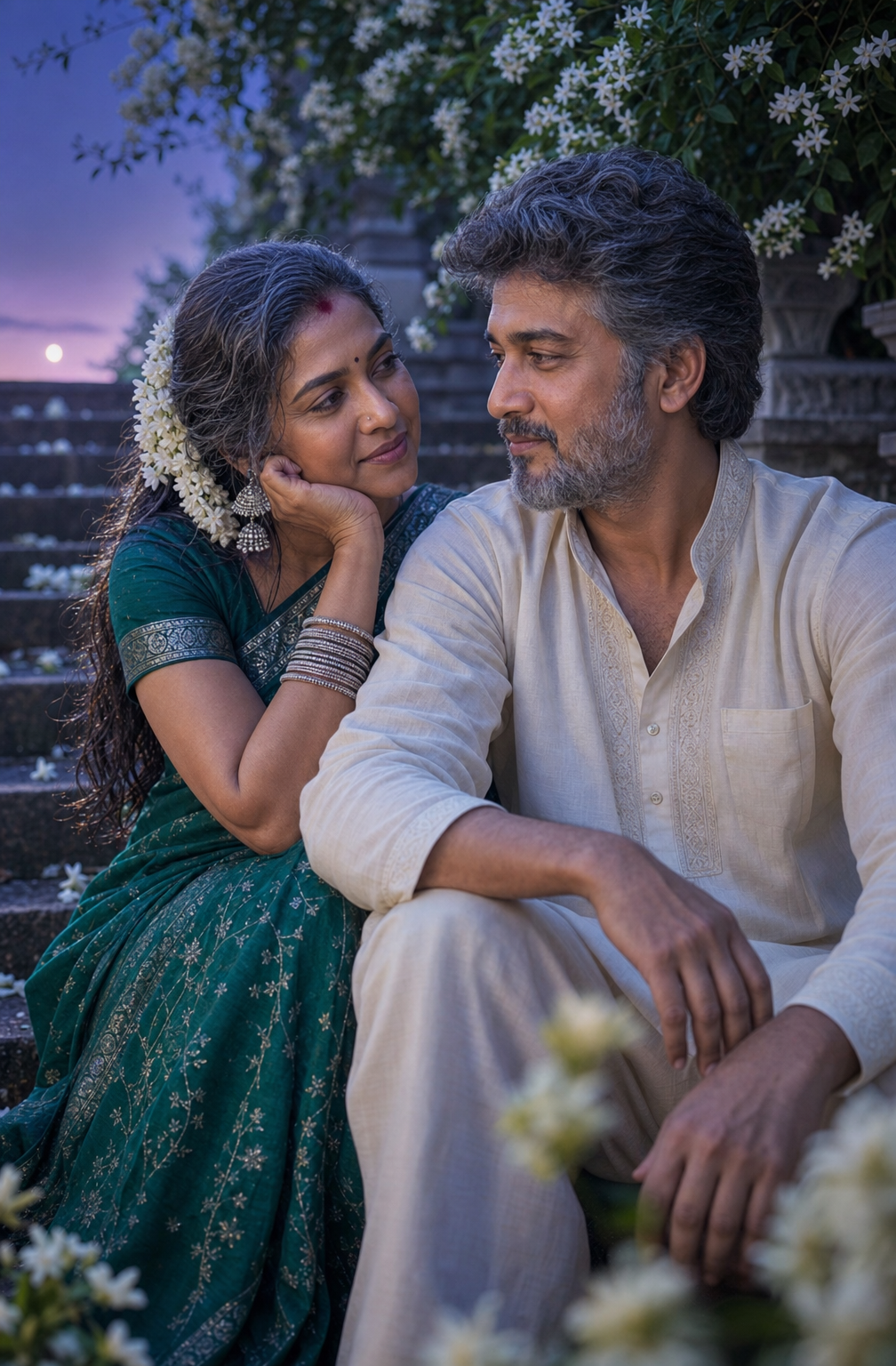
The asymmetrical gaze direction, her 'looking pensively into the distance' against his 'gazes at her affectionately,' is what creates the emotional tension in the frame rather than a mirrored, symmetrical couple pose. 'Soft blue-hour twilight casting cool lavender shadows' explains the teal-dominant palette the render actually produced, while 'burgundy kurta' and 'deep emerald silk saree' are the only warm-toned anchors, which is exactly why the image reads as cool-to-warm rather than purely cool. 'Blurred white flowers in foreground' plus 'shallow depth of field' are the two phrases responsible for the soft beige-white haze framing the couple and pushing focus onto their faces. Without 'subtle rim lighting' specifically named, the marble steps and silhouettes would flatten into the twilight background instead of separating from it.
FAQ
→How do I make the mood warmer and less melancholic?
Swap 'soft blue-hour twilight casting cool lavender shadows' for something like 'golden hour light with warm amber shadows,' and change 'looking pensively into the distance' to 'smiling warmly at each other' so the emotional beat matches the warmer light instead of fighting it.
→How do I make the woman's saree the clear focal point instead of the couple as a pair?
Move her description to the front of the subject line and add framing language like 'close-up on the emerald silk saree with silver embroidery catching the light,' then dial back the man's description to a brief mention or drop 'watching her with devotion' so his gaze doesn't compete for attention.
→How do I turn this into a series with different settings?
Keep the subject block ('middle-aged Indian couple,' 'emerald silk saree,' 'burgundy kurta') and the lighting phrase 'cinematic intimate lighting with subtle rim lighting' fixed, then swap only 'weathered marble steps' and 'white jasmine blossoms and climbing green vines' for other locations like 'a rooftop terrace overlooking city lights' or 'a riverside ghat at dusk' to keep visual consistency across the set.
Learn the technique behind this
- Why does AI get hands and faces wrong, and how do I fix it? — Hands fail because they're small in frame, extremely variable in pose, and self-occluding — the model has less usable signal per pixel than for any other body part.
- Why can't AI spell, and how do I get readable text in an image? — Older diffusion models had no character-level representation of text, so they produced letterform-shaped texture instead of words.
- Do negative prompts work, and what should go in one? — Negative prompts work on models that support a separate negative conditioning channel — mainly Stable Diffusion and FLUX-family models.
Related prompts
Woman in pale blue dress in lily boat

Woman and Man in Intimate Studio Portrait
Older Couple in Tender Watercolor Embrace
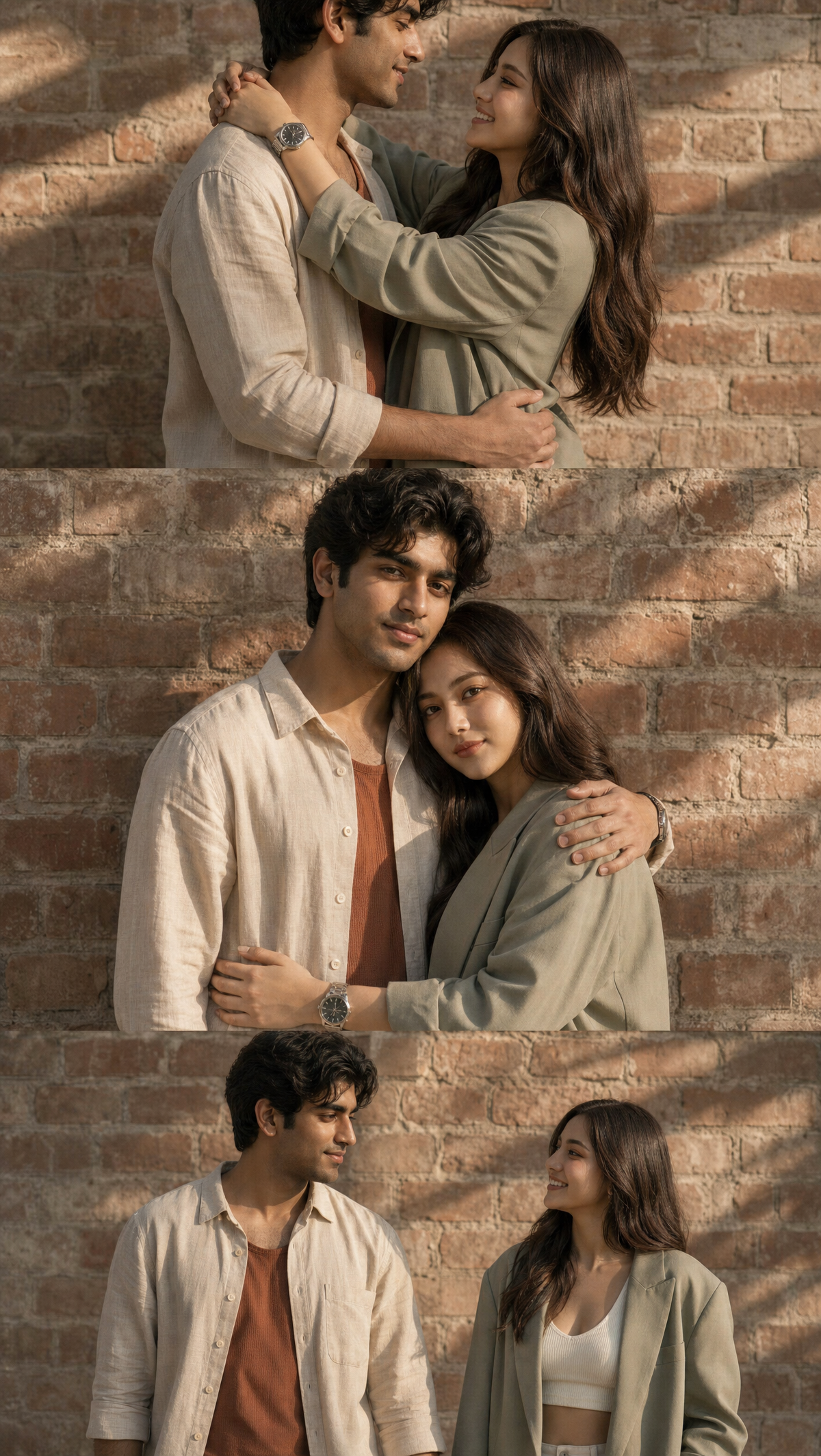
South Asian Couple in Sage and Cream