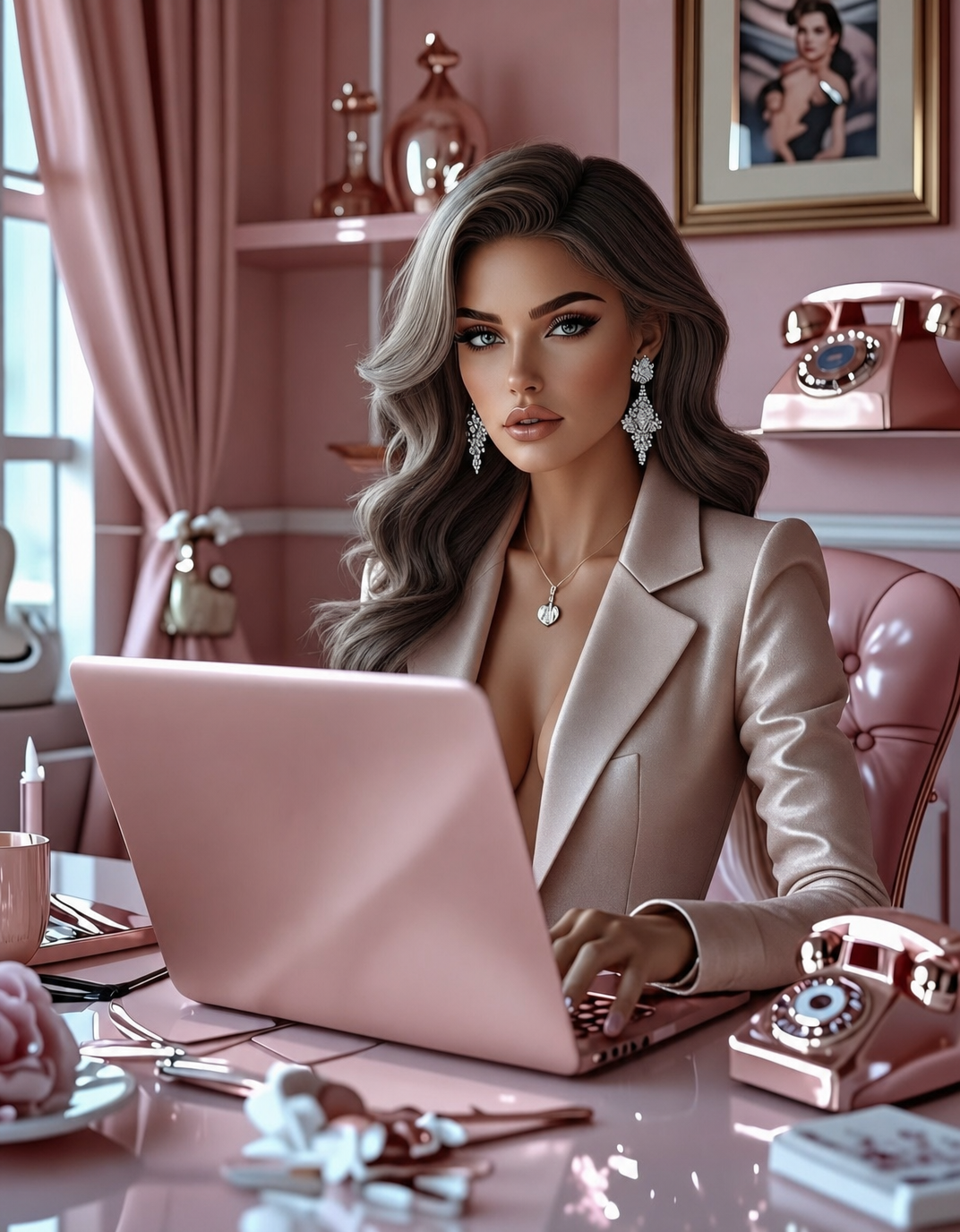
Why this works
The close framing comes directly from “tight photorealistic portrait framing,” keeping the woman, champagne-beige blazer, and rose-gold laptop visually dominant while the pastel pink office recedes into a coordinated backdrop. “Soft morning window light” and “glossy reflections on the laptop and desk” supply the polished editorial sheen, while “vintage rotary telephones and elegant decorative objects” add specific retro-luxury detail around the desk. The generated image’s beige and gray dominance tempers the pink setting, so the “gentle skin tones” and champagne-beige clothing read as the main color harmony rather than an overly saturated pink scene.
FAQ
→How do I make the rose-gold laptop the central visual element?
Replace “tight photorealistic portrait framing” with “tight three-quarter close-up centered on the rose-gold laptop,” and change “using a rose-gold laptop” to “hands prominently typing on a rose-gold laptop in the foreground.” Keep “glossy reflections on the laptop and desk” to preserve its reflective emphasis.
→How do I shift this from a soft polished mood to a more dramatic editorial tone?
Replace “Soft morning window light” with “hard directional afternoon window light with deep shadows,” and replace “gentle skin tones” with “high-contrast sculpted skin tones.” You can also change “glamorous, feminine, polished mood” to “dramatic, sophisticated, high-fashion mood” while retaining the satin blazer and luxury pink office.
→How do I create a series of variations without losing the visual identity?
Keep “photorealistic fashion editorial,” “luxury color palette dominated by pinks and champagne tones,” and “tight photorealistic portrait framing” fixed, then swap only the setting or desk objects. For example, replace “luxury pink office” with “art-deco mint office” and “vintage rotary telephones” with “brass desk accessories,” or use “mid-century teal office” with “ceramic table lamps and archival stationery.”
Learn the technique behind this
- Why can't AI spell, and how do I get readable text in an image? — Older diffusion models had no character-level representation of text, so they produced letterform-shaped texture instead of words.
- How should a prompt be structured, and does word order matter? — A prompt that behaves predictably names one subject first, then what it is doing, then where, then the light, then the lens or medium, then the style.
- Which aspect ratio should I use, and how does it change the image? — Aspect ratio determines what the model composes, not how it's cropped afterwards.
Related prompts
Open-Frame Futuristic PC With Blue LEDs
Magenta-Cyan Hands Nearly Touch

Magenta-Cyan Holographic Control Room

Blue holographic cube on server room pedestal