Why this works
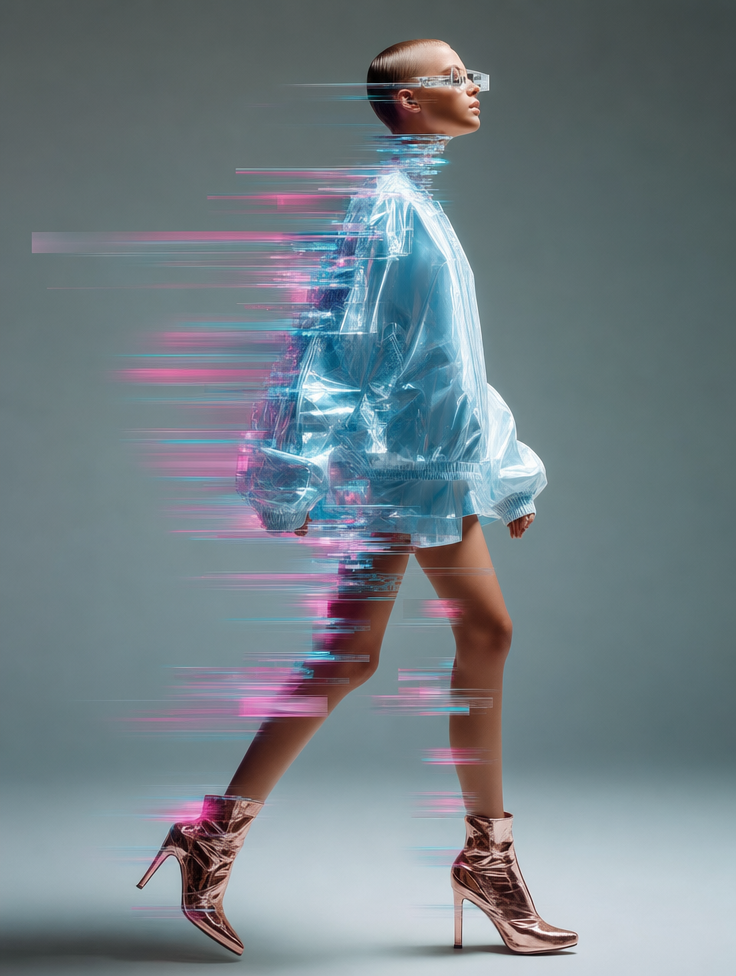
The strict profile and “balanced wide framing” give the full-body portrait a clean, graphic silhouette, while the smooth medium-gray background keeps the model isolated. “Oversized translucent icy-blue” paired with “metallic rose-gold” supplies the cool-versus-warm color contrast visible in the gray, white, pink, and muted brown palette. The “horizontal digital glitch fragmentation effect” and “reflective cyan and magenta chromatic streaks trailing behind the model” create the avant-garde motion without sacrificing the “sharp focus” and “crisp specular reflections” that define the jacket and boots.
FAQ
→How do I make the model feel more central and dominant in the frame?
Replace “balanced wide framing” with “tightly cropped full-body portrait with the model occupying most of the horizontal frame,” and change “smooth medium-gray background” to “minimal seamless gray background with generous contrast around the silhouette.” Keep “strict profile” if the graphic side-on pose should remain the focal point.
→How do I shift this from sleek and futuristic to darker and more aggressive?
Replace “icy-blue jacket with subtle frosted highlights” with “smoked translucent charcoal jacket with sharp black reflective edges,” and change “reflective cyan and magenta chromatic streaks” to “violent red and electric-violet glitch streaks.” Replace “medium-gray background” with “deep graphite studio background” and “cinematic editorial lighting” with “hard directional lighting with severe shadows.”
→How do I create a consistent series of variations from this prompt?
Keep the fixed anchors “strict profile,” “horizontal digital glitch fragmentation effect,” “sharp focus,” and “smooth medium-gray background,” then swap only the wardrobe phrase, such as “translucent icy-blue jacket and rose-gold heeled boots” for “chrome silver sculptural coat and cobalt platform boots.” For controlled color studies, replace “cyan and magenta chromatic streaks” with one repeated pair per variation, such as “amber and violet chromatic streaks” or “lime and ultramarine chromatic streaks.”
Learn the technique behind this
- Why can't AI spell, and how do I get readable text in an image? — Older diffusion models had no character-level representation of text, so they produced letterform-shaped texture instead of words.
- How should a prompt be structured, and does word order matter? — A prompt that behaves predictably names one subject first, then what it is doing, then where, then the light, then the lens or medium, then the style.
- Why does the model ignore parts of my prompt? — Ignored instructions are almost always conflicts, counts, or spatial relationships — three things current models handle badly — rather than the model failing to read you.
Related prompts
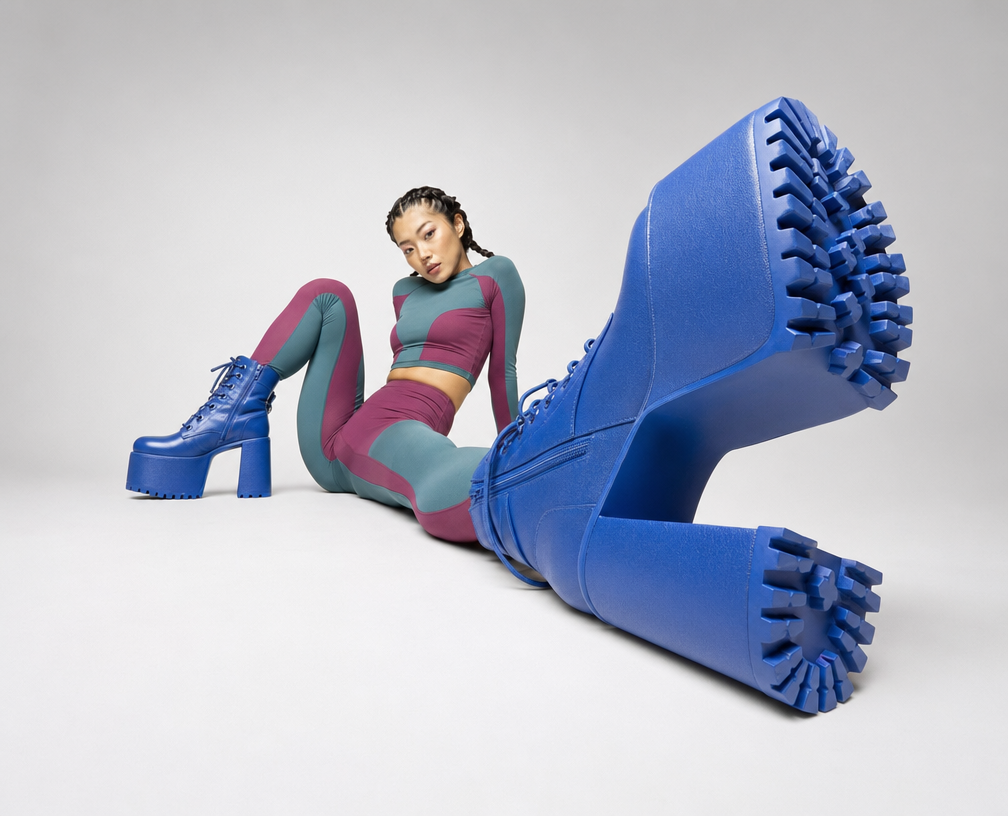
Cobalt Boots in Sleek Studio Edit
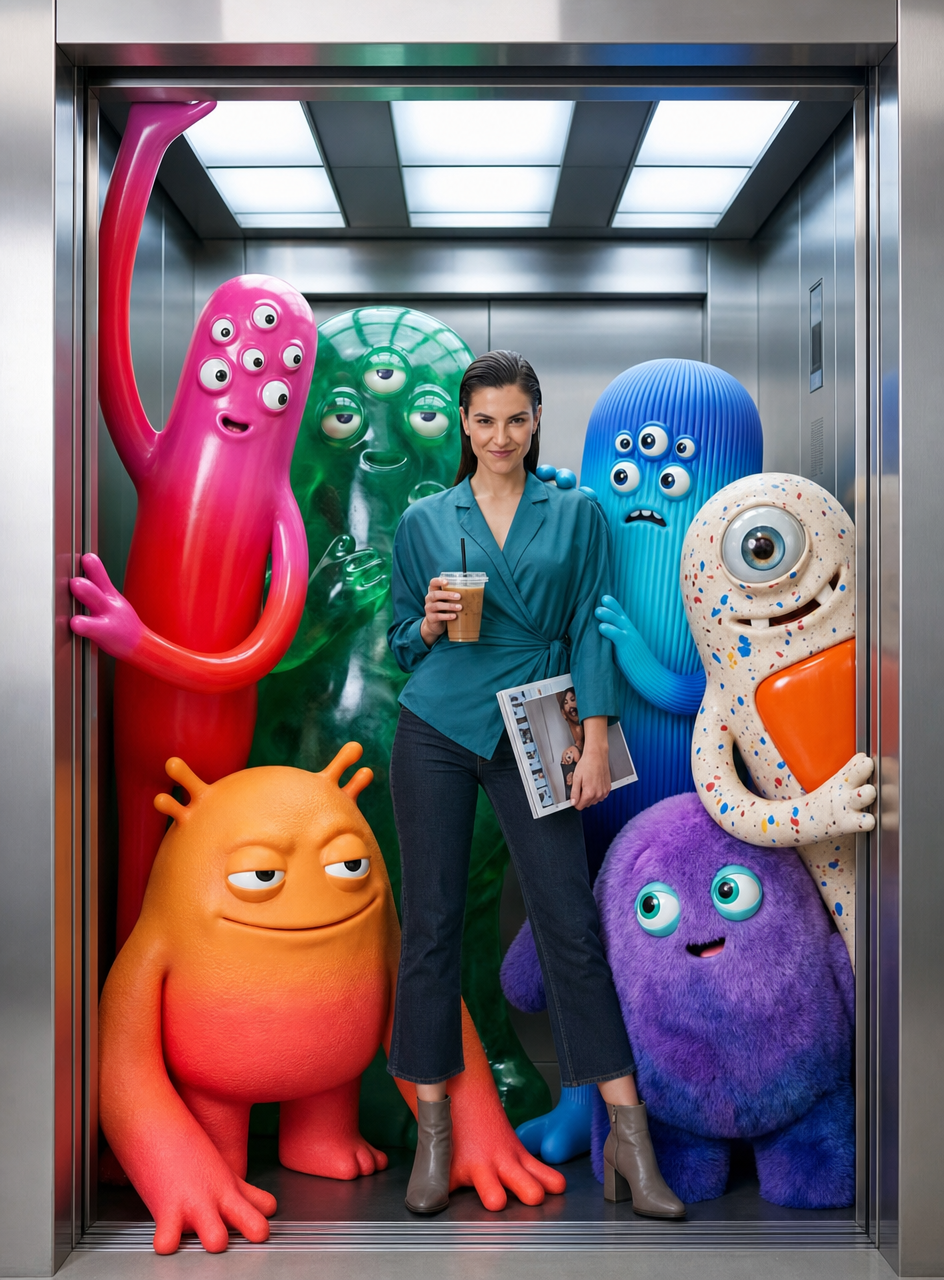
Teal fashion editorial in monster-filled lift

Sunlit editorial on striped beach towel

Silhouette Influencer by Sunlit Window