Why this works
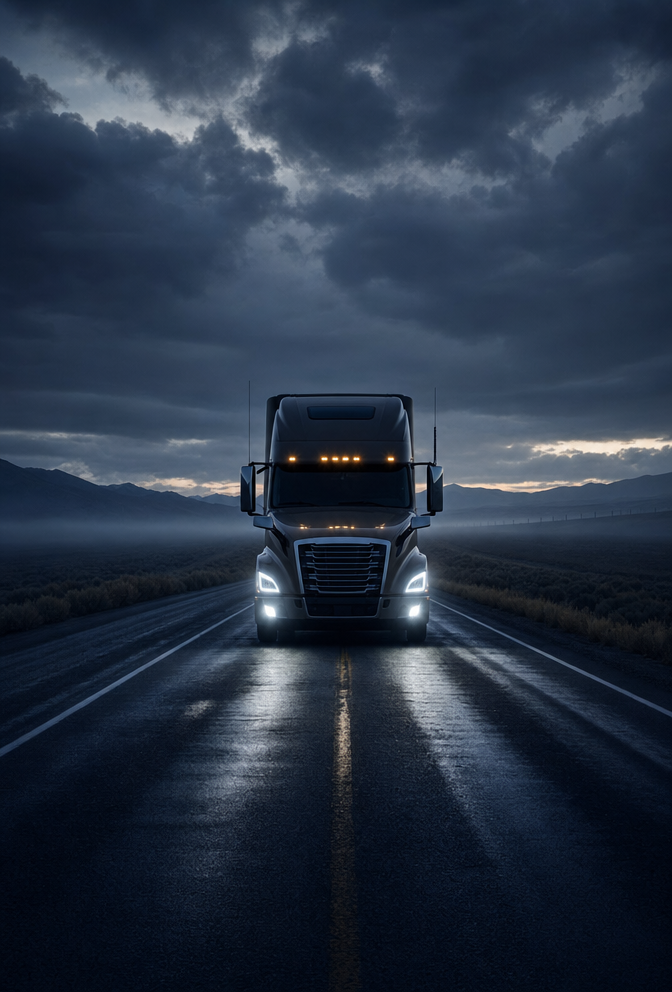
The phrase “cinematic wide front view, centered composition” makes the semi truck the immovable visual anchor, while “realistic scale” lets the empty highway and faint mountain silhouettes establish its size. “Cool white glow” from the headlights against “softer amber” marker lights supplies the restrained white-and-gray palette with a small warm contrast, and “wet and highly reflective” asphalt carries those lights into long streaks across the foreground. “Darker blue-gray storm clouds” and “dramatic moody atmosphere” set the stormy dusk tone, while “high-detail photorealistic lighting” keeps the truck, road texture, and reflections credible rather than stylized.
FAQ
→How do I make the truck feel more imposing and central?
Keep “front-facing” and “centered composition,” but replace “cinematic wide front view” with “low-angle close wide front view, truck dominating the upper two-thirds of the frame.” Replace “realistic scale” with “heroic monumental scale” and reduce “faint mountain silhouettes” to “barely visible mountains” so the truck carries more visual weight.
→How do I shift this from stormy and ominous to a warmer sunset scene?
Replace “darker blue-gray storm clouds” with “layered orange and magenta sunset clouds,” and change “stormy dusk ambient light” to “warm golden-hour backlight.” Replace “cool white glow” with “warm white headlights” while keeping “softer amber marker lights,” so the road retains the truck’s light pattern but moves the overall palette beyond gray, black, and white.
→How do I create several variations while preserving the same cinematic road image?
Keep the fixed structure “front-facing semi truck,” “centered composition,” “wet and highly reflective” asphalt, and “high-detail photorealistic lighting.” For controlled variations, swap only the setting phrase “faint mountain silhouettes” with “snow-covered alpine peaks,” “flat prairie horizon,” or “dense pine forest,” and replace “darker blue-gray storm clouds” with “clear violet twilight,” “heavy rain curtains,” or “low amber fog.”
Learn the technique behind this
- Why can't AI spell, and how do I get readable text in an image? — Older diffusion models had no character-level representation of text, so they produced letterform-shaped texture instead of words.
- How should a prompt be structured, and does word order matter? — A prompt that behaves predictably names one subject first, then what it is doing, then where, then the light, then the lens or medium, then the style.
- Do negative prompts work, and what should go in one? — Negative prompts work on models that support a separate negative conditioning channel — mainly Stable Diffusion and FLUX-family models.
Related prompts
Shirtless Man, Vintage Car, Coastline Light
Golden-hour couple rides a classic bike
Deep-blue Audi concept in brutalist garage
Red endurance race car with blue silver accents