Why this works
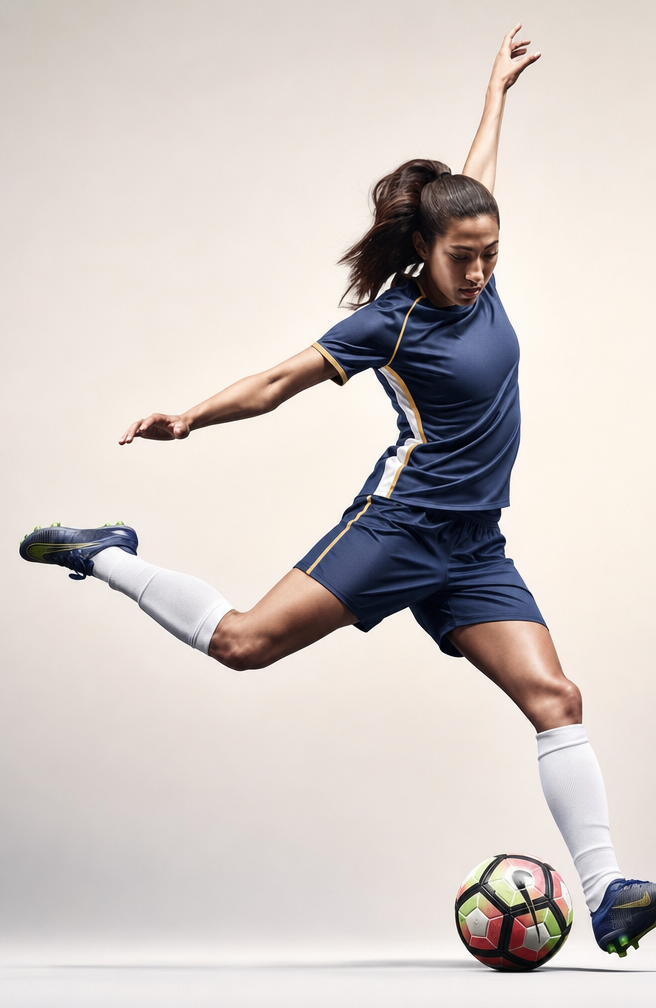
The phrase “female soccer player captured mid-air in a powerful kicking pose” supplies the image’s dynamic energy, while “one leg extended striking a soccer ball” gives the full-body portrait a clear diagonal action line. “Dynamic motion freeze,” “crisp detail,” and “sharper highlights” keep the airborne pose and ball readable instead of blurred. The “soft off-white gradient” produces the pale dominant background, while the navy uniform with “white and gold accents” adds controlled contrast against the mostly white, black, and brown palette.
FAQ
→How do I make the player’s kick feel more explosive and central?
Replace “captured mid-air in a powerful kicking pose” with “dramatic high kick at the peak of a powerful jump, body fully extended toward camera,” and change “Full-body composition” to “centered full-body composition with the player and ball filling most of the vertical frame.” Keep “dynamic motion freeze” so the larger pose remains sharply defined.
→How do I shift this from a clean studio portrait to a darker, more intense match atmosphere?
Replace “soft off-white gradient background” with “dark charcoal stadium background with subtle blurred floodlights,” and change “slightly cooler crisp studio lighting with sharper highlights” to “hard directional stadium lighting with deep shadows and bright rim light.” Retain “focused expression” and “crisp detail” to preserve the concentrated sports-editorial tone.
→How do I create a consistent series using different athletes or uniforms?
Keep the fixed structure “photorealistic studio sports photography,” “Full-body composition,” “dynamic motion freeze,” and “soft off-white gradient background,” then swap “female soccer player” for another athlete and replace “navy athletic uniform with white and gold accents” with a clearly specified team color set such as “red uniform with black and white accents.” Change only the action phrase, such as “mid-kick” to “leaping header,” so pose variations remain visually comparable.
Learn the technique behind this
- Why can't AI spell, and how do I get readable text in an image? — Older diffusion models had no character-level representation of text, so they produced letterform-shaped texture instead of words.
- How should a prompt be structured, and does word order matter? — A prompt that behaves predictably names one subject first, then what it is doing, then where, then the light, then the lens or medium, then the style.
- Which aspect ratio should I use, and how does it change the image? — Aspect ratio determines what the model composes, not how it's cropped afterwards.
Related prompts
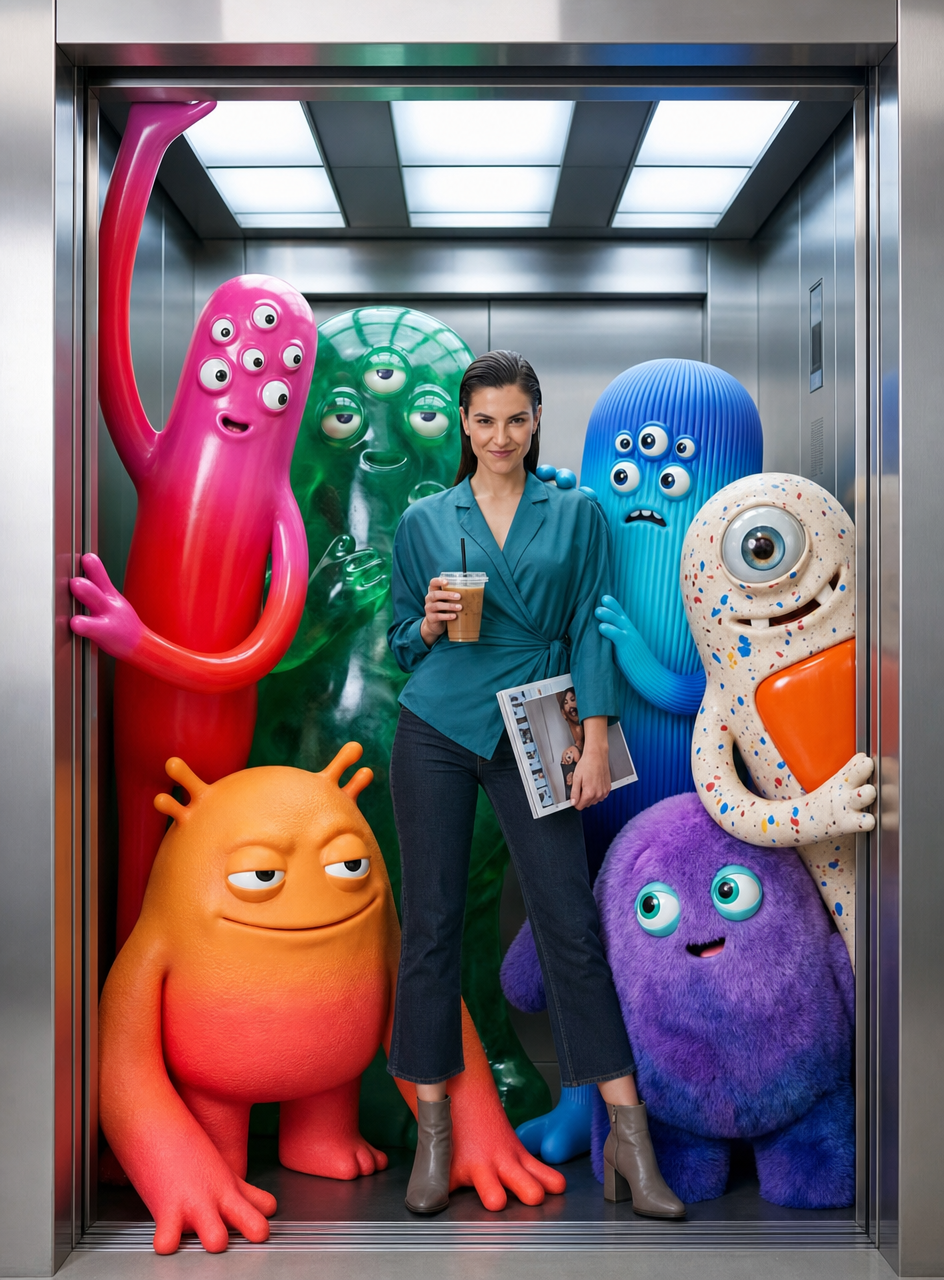
Teal fashion editorial in monster-filled lift
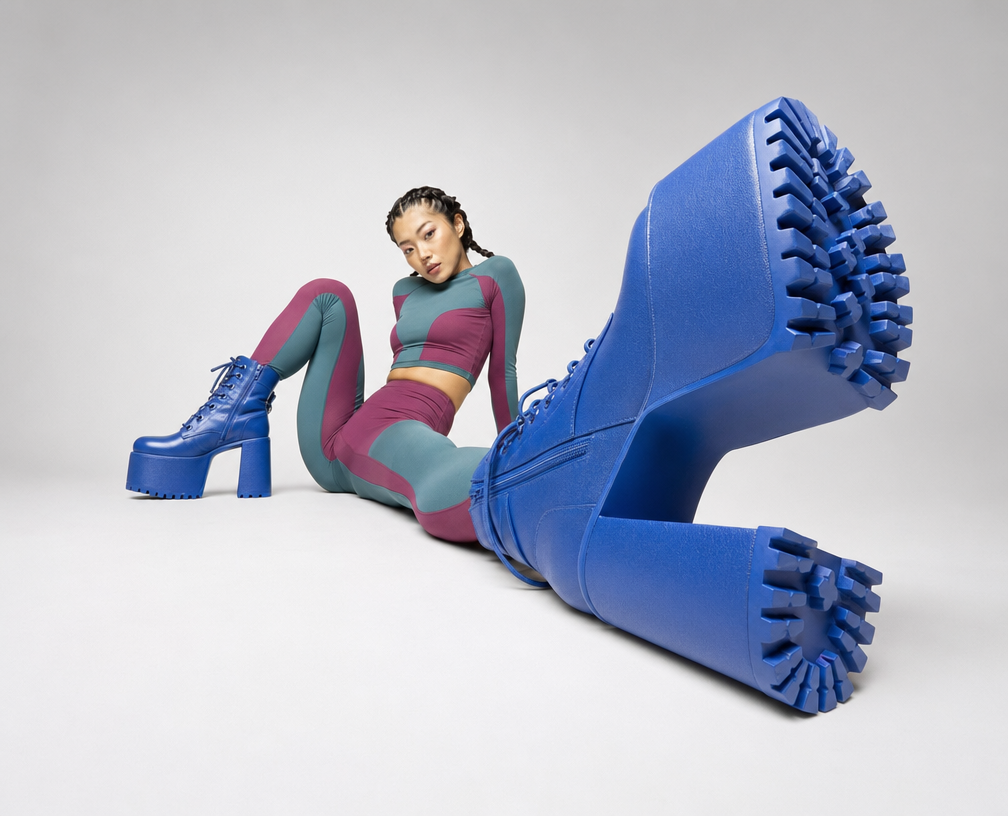
Cobalt Boots in Sleek Studio Edit
Silhouette Influencer by Sunlit Window
Sunlit editorial on striped beach towel