Why this works
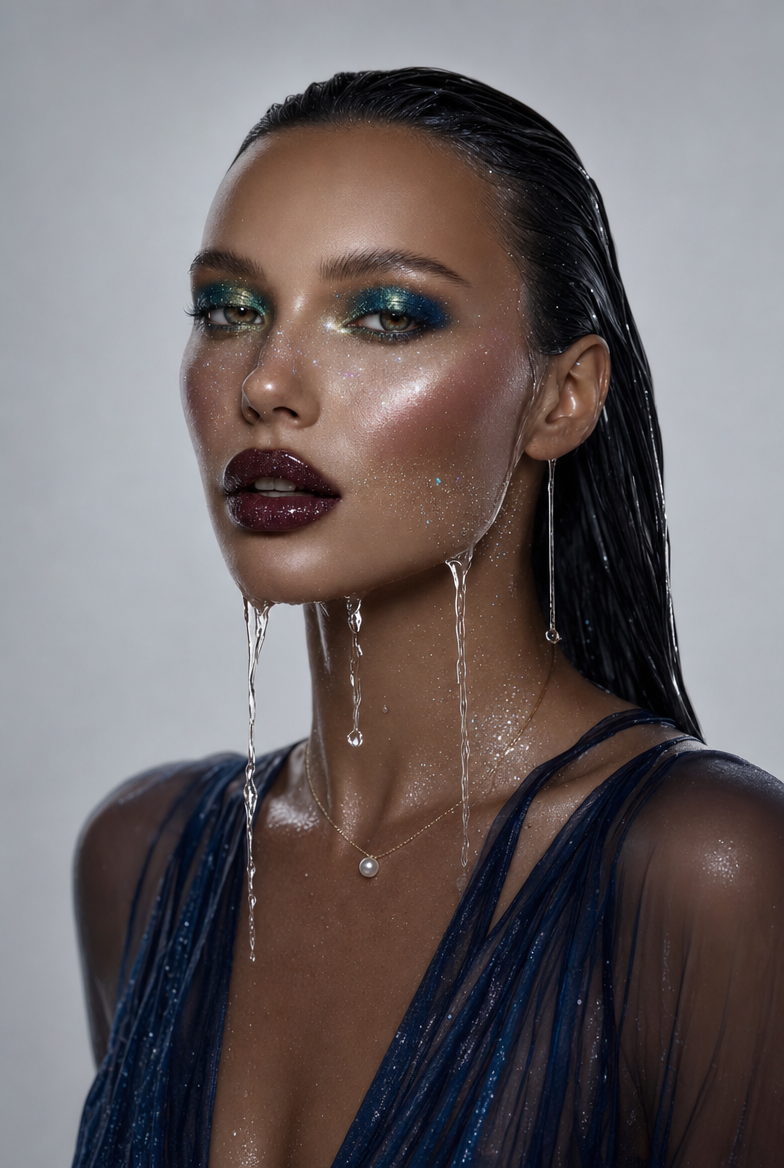
The jewel-tone concentration comes from naming exact pigments rather than general color families: 'deep emerald and sapphire eyeshadow with golden undertones' and 'rich jewel-toned lip color' are what push the navy and brown dominant palette instead of a generic beauty-shot pastel look. 'Soft diffused studio lighting' paired with 'moisture glistening across her cheekbones and temple' is doing the work of the skin's dewy highlight pattern, not the holographic dust, which just adds sparkle texture on top. The otherworldly mood doesn't come from the studio setup at all, it comes from 'scattered holographic dust' and 'sheer midnight-blue silk fabric' sitting against a flat 'pale grey background', that contrast between an almost clinical backdrop and surreal skin texture is what reads as ethereal. And 'extreme close-up editorial beauty perspective' is the phrase forcing the tight portrait-closeup crop, without it you'd likely get a waist-up fashion shot instead.
FAQ
→How do I make the eyeshadow and eyes the clear focal point instead of an even split with the lips and skin?
Move 'deep emerald and sapphire eyeshadow with golden undertones' to the front of the subject description and add a modifier like 'intensely detailed iris' or 'eyes half-closed, catching light directly'. Also consider dropping 'rich jewel-toned lip color' down to something muted like 'soft neutral lips' so it stops competing for attention.
→How do I shift this from ethereal and cool to warm and sensual?
Swap 'sapphire eyeshadow' for 'copper and bronze eyeshadow', change 'sheer midnight-blue silk fabric' to 'sheer amber or terracotta silk fabric', and replace 'pale grey background' with 'warm caramel-toned background'. Keep 'soft diffused studio lighting' as is since that structural light source doesn't need to change, only the color temperature of the props and makeup does.
→How do I build a series of variations from this same portrait without losing the style?
Keep the fixed scaffolding: 'Extreme close-up editorial beauty perspective', 'soft diffused studio lighting', 'hyperrealistic', and 'surreal high-fashion editorial beauty photography'. Then cycle the variable slots: swap 'holographic dust' for 'silver leaf flecks' or 'crushed opal shimmer', change 'sleek black hair' to 'platinum blonde' or 'copper red', and rotate the eyeshadow and fabric colors together (e.g. 'ruby and garnet eyeshadow' with 'crimson silk fabric') so each version reads as part of the same shoot but with a distinct color story.
Learn the technique behind this
- Why can't AI spell, and how do I get readable text in an image? — Older diffusion models had no character-level representation of text, so they produced letterform-shaped texture instead of words.
- How should a prompt be structured, and does word order matter? — A prompt that behaves predictably names one subject first, then what it is doing, then where, then the light, then the lens or medium, then the style.
- Why does AI get hands and faces wrong, and how do I fix it? — Hands fail because they're small in frame, extremely variable in pose, and self-occluding — the model has less usable signal per pixel than for any other body part.
Related prompts
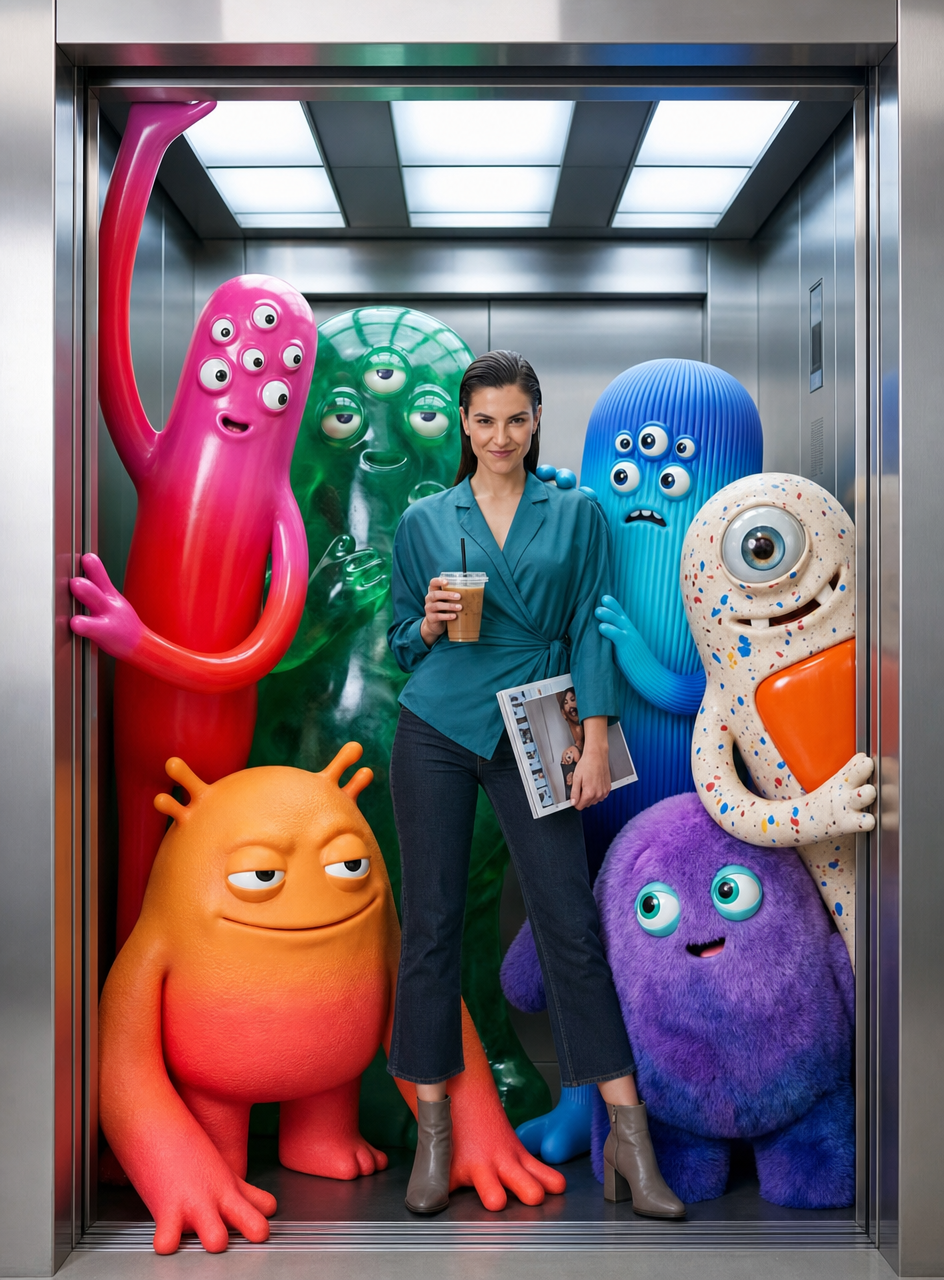
Teal fashion editorial in monster-filled lift
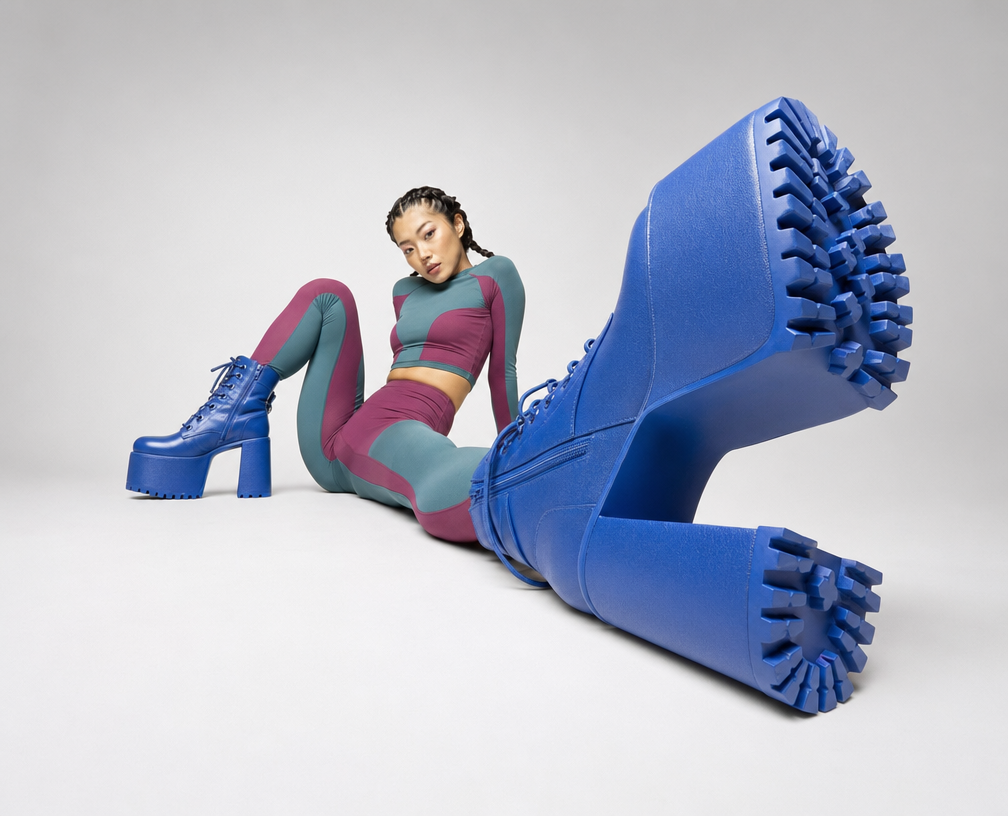
Cobalt Boots in Sleek Studio Edit
Sunlit editorial on striped beach towel
Silhouette Influencer by Sunlit Window