Why this works
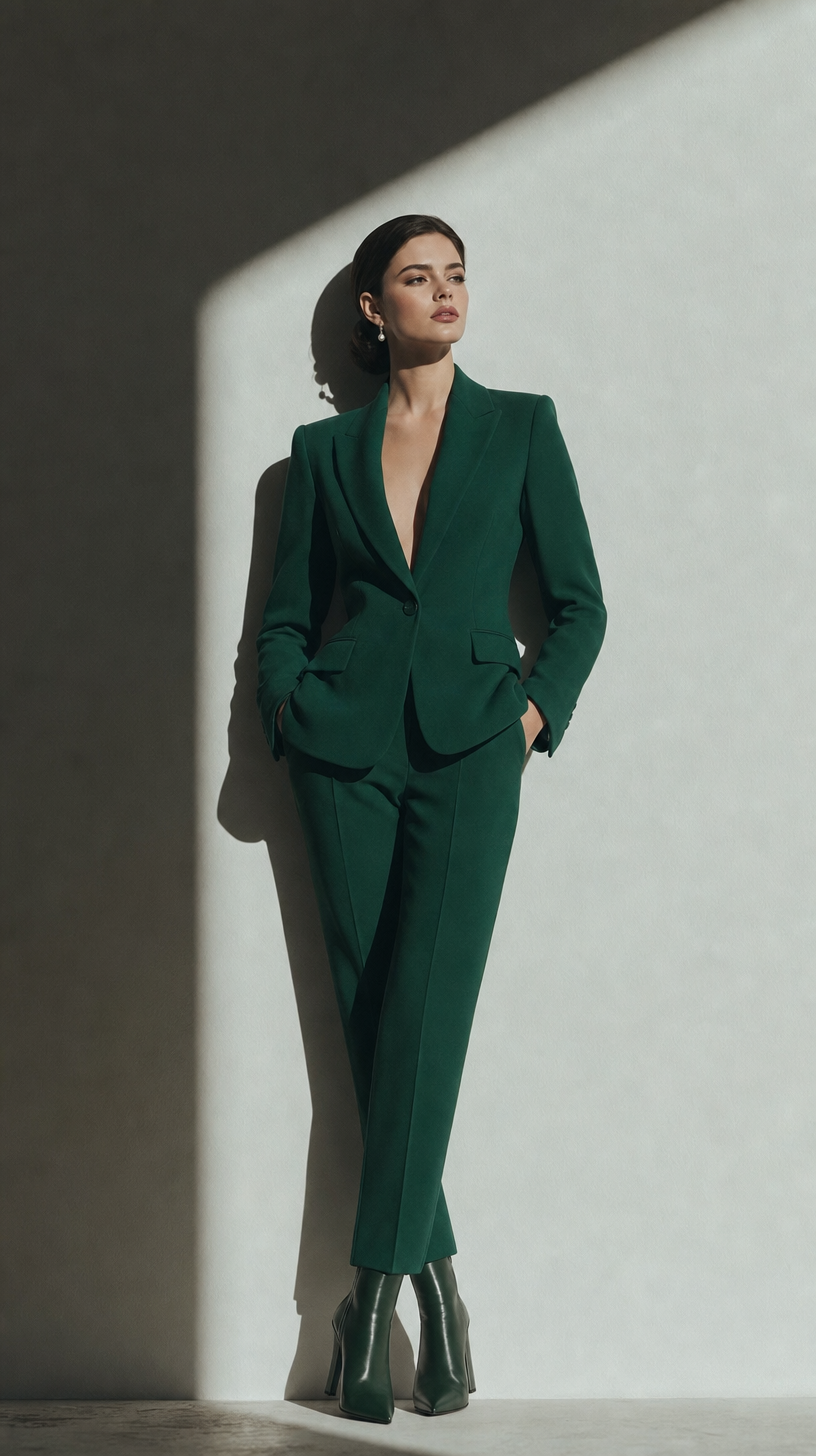
The full-body portrait is anchored by “a tall woman standing against a minimalist studio wall” and “full-body composition,” giving the figure a clean, vertically dominant frame. The dramatic mood comes specifically from “late-afternoon sunlight enters from the side at a low angle” and “strong diagonal shadows across the wall and her silhouette,” while “tailored emerald-green pantsuit,” “sharp shoulders,” and “deep V blazer” supply the structured luxury-editorial silhouette. The dominant gray appearance likely comes from the minimalist wall and neutral studio treatment, which let the emerald suit, mauve makeup, and graphic ace motifs act as controlled accents rather than competing with the composition.
FAQ
→How do I make the woman feel more powerful and central in the frame?
Replace “hands resting in her pockets” with “one hand on her hip, the other gripping the blazer lapel,” and add “low camera angle, centered symmetrical stance, figure occupying most of the vertical frame.” Keep “sharp shoulders” and “deep V blazer,” since those phrases reinforce an assertive silhouette.
→How do I shift this from dramatic late-afternoon fashion to a softer, more romantic editorial?
Replace “dramatic late-afternoon sunlight enters from the side at a low angle” and “strong diagonal shadows” with “diffused window light from the front, soft wraparound illumination, barely visible shadows.” Change “soft berry lipstick” to “dusty rose lipstick” and add “pale blush and warm ivory highlights” to soften the mauve-and-gray palette.
→How do I create a series of variations while keeping the same luxury campaign identity?
Keep “high-fashion editorial full-body portrait,” “luxury magazine fashion photography,” and “oversized playing-card ace motifs,” then swap only the suit and card language: use “sapphire-blue velvet tuxedo with diamond motifs,” “ruby-red silk column dress with heart motifs,” or “ivory sculptural suit with club motifs.” Preserve “low-angle late-afternoon sunlight” and the “minimalist studio wall” so the changing wardrobe remains part of one coherent series.
Learn the technique behind this
- Why does AI get hands and faces wrong, and how do I fix it? — Hands fail because they're small in frame, extremely variable in pose, and self-occluding — the model has less usable signal per pixel than for any other body part.
- Why can't AI spell, and how do I get readable text in an image? — Older diffusion models had no character-level representation of text, so they produced letterform-shaped texture instead of words.
- How should a prompt be structured, and does word order matter? — A prompt that behaves predictably names one subject first, then what it is doing, then where, then the light, then the lens or medium, then the style.
Related prompts

Teal fashion editorial in monster-filled lift
Cobalt Boots in Sleek Studio Edit
Silhouette Influencer by Sunlit Window
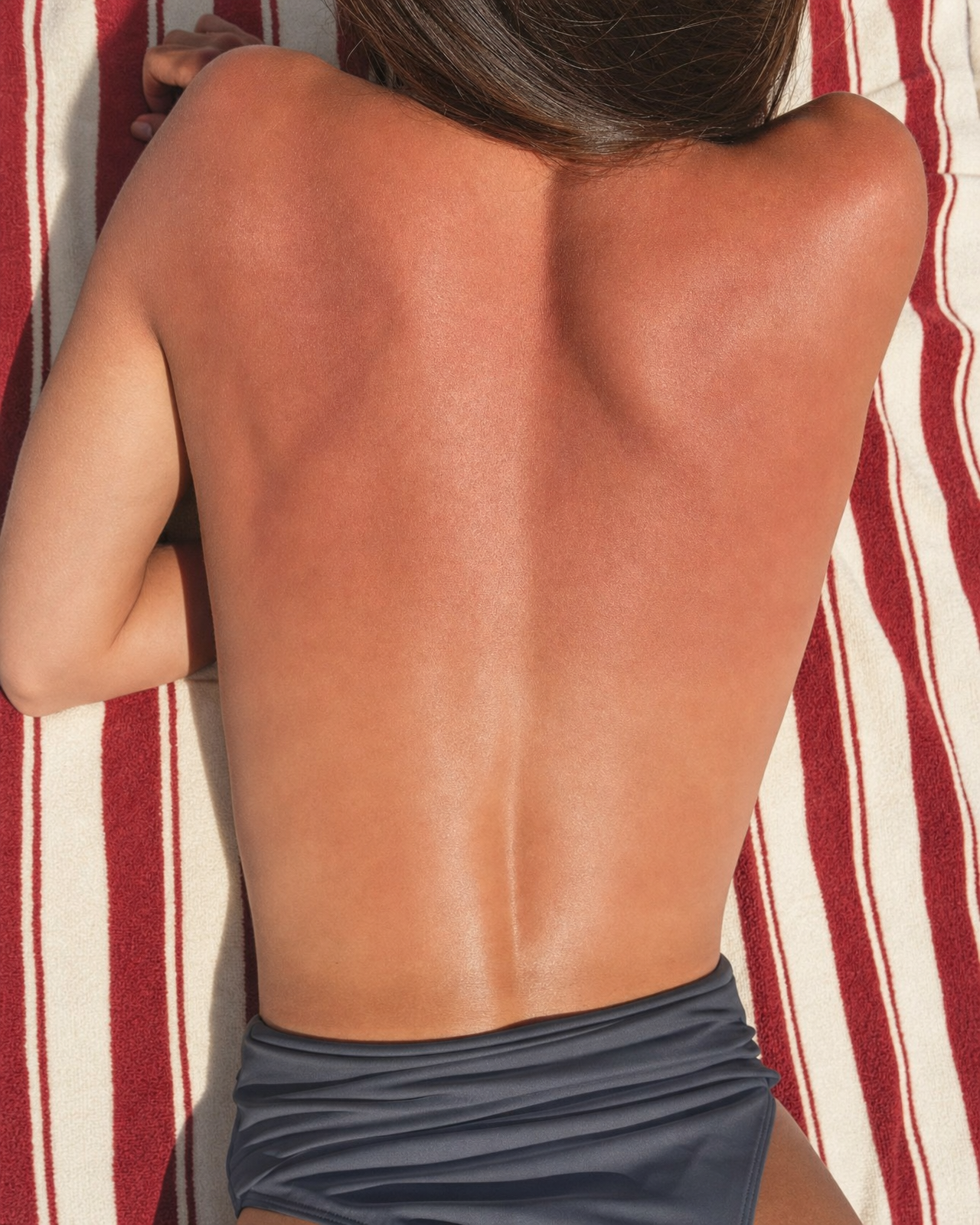
Sunlit editorial on striped beach towel