Why this works
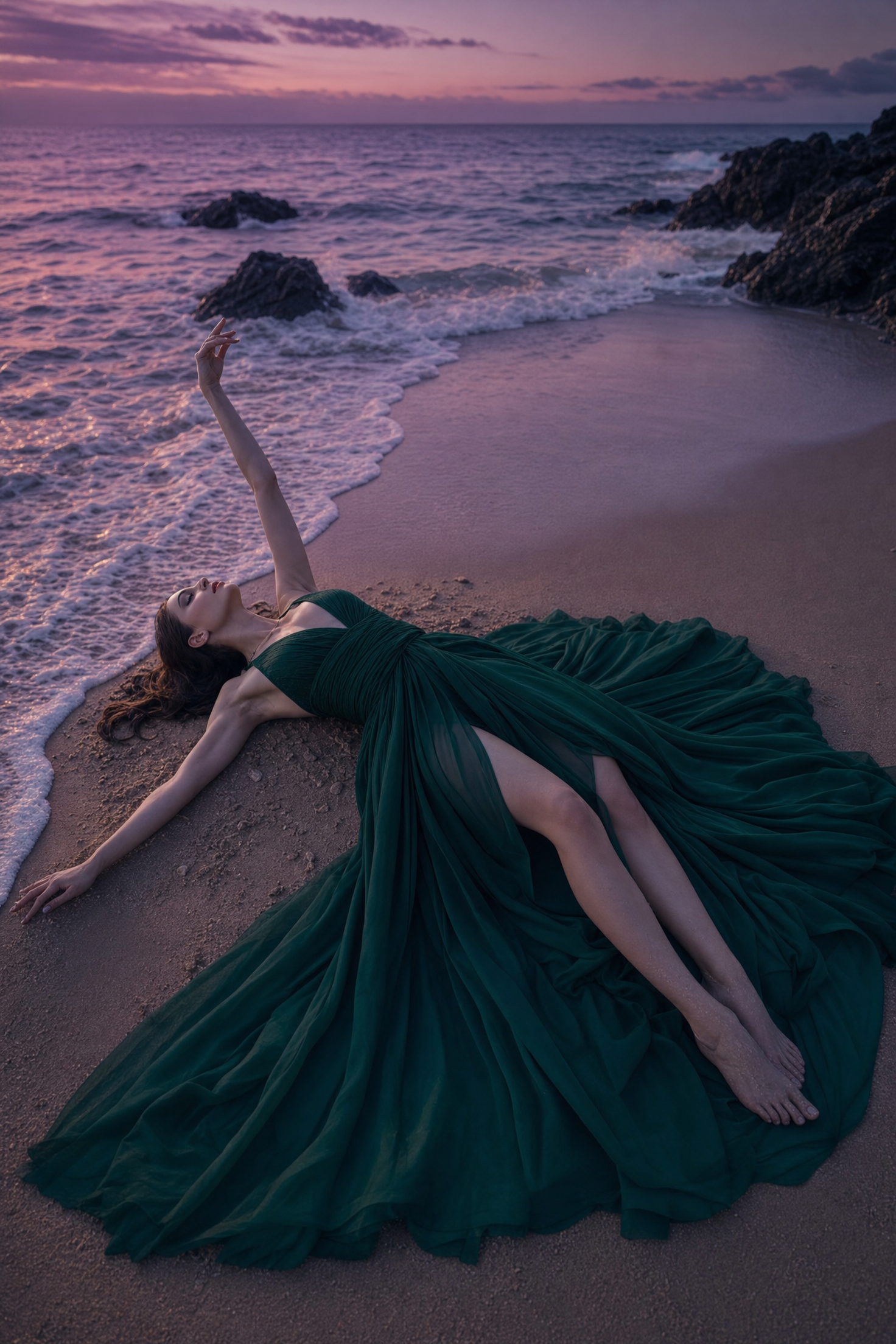
“Aerial diagonal side view” and “elegant full-body pose” establish the wide, editorial composition, letting the woman, shoreline, and dark rock formations read as one graphic arrangement rather than a conventional portrait. The “deep emerald-green gown” is the visual anchor against “cool pale sand,” while the “muted teal and lilac color palette” and dominant navy-purple tones extend the dusk atmosphere around it. “Soft twilight light,” “gentle rim highlights,” and “romantic, dreamy, ethereal mood” specifically produce the calm glow, while “voluminous chiffon layers” and “realistic fabric drape” keep the gown tactile and luxurious.
FAQ
→How do I make the woman and gown more prominent in the composition?
Replace “aerial diagonal side view” with “low oblique three-quarter view” and change “elegant full-body framing” to “medium full-body fashion portrait, subject filling 70 percent of the frame.” Keep “deep emerald-green gown,” but add “gown as the dominant visual focus, sharply detailed face and fabric.”
→How do I make this scene feel darker and more dramatic instead of dreamy?
Replace “soft twilight light with gentle rim highlights and a calm, romantic glow” with “deep blue-hour light, hard side lighting, pronounced shadows, and a narrow silver rim light.” Change “romantic dreamy ethereal mood” to “moody, dramatic, cinematic tension,” and replace “muted teal and lilac color palette” with “desaturated navy, charcoal, and emerald with restrained highlights.”
→How do I create a series of variations while keeping the same fashion-editorial identity?
Keep “photorealistic fashion editorial,” “cinematic luxury campaign look,” “high-fashion composition,” and “realistic fabric drape and chiffony layer structure” unchanged. Swap the setting phrase “seaside shoreline with weathered dark rocky outcrops” for variations such as “misty black-sand volcanic coast,” “sunlit Mediterranean cove,” or “windy salt flat beside a tidal pool,” and replace “deep emerald-green gown” with coordinated colors such as “sapphire-blue silk gown” or “burnt-umber chiffon gown.”
Learn the technique behind this
- Why can't AI spell, and how do I get readable text in an image? — Older diffusion models had no character-level representation of text, so they produced letterform-shaped texture instead of words.
- How should a prompt be structured, and does word order matter? — A prompt that behaves predictably names one subject first, then what it is doing, then where, then the light, then the lens or medium, then the style.
- Why does the model ignore parts of my prompt? — Ignored instructions are almost always conflicts, counts, or spatial relationships — three things current models handle badly — rather than the model failing to read you.
Related prompts
Cobalt Boots in Sleek Studio Edit

Teal fashion editorial in monster-filled lift

Sunlit editorial on striped beach towel
Silhouette Influencer by Sunlit Window