Why this works
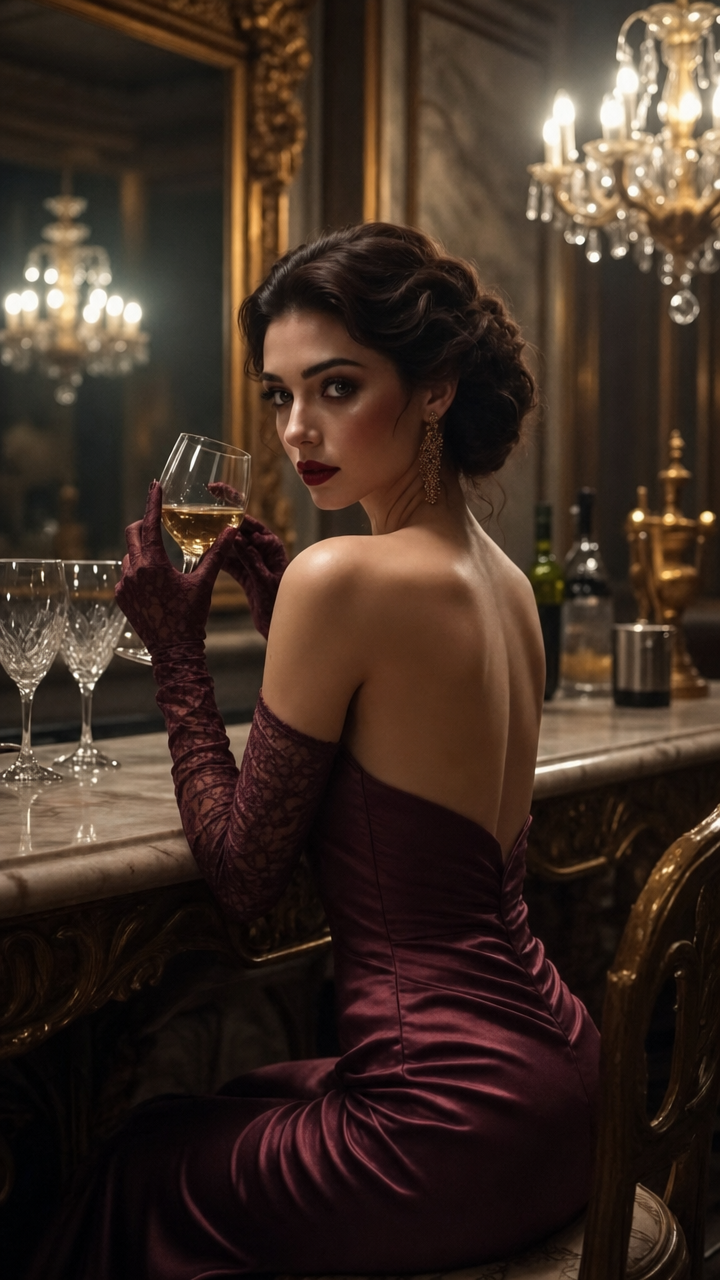
The phrase “burgundy satin backless evening gown with long sheer lace gloves” gives the portrait its strongest color and texture contrast, with the purple-burgundy fabric standing out against the image’s black, beige, and gold interior. “High-end bar,” “gilded trim,” and “sparkling crystal chandeliers” establish the sophisticated setting, while “warm amber ambient lighting” supplies the gold warmth and “mirrored wall reflections create subtle symmetry behind her” organizes the full-body composition. “Shallow depth of field” and “high-detail focus on the subject” keep the woman and wine glass visually dominant while “intimate glamorous mood” narrows the scene’s emotional tone.
FAQ
→How do I make the woman more visually central and commanding?
Replace “seated at a high-end bar” with “standing centrally beside the high-end bar in a commanding full-body pose,” and change “cinematic framing” to “centered symmetrical framing with the subject occupying most of the frame.” Keep “high-detail focus on the subject,” since it explicitly protects facial, glove, and satin detail.
→How do I shift this from intimate glamour to a darker, more dramatic mood?
Replace “warm amber ambient lighting” with “low-key burgundy and blue side-lighting with deep shadows,” and replace “intimate glamorous mood” with “moody, mysterious noir atmosphere.” Changing “natural filmic color grading” to “high-contrast cinematic color grading” will further deepen the black and purple tones without removing the chandelier setting.
→How do I create a matching series with different subjects while preserving this visual identity?
Keep “photorealistic cinematic luxury portrait,” “ornate gilded interior bar,” “mirrored wall reflections,” “warm amber ambient lighting,” “shallow depth of field,” and “natural filmic color grading” unchanged. Swap “elegant woman wearing a burgundy satin backless evening gown” for a consistent subject template such as “elegant man in a black velvet tuxedo” or “jazz singer in an emerald silk dress,” then replace “holding a stemmed glass of white wine” with a recurring prop suited to each character.
Learn the technique behind this
- Why can't AI spell, and how do I get readable text in an image? — Older diffusion models had no character-level representation of text, so they produced letterform-shaped texture instead of words.
- Why does AI get hands and faces wrong, and how do I fix it? — Hands fail because they're small in frame, extremely variable in pose, and self-occluding — the model has less usable signal per pixel than for any other body part.
- How should a prompt be structured, and does word order matter? — A prompt that behaves predictably names one subject first, then what it is doing, then where, then the light, then the lens or medium, then the style.
Related prompts
Cobalt Boots in Sleek Studio Edit
Teal fashion editorial in monster-filled lift

Sunlit editorial on striped beach towel
Silhouette Influencer by Sunlit Window