Why this works
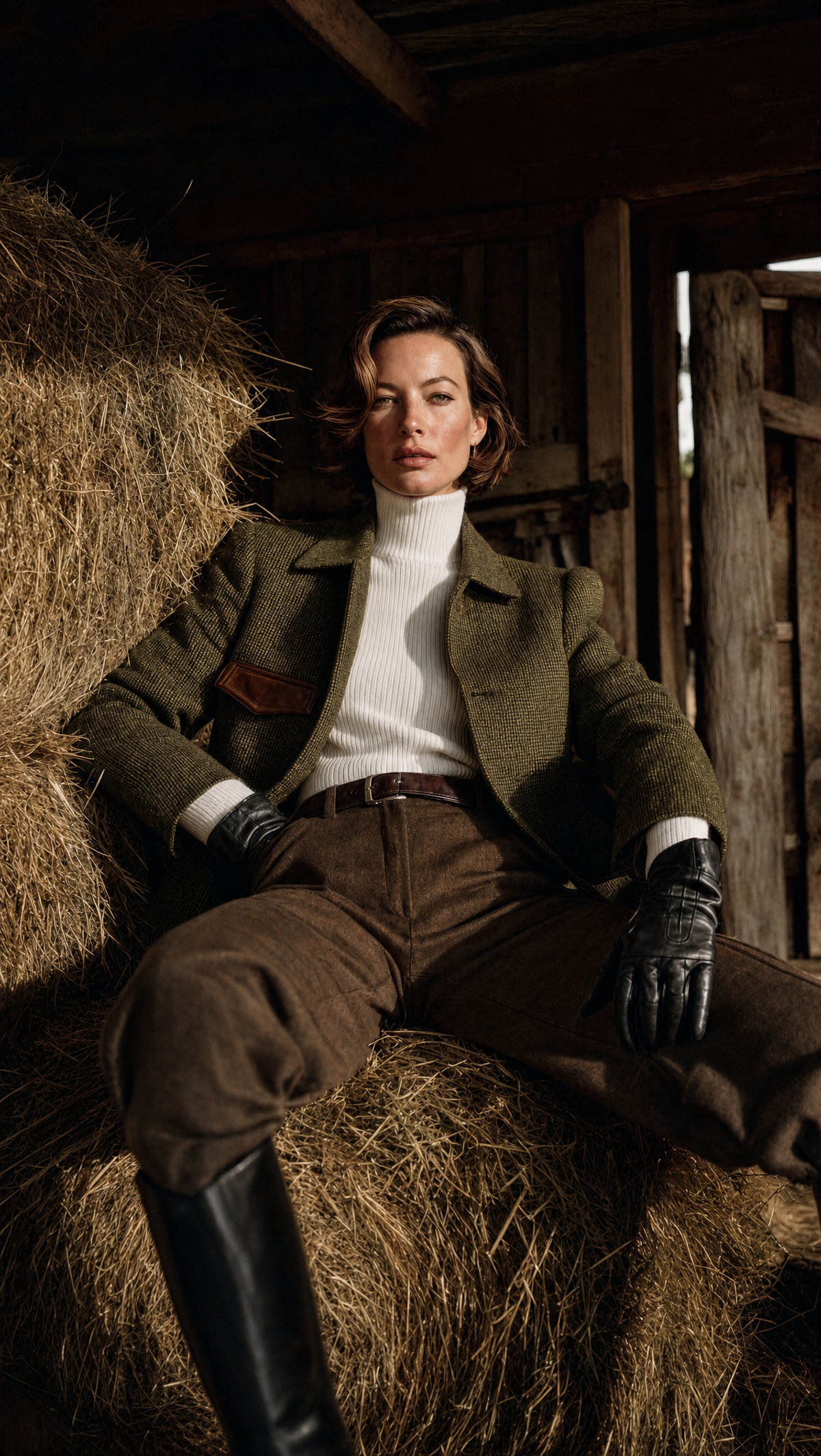
The phrase “close-up fashion editorial portrait” gives the image a polished magazine structure, while “three-quarter view” keeps the woman’s pose readable against the stable rather than flattening it into a straight-on catalog shot. “Warm golden-hour natural daylight with soft shadows” supplies the confident, warm mood, and “olive-green riding jacket,” “white ribbed turtleneck,” and “dark brown high-waisted riding trousers” create a restrained earth-tone palette that aligns with the image’s dominant black, tan, and beige colors. “Realistic fabric and leather textures” makes the gloves, boots, jacket, and hay feel tactile, while “rustic-luxury countryside aesthetic” connects the refined wardrobe to the rough stable setting.
FAQ
→How do I make the woman’s face and expression more central?
Replace “close-up fashion editorial portrait” with “tight head-and-shoulders beauty portrait,” and add “face centered, direct eye contact, sharply rendered eyes, expressive confident gaze.” Remove or soften “portrait-full-body” so the framing prioritizes her expression over the riding boots and hay bales.
→How do I shift this from warm rustic luxury to a darker, more dramatic editorial mood?
Replace “warm golden-hour natural daylight with soft shadows” with “low-key directional window light, deep shadows, controlled chiaroscuro, muted highlights.” Change “cinematic warm color grading” to “cool desaturated color grading with charcoal and steel-blue tones,” while keeping “black leather gloves” and “tall black riding boots” to anchor the darker palette.
→How do I create a cohesive series with different equestrian looks and stable scenes?
Keep the fixed visual language, including “photorealistic,” “fashion editorial,” “cinematic composition,” “three-quarter view,” and “realistic fabric and leather textures.” For each variation, replace only “olive-green riding jacket,” “white ribbed turtleneck,” and “dark brown high-waisted riding trousers” with a new outfit, then swap “rustic stable with hay bales” for settings such as “weathered tack room,” “misty paddock at dawn,” or “stone courtyard beside the stable.”
Learn the technique behind this
- Why can't AI spell, and how do I get readable text in an image? — Older diffusion models had no character-level representation of text, so they produced letterform-shaped texture instead of words.
- How should a prompt be structured, and does word order matter? — A prompt that behaves predictably names one subject first, then what it is doing, then where, then the light, then the lens or medium, then the style.
- Which aspect ratio should I use, and how does it change the image? — Aspect ratio determines what the model composes, not how it's cropped afterwards.
Related prompts

Teal fashion editorial in monster-filled lift
Cobalt Boots in Sleek Studio Edit
Silhouette Influencer by Sunlit Window
Sunlit editorial on striped beach towel