Why this works
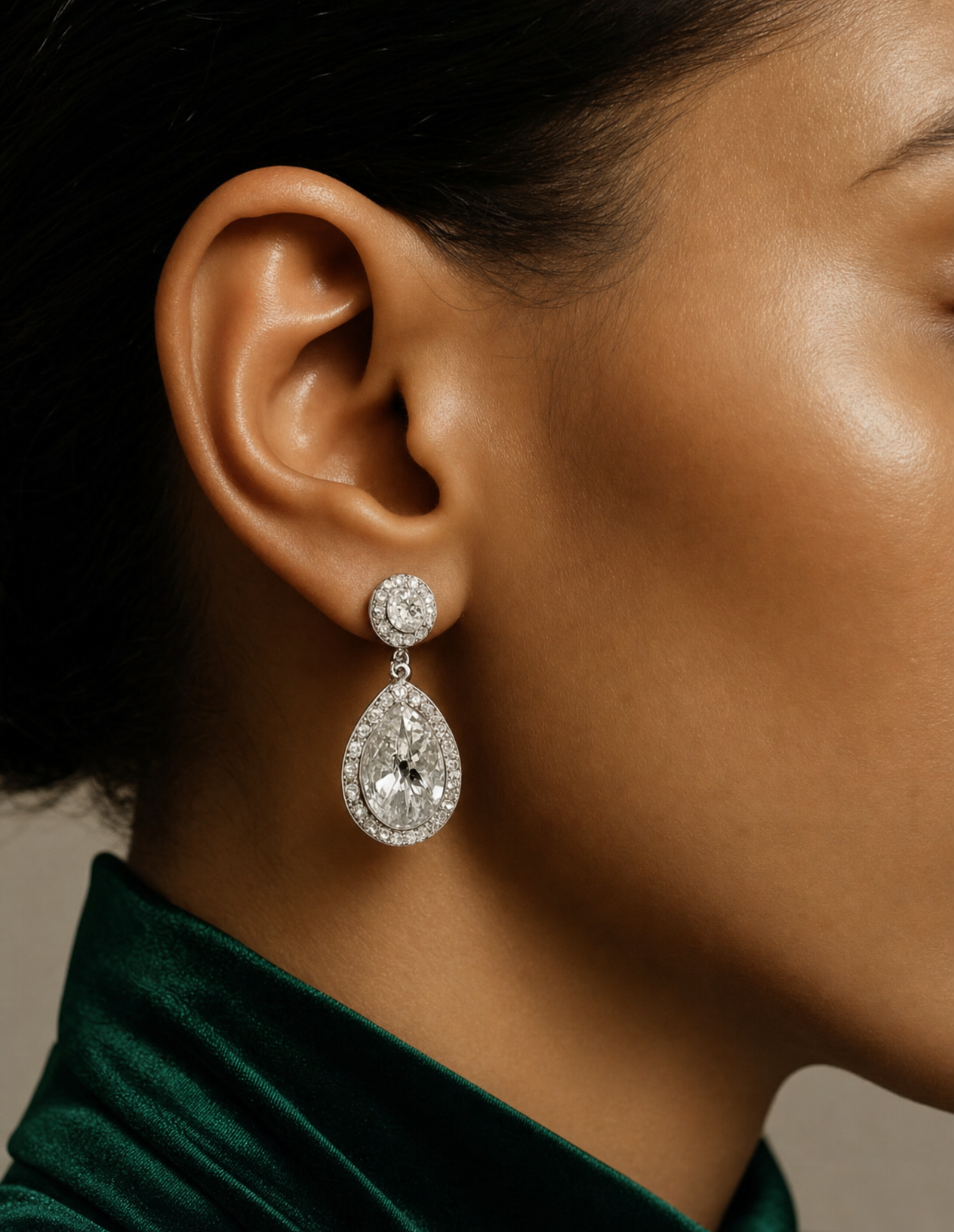
The centered ear and “3:4 vertical framing” make the image read as a deliberate portrait-close-up, while “sharp focus on skin and jewelry detail” keeps attention on the earring rather than the surrounding outfit. “Deep emerald outfit instead of black” supplies the main green accent against the “clean dark background,” producing the image’s black-green-gray harmony and richer contrast. The luxurious tone comes from the combined phrases “dramatic soft lighting,” “delicate specular highlights on the earring,” and “luxurious refined glamorous mood,” with “naturally textured, luminous skin” preventing the close-up from feeling overly retouched.
FAQ
→How do I make the diamond earring more prominent than the ear and outfit?
Replace “centered ear” with “diamond drop earring centered and dominant in the frame,” and change “sharp focus on skin and jewelry detail” to “ultra-sharp focus on the diamond facets, with the ear and emerald outfit subtly receding.” You can also add “earring occupying the central third of the image” for stronger scale and placement control.
→How do I shift this from glamorous luxury to a darker, more dramatic editorial mood?
Replace “luxurious refined glamorous mood” with “moody, austere haute couture mood,” and change “dramatic soft lighting” to “low-key directional side lighting with deep shadows.” Keep “clean dark background,” but replace “delicate specular highlights” with “a single controlled highlight along the diamond edges” to reduce the polished sparkle.
→How do I create a coordinated series with different jewelry and wardrobe colors?
Keep the fixed structure, including “Photorealistic 8K high-fashion editorial close-up,” “3:4 vertical framing,” and “sharp focus on skin and jewelry detail,” then swap “diamond drop earring” for variations such as “sculptural gold hoop,” “pearl ear cuff,” or “ruby chandelier earring.” Replace “deep emerald outfit” with coordinated colors such as “sapphire-blue outfit,” “burgundy silk outfit,” or “ivory satin outfit,” while retaining “clean dark background” so the series shares the same visual anchor.
Learn the technique behind this
- Why can't AI spell, and how do I get readable text in an image? — Older diffusion models had no character-level representation of text, so they produced letterform-shaped texture instead of words.
- Which aspect ratio should I use, and how does it change the image? — Aspect ratio determines what the model composes, not how it's cropped afterwards.
- How should a prompt be structured, and does word order matter? — A prompt that behaves predictably names one subject first, then what it is doing, then where, then the light, then the lens or medium, then the style.
Related prompts
Cobalt Boots in Sleek Studio Edit
Teal fashion editorial in monster-filled lift

Sunlit editorial on striped beach towel
Silhouette Influencer by Sunlit Window