Why this works
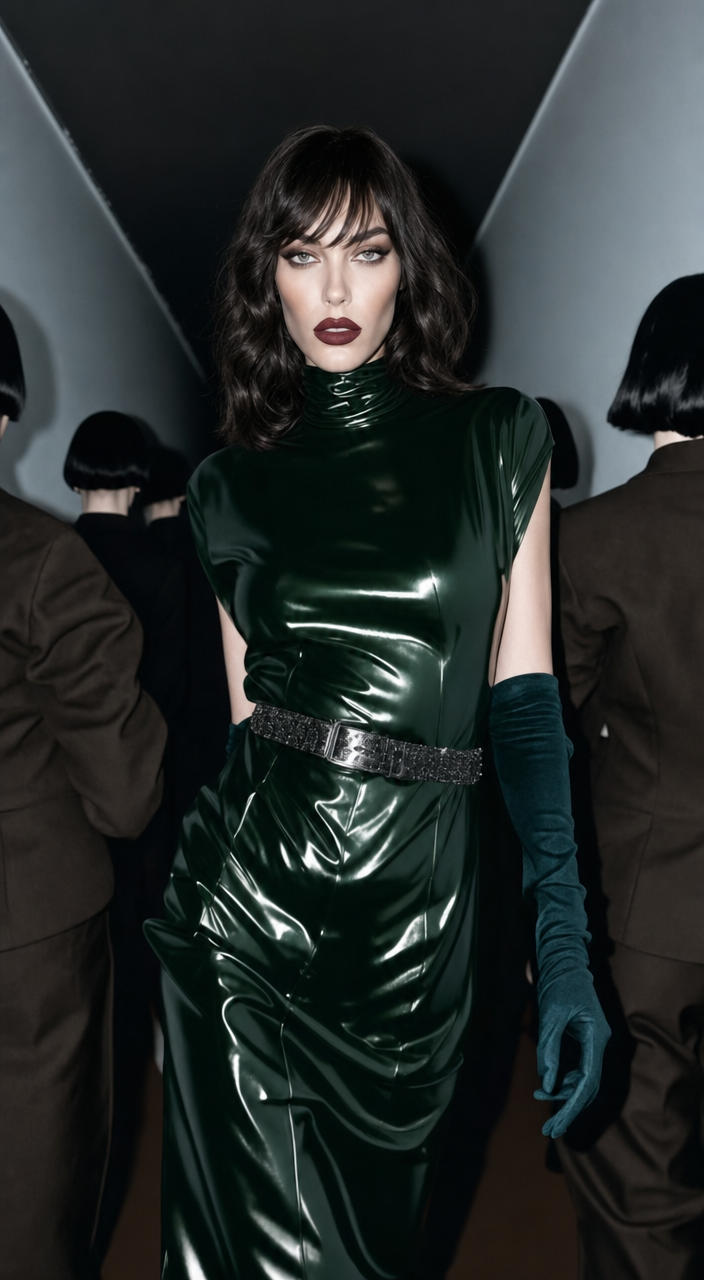
The full-body editorial framing and the phrase “walking confidently down a narrow, high-drama corridor” give the model a strong forward-moving presence and turn the hallway into a visual runway. “Glossy deep-green latex,” “dark emerald” gloves, and the “dark charcoal ceiling and nearly black background” create a controlled green-gray harmony, while “sharp highlights and deep shadows” makes the latex reflective and keeps the mood sleek, ominous, and glamorous. “Dramatic pale makeup with matte berry lipstick” supplies the clearest facial contrast against the dark setting, and “high contrast, polished commercial finish” pushes the image toward a crisp fashion-campaign surface rather than a naturalistic portrait.
FAQ
→How do I change this prompt to make the model’s face more prominent?
Replace “Editorial portrait framing with a confident walking perspective down the corridor” and “portrait-full-body” with “tight three-quarter beauty portrait, face and makeup dominant, corridor reduced to a soft background.” Keep “dramatic pale makeup with matte berry lipstick,” but add “sharp focus on the eyes and lips” to preserve the makeup as the focal point.
→How do I make the image feel brighter and less ominous?
Replace “dark charcoal ceiling and nearly black background” with “pale stone corridor with reflective silver walls,” and change “deep shadows” to “soft diffused runway lighting with controlled highlights.” Retain “glossy deep-green latex” so the green remains the anchor while the lighter setting shifts the tone from nocturnal drama to luminous luxury.
→How do I build a series of variations from this fashion concept?
Keep “high-fashion editorial portrait,” “cinematic runway-style lighting,” and “high-contrast, polished commercial finish” fixed, then swap the subject and setting phrases in separate versions. For example, replace “glossy deep-green latex dress” with “sculptural ivory satin gown” and “narrow corridor” with “brutalist concrete stairwell,” or use “metallic cobalt mini-dress” and “mirrored backstage tunnel” for a consistent editorial series with new color and location identities.
Learn the technique behind this
- Why can't AI spell, and how do I get readable text in an image? — Older diffusion models had no character-level representation of text, so they produced letterform-shaped texture instead of words.
- How should a prompt be structured, and does word order matter? — A prompt that behaves predictably names one subject first, then what it is doing, then where, then the light, then the lens or medium, then the style.
- Why does the model ignore parts of my prompt? — Ignored instructions are almost always conflicts, counts, or spatial relationships — three things current models handle badly — rather than the model failing to read you.
Related prompts
Teal fashion editorial in monster-filled lift
Cobalt Boots in Sleek Studio Edit
Silhouette Influencer by Sunlit Window

Sunlit editorial on striped beach towel