Why this works
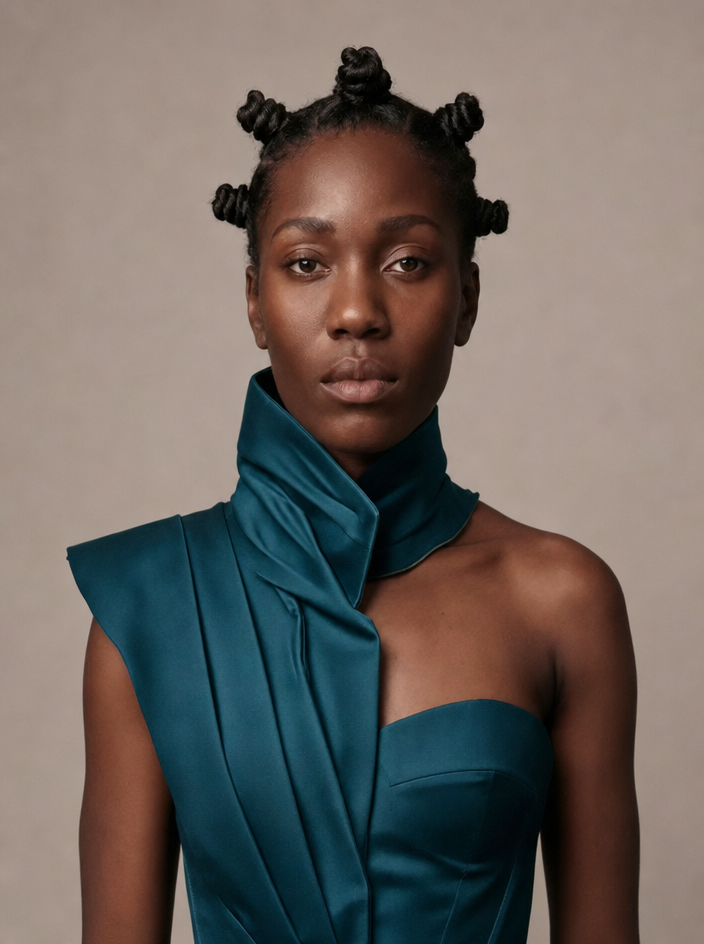
The phrase “centered in frame” and the “portrait-closeup” composition give the sculptural bantu knots and facial features immediate priority, while “clean minimal fashion photography style” keeps the beige seamless background visually quiet. “Soft diffused studio lighting” supports the serene, elegant mood by preserving realistic skin texture without harsh shadows, and “deep teal asymmetrical high-collar outfit” provides the main designed contrast against the image’s dominant brown-gray neutrals. “One-shoulder draping” adds a controlled diagonal to an otherwise stable centered composition, making the garment feel avant-garde without disturbing the minimalist balance.
FAQ
→How do I make the outfit more prominent than the face?
Replace “centered in frame” and “portrait-closeup” with “three-quarter fashion portrait, garment-focused framing,” and add “full asymmetrical silhouette clearly visible from shoulder to hip.” Keep “deep teal asymmetrical high-collar outfit” and “one-shoulder draping,” but specify “high-contrast teal garment as the visual focal point.”
→How do I shift the serene mood toward something darker and more dramatic?
Replace “soft diffused studio lighting” with “directional low-key side lighting with deep sculptural shadows,” and change “serene minimalist mood” to “moody, nocturnal, dramatic editorial mood.” Replace “neutral seamless beige studio background” with “seamless charcoal-gray studio background” to move the palette away from the current brown-gray neutrality.
→How do I create a consistent series with different garments while preserving this portrait’s identity?
Keep “dark-skinned woman with sculptural bantu knots,” “centered in frame,” “neutral seamless beige studio background,” “realistic skin texture,” and “clean minimal fashion photography style” unchanged. Replace only “deep teal asymmetrical high-collar outfit with one-shoulder draping” with controlled variants such as “cobalt blue architectural cape dress,” “ivory pleated high-collar suit,” or “burnt orange sculptural halter gown,” while retaining “soft diffused studio lighting” and “high-detail” for visual continuity.
Learn the technique behind this
- Why can't AI spell, and how do I get readable text in an image? — Older diffusion models had no character-level representation of text, so they produced letterform-shaped texture instead of words.
- How should a prompt be structured, and does word order matter? — A prompt that behaves predictably names one subject first, then what it is doing, then where, then the light, then the lens or medium, then the style.
- Why does AI get hands and faces wrong, and how do I fix it? — Hands fail because they're small in frame, extremely variable in pose, and self-occluding — the model has less usable signal per pixel than for any other body part.
Related prompts
Teal fashion editorial in monster-filled lift
Cobalt Boots in Sleek Studio Edit
Silhouette Influencer by Sunlit Window
Sunlit editorial on striped beach towel