Why this works
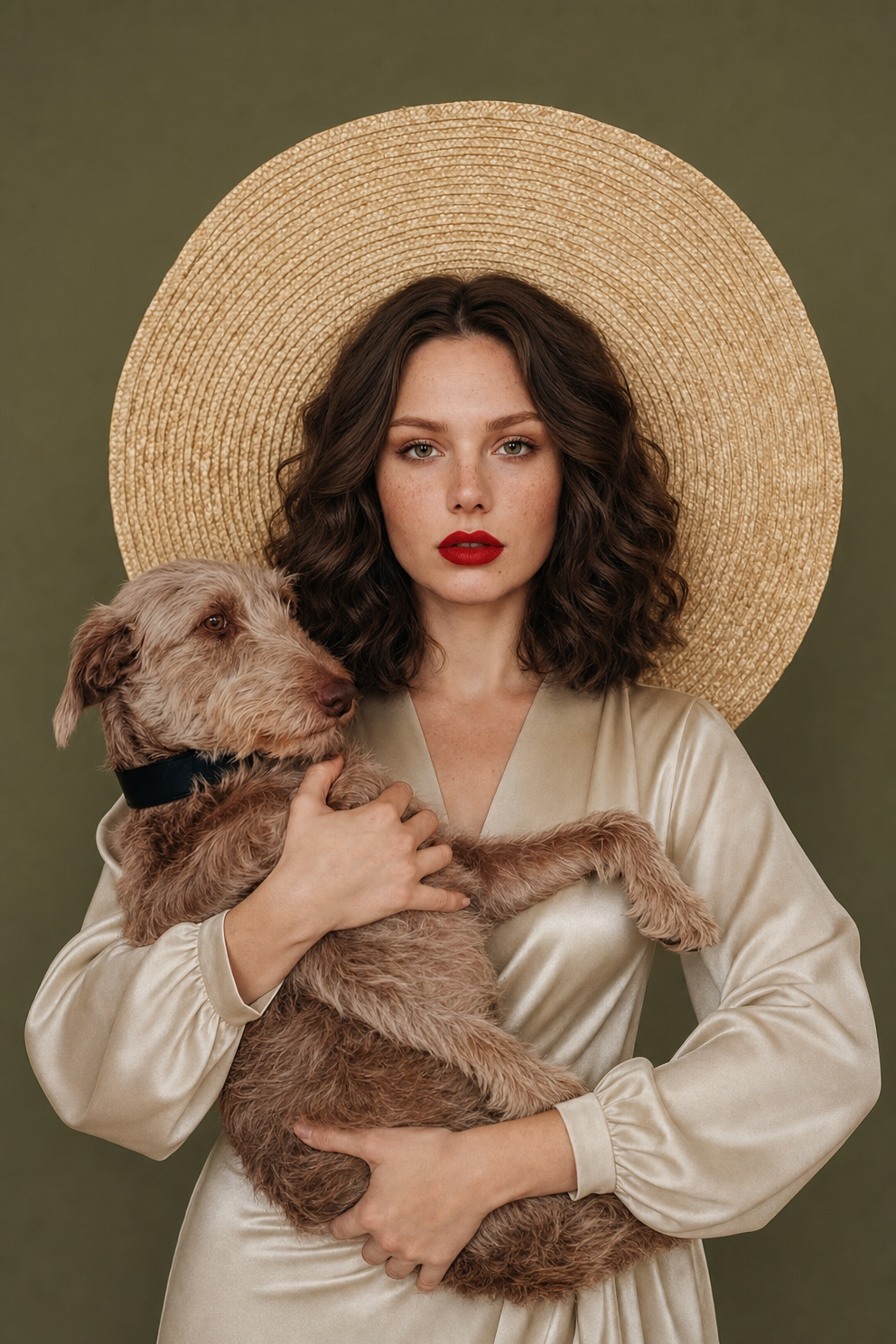
The centered waist-up framing and “solid muted olive-green background” give the portrait a controlled editorial structure, while “strong color blocking” makes the cream satin dress and brown-gray dog read as deliberate graphic shapes. “Soft even studio lighting” preserves natural skin texture and crisp fur and fabric detail, and the phrase “elegant and dramatic modern mood” steers the restrained pose toward fashion-editorial polish rather than a casual pet portrait. The woman and dog share the visual center, with “sharp focus on faces and fur” making their relationship the image’s clearest point of attention.
FAQ
→How do I make the dog more prominent than the woman?
Replace “cradling a shaggy terrier-like dog in her arms” with “the shaggy terrier-like dog held prominently in the foreground, its head and fur larger than the woman’s,” and change “sharp focus on faces and fur” to “primary sharp focus on the dog’s face and fur, with the woman slightly softer.”
→How do I shift this from dramatic fashion editorial to a warmer, more intimate portrait?
Replace “Bold, modern styling” and “elegant and dramatic mood” with “warm, intimate, affectionate mood,” and change “soft even studio lighting” to “soft warm window-like light with gentle falloff and subtle shadows.” Keeping “natural skin texture” and “crisp fur detail” will preserve the tactile realism.
→How do I create a series with different outfits and background colors?
Keep “photorealistic fashion editorial studio portrait,” “centered waist-up framing,” and “sharp focus on faces and fur” unchanged, then replace “cream satin V-neck dress” with a controlled outfit list such as “black velvet halter dress,” “cobalt silk blouse,” or “rust-colored tailored suit.” Replace “muted olive-green solid background” with matching solid backdrops such as “deep burgundy,” “powder blue,” or “warm charcoal,” while retaining “strong color blocking” for visual consistency across the series.
Learn the technique behind this
- Why can't AI spell, and how do I get readable text in an image? — Older diffusion models had no character-level representation of text, so they produced letterform-shaped texture instead of words.
- Why does AI get hands and faces wrong, and how do I fix it? — Hands fail because they're small in frame, extremely variable in pose, and self-occluding — the model has less usable signal per pixel than for any other body part.
- How do I keep the same character across multiple images? — Text prompts alone won't hold a face across images — a description defines a type, not a person.
Related prompts
Teal fashion editorial in monster-filled lift
Cobalt Boots in Sleek Studio Edit
Silhouette Influencer by Sunlit Window
Sunlit editorial on striped beach towel