Why this works
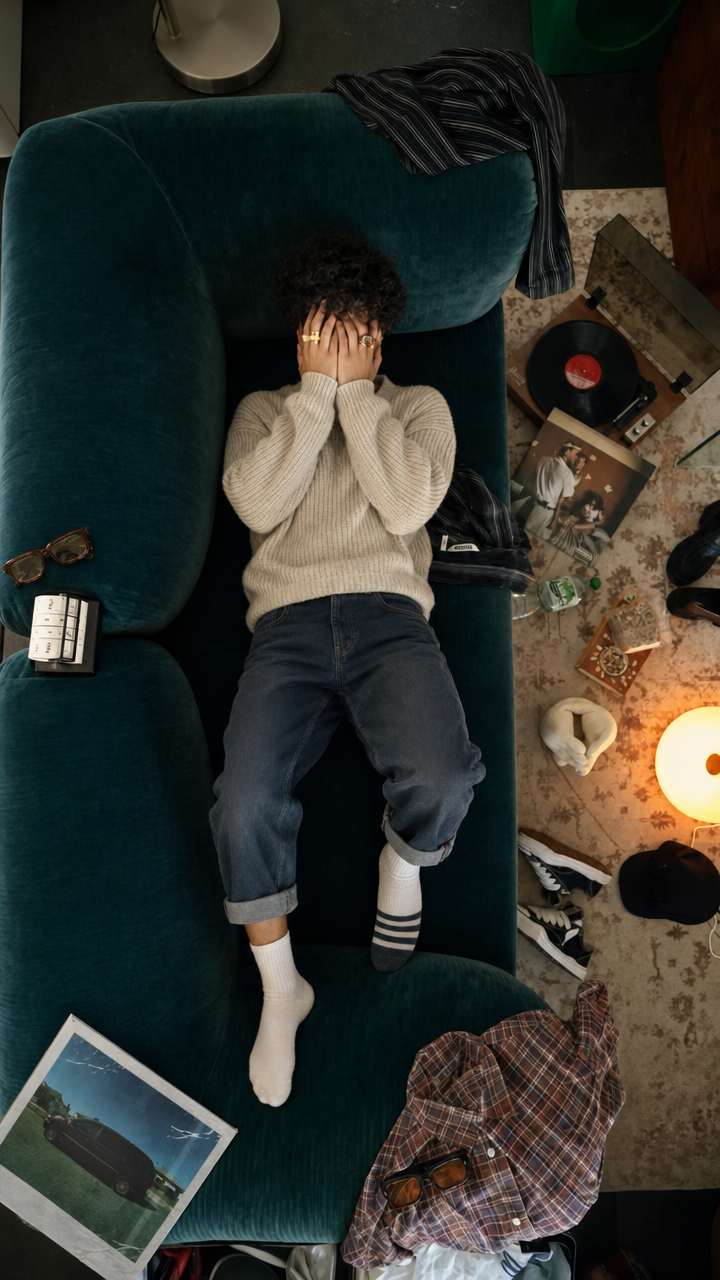
The phrase “overhead photorealistic editorial lifestyle scene” establishes the flat-lay framing, while “a person reclines on a deep teal velvet couch” gives the composition a single color anchor against the dominant gray, brown, and black objects. “Warm practical lamp light” and “soft, realistic shadows” produce the relaxed intimate mood, with “natural textures of fabric and vinyl” directing attention to the sweater, velvet, denim, records, and magazines. The specific clutter list, including “vinyl records, loose garments, eyeglasses, a record player/turntable, and a few magazines scattered naturally,” supplies the candid lived-in narrative rather than a staged furniture shot.
FAQ
→How do I make the reclining person more visually central?
Replace “surrounded by vinyl records and scattered clothing” with “the person occupies the central two-thirds of the frame, with vinyl records and clothing forming a loose peripheral border,” and add “hands, sweater ribbing, and mismatched socks remain clearly visible.” This reduces the equal visual weight of the surrounding objects while preserving the overhead composition.
→How do I shift this from warm and relaxed to moody and nocturnal?
Replace “Warm practical lamp light with soft, realistic shadows” with “single dim amber lamp from one side, deep directional shadows, and subtle pools of light,” and change “warm color grading” to “muted charcoal and desaturated brown color grading.” Keep “deep teal velvet couch” if you want the teal to become a darker accent in the reduced light.
→How do I create a coordinated series of variations from this scene?
Keep “overhead photorealistic editorial lifestyle scene,” “editorial composition,” and “high-detail textures” unchanged, then swap the object and garment phrases as a set: replace “vinyl records, ... a record player/turntable” with “open sketchbooks, graphite pencils, and a ceramic mug,” and replace “ribbed oatmeal knit sweater” with “washed navy cotton sweatshirt.” Repeat the same overhead framing and “warm practical lamp light” across each version so the props and subject change while the visual identity stays consistent.
Learn the technique behind this
- Why can't AI spell, and how do I get readable text in an image? — Older diffusion models had no character-level representation of text, so they produced letterform-shaped texture instead of words.
- Why does AI get hands and faces wrong, and how do I fix it? — Hands fail because they're small in frame, extremely variable in pose, and self-occluding — the model has less usable signal per pixel than for any other body part.
- How should a prompt be structured, and does word order matter? — A prompt that behaves predictably names one subject first, then what it is doing, then where, then the light, then the lens or medium, then the style.
Related prompts
Young woman with two cats
Blonde woman hugging beige pillow on off-white bed
Black tower fan on gray rug by window
Cozy Winter Living Room in Sage