Why this works
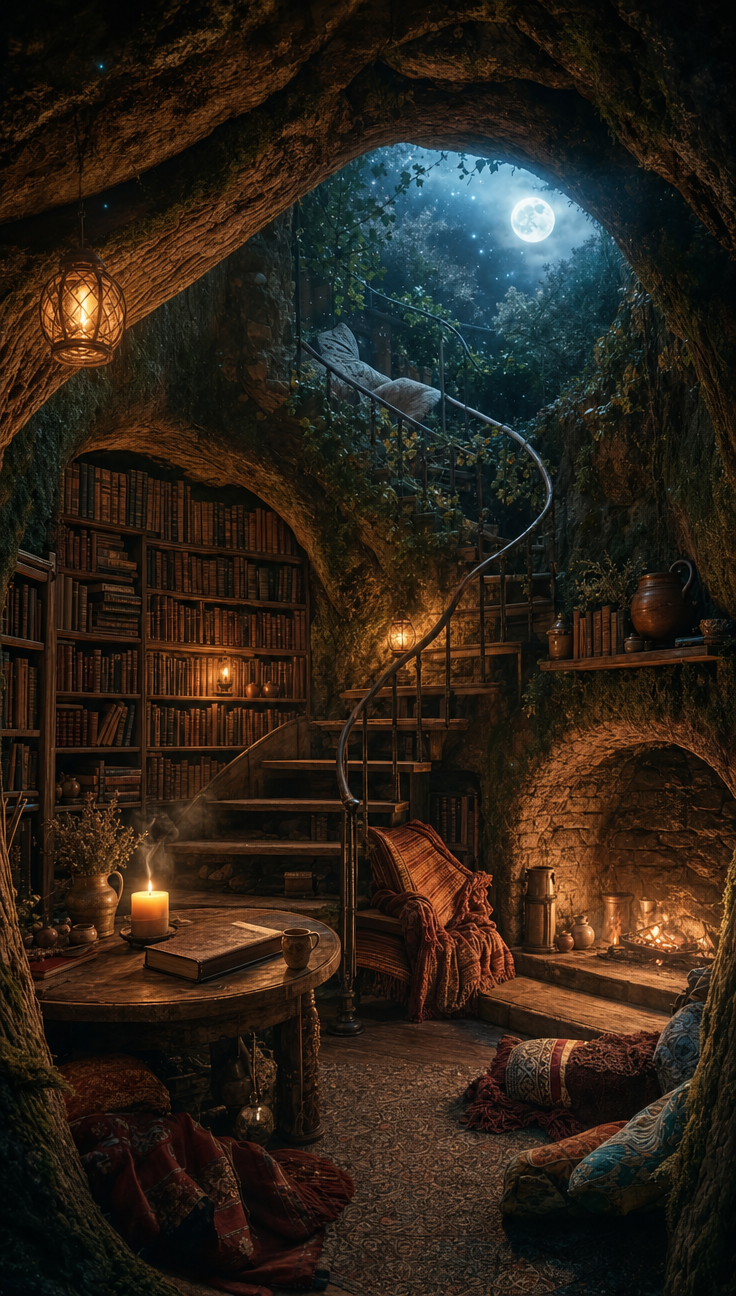
The phrase “hidden library inside the hollow trunk of a giant ancient tree” establishes a secluded fantasy setting, while “floor-to-ceiling bookshelves” and the “elegant spiral staircase” create vertical depth within the wide-shot composition. Warm orange focus comes from the “glowing embers,” “single lit candle,” and “warm light,” contrasted by the “cool blue moonlight” through the canopy opening; this produces the image’s black, orange, gray, and beige harmony. “Dust motes floating in the air” and “rich earthy textures” supply atmospheric detail, while the “round reading table” with a “closed book” gives the eye a quiet foreground anchor.
FAQ
→How do I make the fireplace and seating area the main focal point?
Replace “On the right, a low hearth fireplace” with “a large central hearth fireplace as the primary focal point,” and change “wide-shot” to “medium-wide composition centered on the hearth.” Add “the round reading table pushed to the left edge” and “firelight prominently illuminating the cushions and woven blankets.”
→How do I make the scene moodier and more mysterious?
Replace “warm light across plush cushions” with “low, restrained ember light leaving most of the library in deep shadow,” and change “inviting” to “quietly ominous and mysterious.” Reduce “single lit candle” to “one nearly extinguished candle,” while replacing “cool blue moonlight streams” with “a narrow shaft of stark blue moonlight cuts through the darkness.”
→How do I turn this into a series of related tree-library variations?
Keep the core phrase “hidden library inside the hollow trunk of a giant ancient tree,” then swap the location details in each version: replace “irregular oval opening in the canopy” with “a narrow root-level doorway,” “a stained-glass branch window,” or “a circular opening high in the trunk.” You can also replace “a closed book” with “an open spellbook,” “a stack of weathered maps,” or “a glowing botanical journal” while retaining the same “warm candle and ember glow mixed with cool blue moonlight” for visual continuity.
Learn the technique behind this
- Why can't AI spell, and how do I get readable text in an image? — Older diffusion models had no character-level representation of text, so they produced letterform-shaped texture instead of words.
- Which aspect ratio should I use, and how does it change the image? — Aspect ratio determines what the model composes, not how it's cropped afterwards.
- How should a prompt be structured, and does word order matter? — A prompt that behaves predictably names one subject first, then what it is doing, then where, then the light, then the lens or medium, then the style.
Related prompts
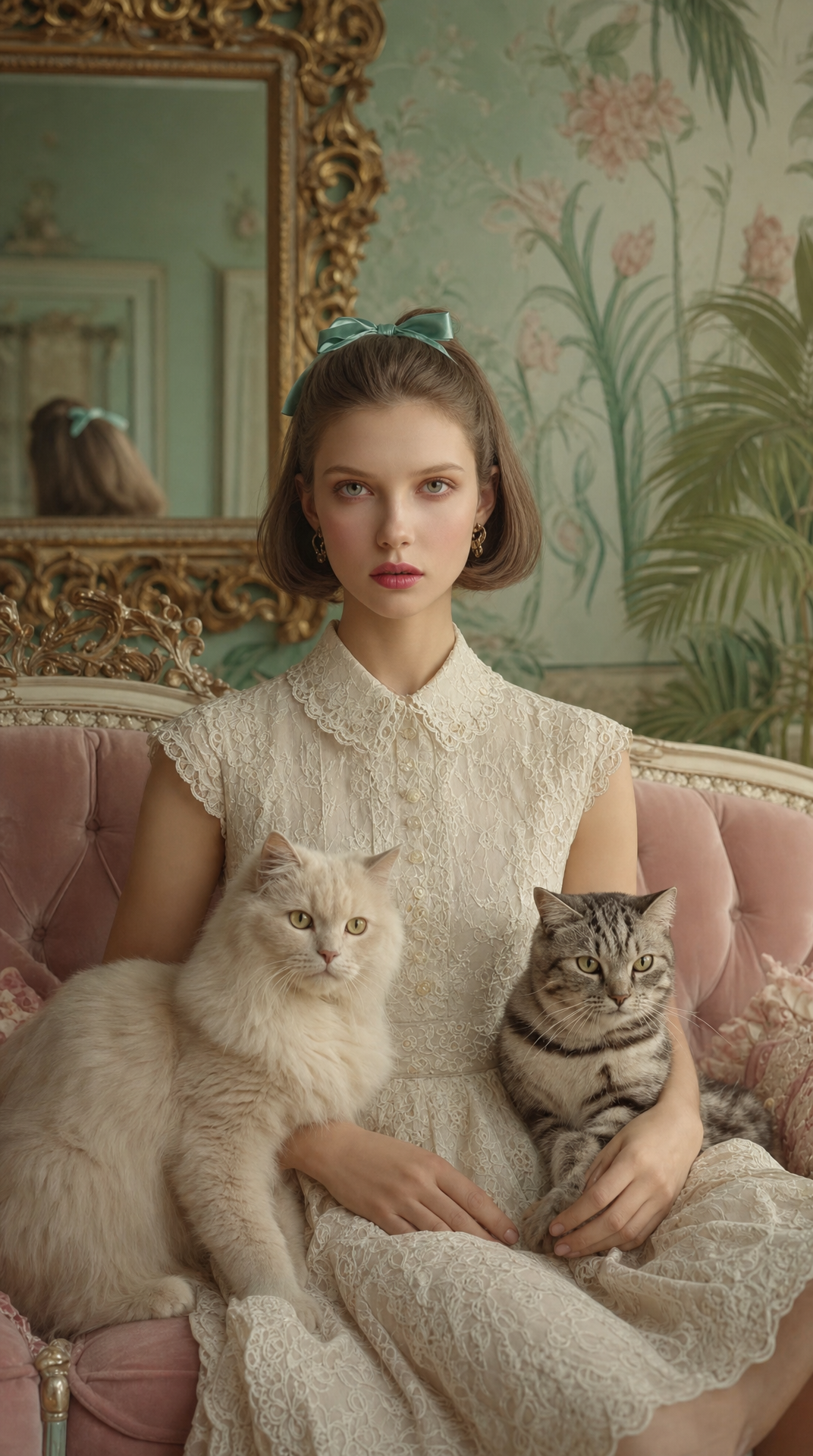
Young woman with two cats
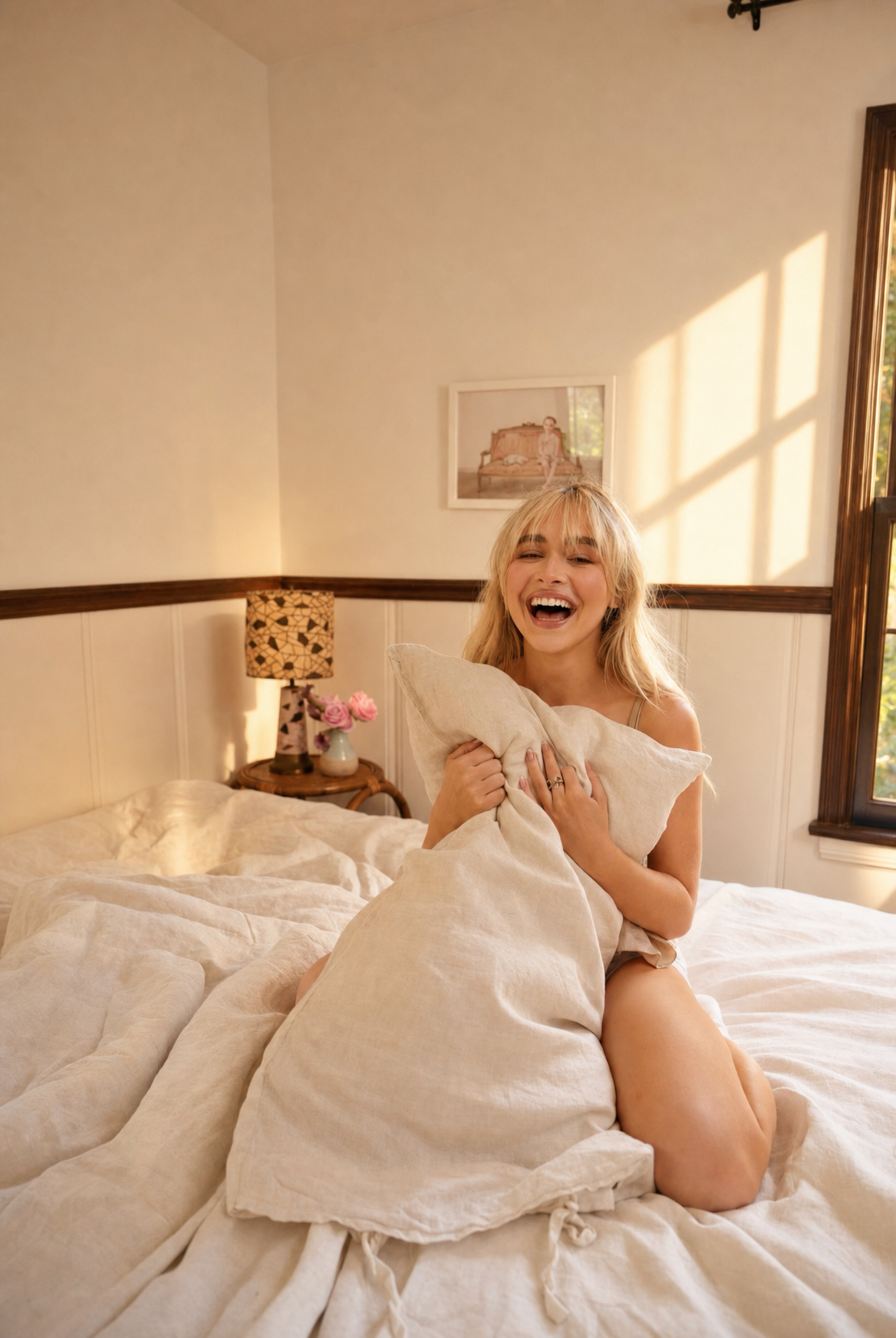
Blonde woman hugging beige pillow on off-white bed
Black tower fan on gray rug by window
Cozy Winter Living Room in Sage