Why this works
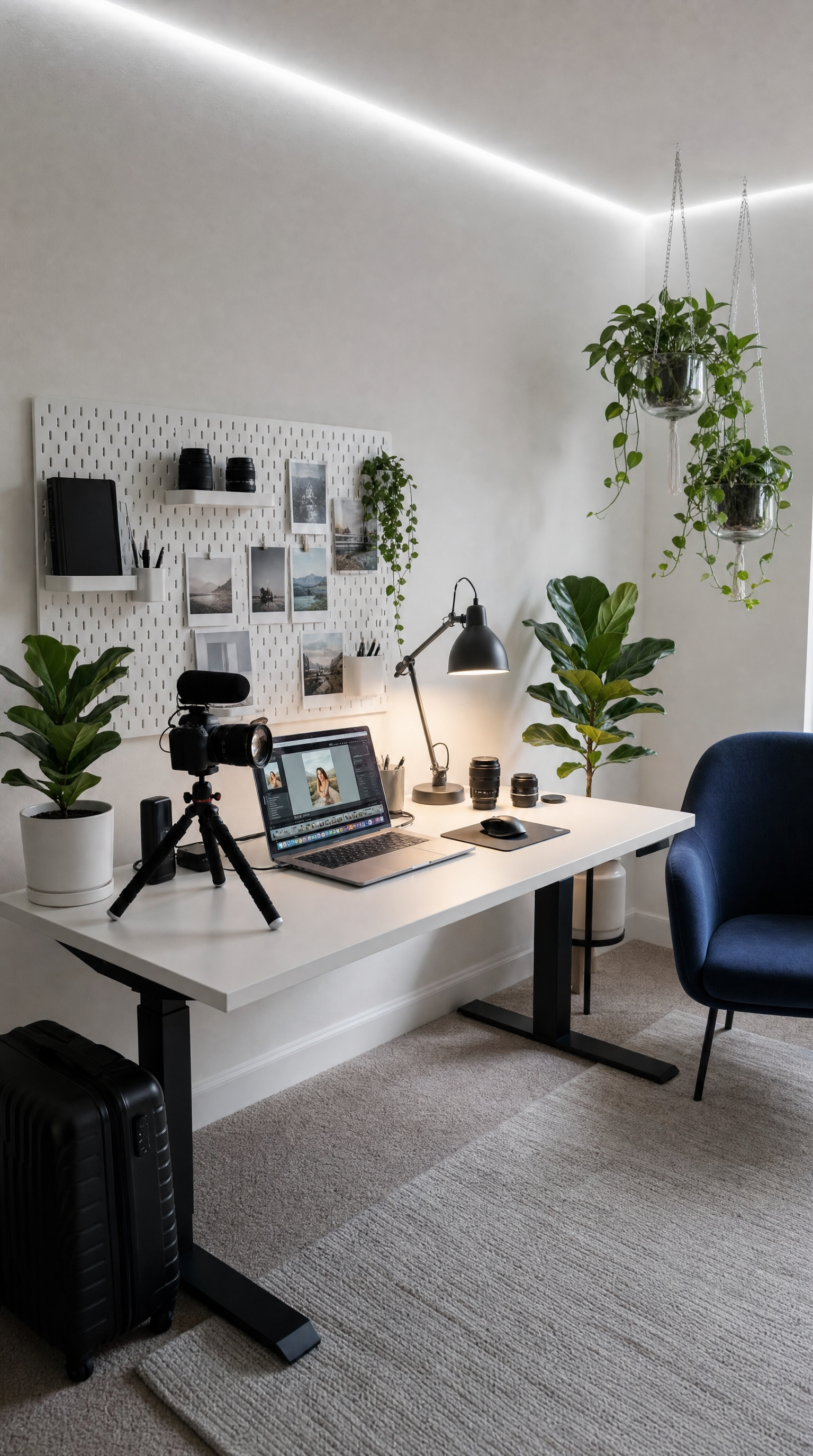
The phrase 'cool-toned LED strip lighting along the ceiling edge' is what produces the blue-gray cast dominating the image, not just 'soft cool lighting' on its own since that alone wouldn't specify the ceiling-edge placement that rims the room in that even glow. 'Trailing ivy in glass hanging planters' and 'sculptural ceramic planter' are the two load-bearing phrases behind the green accents breaking up the black-and-gray palette, giving the calm workspace a living, organic counterpoint. The wide framing implied by naming so many discrete objects in sequence, desk, monitor, camera stand, lens box, lamp, pegboard, rug, chair, forces the wide-shot composition since a tight crop couldn't fit all of them, which is also why the navy chair reads as a small background accent rather than a focal point. 'Matte black articulating lamp' and 'pegboard wall organizer with sketches and color swatches' are what keep the creative, working-studio identity intact rather than the shot drifting into generic showroom territory.
FAQ
→How do I make the camera and lenses the clear focal point instead of the whole room?
Move the camera gear language to the front of the prompt and add framing cues like 'close-up on mirrorless camera on compact stand, lenses in wooden box in foreground, blurred workspace behind.' Also change 'interior photography, modern composition' to 'macro photography, shallow depth of field' so the composition tightens instead of defaulting to a wide-shot.
→How do I shift the mood from calm and minimalist to warm and energetic?
Swap 'cool-toned LED strip lighting' for 'warm amber string lighting' and change 'light gray linen area rug' to 'terracotta patterned rug.' Also drop 'contemporary minimalist aesthetic' in favor of 'eclectic bohemian aesthetic' since that phrase is doing the work of keeping things sparse and clean right now.
→How do I turn this into a series with different room styles but the same layout?
Keep the object list (desk, monitor, camera stand, lens box, lamp, pegboard, planters, rug, chair) fixed and only rotate the style_modifiers and lighting phrases, for example swap 'cool color palette' and 'contemporary style' for 'warm color palette' and 'mid-century modern style' in one version, then 'industrial style' with 'exposed brick, black metal accents' in another. Changing just those two fields while leaving the subject list untouched gives you a consistent workspace with distinct moods.
Learn the technique behind this
- Why can't AI spell, and how do I get readable text in an image? — Older diffusion models had no character-level representation of text, so they produced letterform-shaped texture instead of words.
- How should a prompt be structured, and does word order matter? — A prompt that behaves predictably names one subject first, then what it is doing, then where, then the light, then the lens or medium, then the style.
- Do negative prompts work, and what should go in one? — Negative prompts work on models that support a separate negative conditioning channel — mainly Stable Diffusion and FLUX-family models.
Related prompts
Young woman with two cats
Blonde woman hugging beige pillow on off-white bed
Cozy Winter Living Room in Sage
Morning Tea at the Writing Desk