Why this works
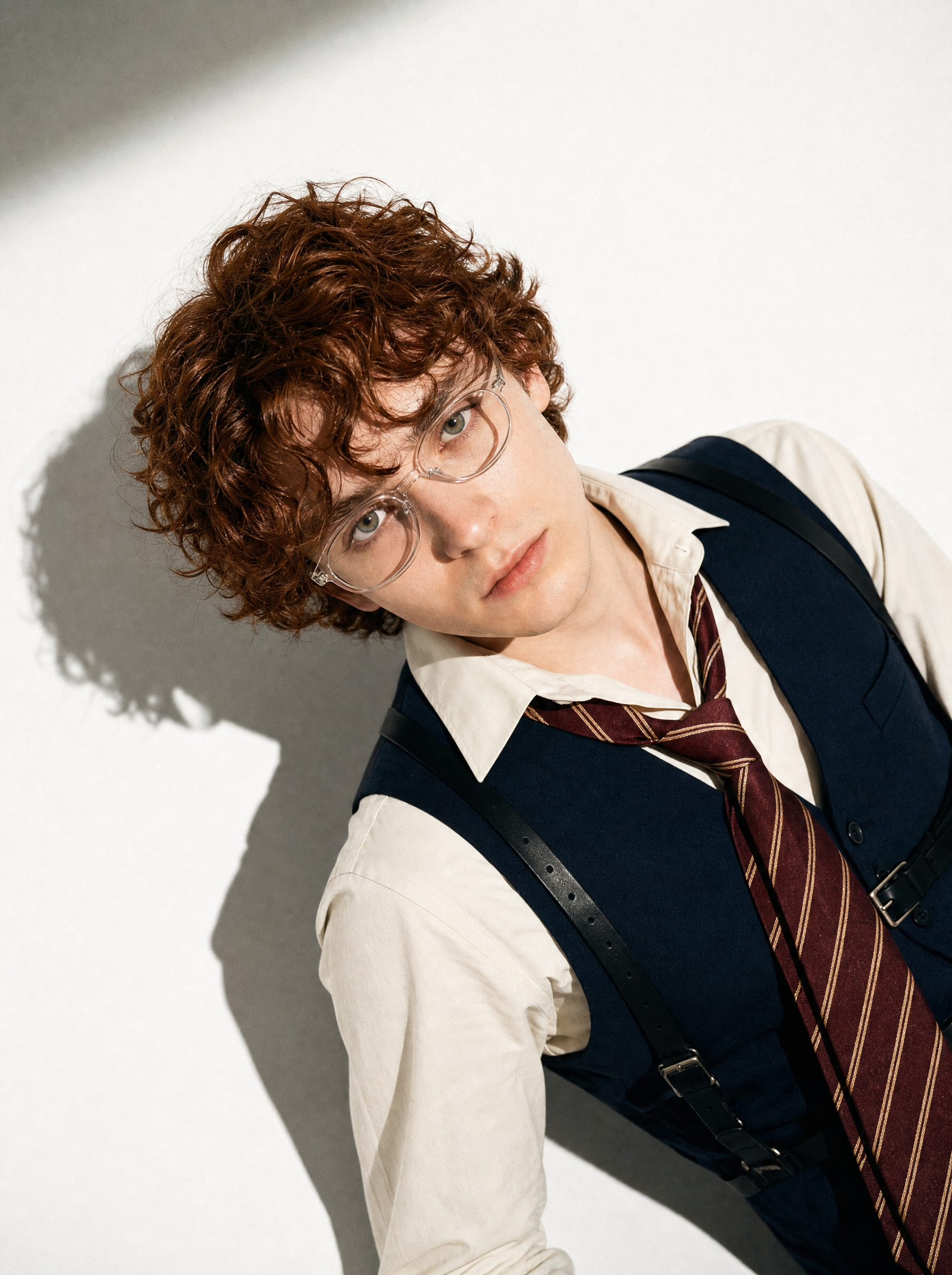
The “3/4 vertical editorial composition” and portrait-closeup framing keep the face, oval glasses, and layered collar central, while “sharp focus with shallow depth of field” separates him from the clean white wall. “Bright hard sunlight from the upper-right” supplies the crisp shadow silhouette, strong eye catchlights, and high-contrast structure; the cream shirt and white backdrop preserve brightness while “deep navy,” “burgundy,” and copper-brown curls anchor the image in a restrained warm-cool palette. “Calm neutral expression,” “hyper-realistic editorial fashion photography,” and “subtle film grain” temper the graphic sunlight with a controlled, slightly moody magazine feel.
FAQ
→How do I make the portrait feel darker and more mysterious?
Replace “Bright hard sunlight from the upper-right” with “single narrow beam of hard side light from the left, deep surrounding shadows,” and change “clean white wall backdrop” to “charcoal-gray plaster wall.” Replace “warm skin tones” with “cool desaturated skin tones” while keeping the burgundy tie as the main color accent.
→How do I make the harness and tie more visually central?
Replace “portrait-closeup” and “3/4 vertical editorial composition” with “mid-torso vertical fashion portrait, centered chest-level framing.” Change “slender black harness straps crossing the chest” to “bold geometric black harness straps prominently spanning the vest,” and replace “loosely worn” with “loosely knotted burgundy necktie positioned at the center of the chest.”
→How do I build a location-based variation without losing the same editorial identity?
Replace “clean white wall backdrop” with a specific setting such as “sunlit brutalist concrete corridor with pale geometric walls,” while retaining “bright hard sunlight from the upper-right” and “crisp shadow silhouette.” Keep “hyper-realistic editorial fashion photography,” “subtle film grain,” the navy vest, burgundy-and-gold tie, and clear oval glasses unchanged so the location changes without losing the subject’s visual signature.
Learn the technique behind this
- Why can't AI spell, and how do I get readable text in an image? — Older diffusion models had no character-level representation of text, so they produced letterform-shaped texture instead of words.
- Which aspect ratio should I use, and how does it change the image? — Aspect ratio determines what the model composes, not how it's cropped afterwards.
- How should a prompt be structured, and does word order matter? — A prompt that behaves predictably names one subject first, then what it is doing, then where, then the light, then the lens or medium, then the style.
Related prompts
Cobalt Boots in Sleek Studio Edit
Teal fashion editorial in monster-filled lift
Sunlit editorial on striped beach towel
Silhouette Influencer by Sunlit Window