Why this works
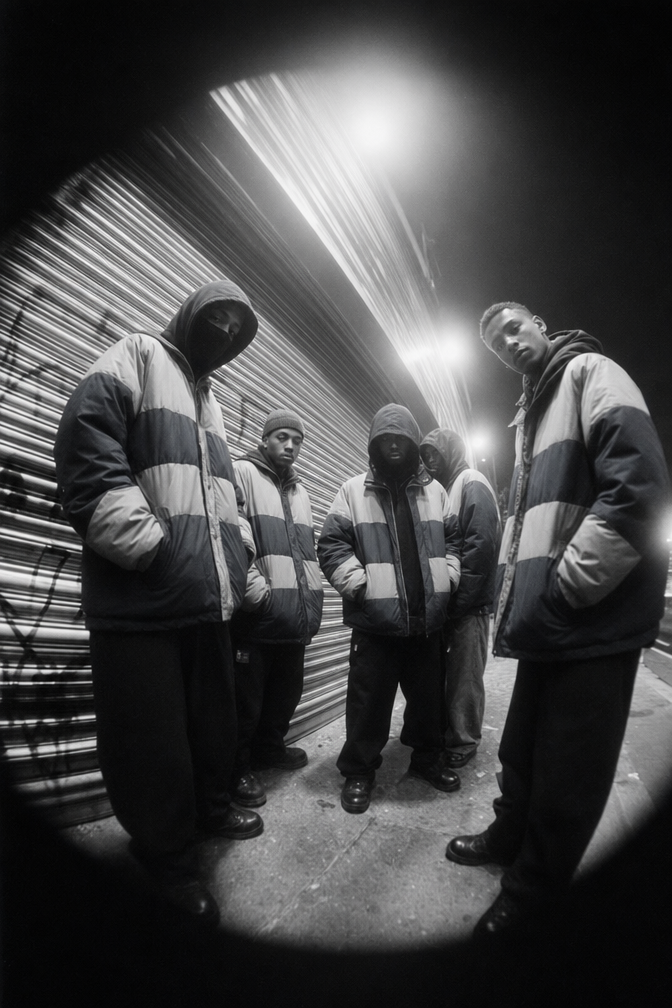
The tight group of “five young men” in a “low-angle wide shot” makes the figures feel imposing, while “slight barrel distortion” exaggerates the crowded street-level perspective. “Stark direct flash lighting with sharp shadows,” “faces mostly in shadow,” and “deep contrast” establish the raw, guarded mood more directly than the black-and-white palette alone. The “matte dark navy and icy white panels” provide restrained jacket separation, while “corrugated metal shutter,” “faint graffiti,” “heavy film grain,” and “vignetted edges” anchor the image in documentary street photography.
FAQ
→How do I make one man the clear focal point instead of keeping all five equally prominent?
Replace “five young men standing tightly together” with “four young men grouped behind one central figure,” and add “the central man slightly closer to camera, shoulders squared, face catching the edge of the flash.” Keep “low-angle wide shot” for scale, but change “faces mostly in shadow” to “only the central face partially illuminated.”
→How do I shift the image from raw and intimidating to a colder, more fashion-editorial mood?
Replace “gritty city street,” “raw, gritty, moody,” and “stark direct flash lighting with sharp shadows” with “clean industrial street,” “restrained, icy editorial mood,” and “hard controlled flash with crisp sculpted highlights.” Retain “matte dark navy and icy white panels,” but replace “heavy film grain” with “fine 35mm grain” to reduce the distressed documentary texture.
→How do I create a series of variations while preserving this group’s visual identity?
Keep the fixed phrases “five young men,” “oversized puffer jackets,” “matte dark navy and icy white panels,” “black-and-white 35mm documentary street photography,” and “low-angle wide shot.” For each variation, swap only “corrugated metal shutter backdrop with faint graffiti” for settings such as “rainy underpass with tiled walls,” “empty laundromat exterior,” or “concrete parking garage,” then vary “one man wearing a knit beanie” to “one man in a raised hood” or “one man wearing a white scarf.”
Learn the technique behind this
- Why can't AI spell, and how do I get readable text in an image? — Older diffusion models had no character-level representation of text, so they produced letterform-shaped texture instead of words.
- How should a prompt be structured, and does word order matter? — A prompt that behaves predictably names one subject first, then what it is doing, then where, then the light, then the lens or medium, then the style.
- Do negative prompts work, and what should go in one? — Negative prompts work on models that support a separate negative conditioning channel — mainly Stable Diffusion and FLUX-family models.
Related prompts
Cobalt Boots in Sleek Studio Edit
Teal fashion editorial in monster-filled lift
Sunlit editorial on striped beach towel
Silhouette Influencer by Sunlit Window