Why this works
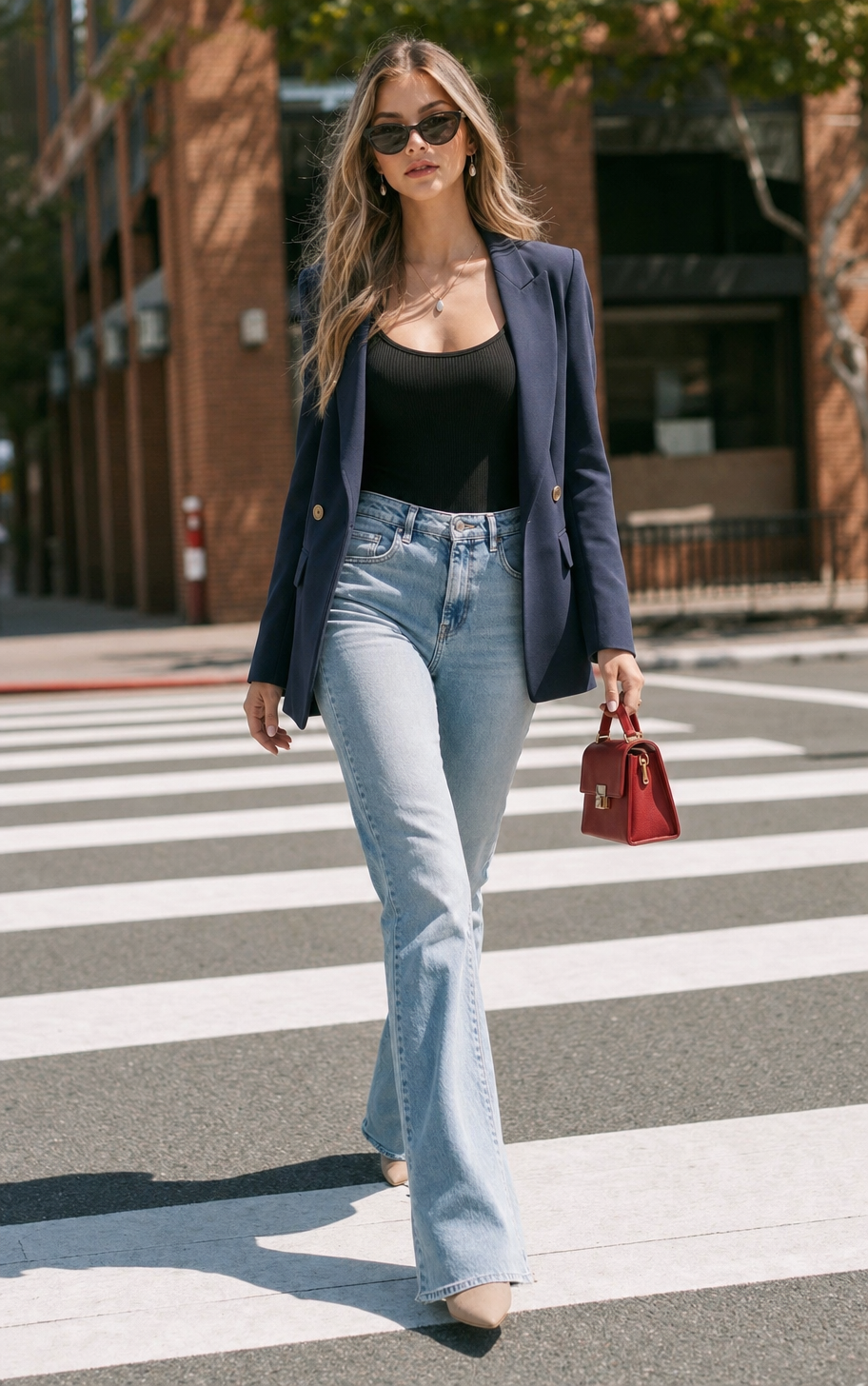
The phrase “full-body fashion photography” keeps the woman and her outfit fully legible, while “walking confidently across a city crosswalk” supplies a natural diagonal sense of movement instead of a static catalog pose. “Bright afternoon light” and “natural sunlight” explain the sunlit, slightly warm mood, while “shallow depth of field” separates the black, navy, and red outfit accents from the “urban brick building background.” The “small structured red handbag” acts as the sharpest color contrast against the dominant black, gray, and brown city palette, giving the full-body frame a controlled focal accent.
FAQ
→How do I make the handbag and accessories more visually prominent?
Replace “small structured red handbag” with “large structured crimson handbag held prominently at hip level,” and change “subtle drop earrings and a single delicate pendant” to “bold sculptural earrings and a layered statement necklace.” Add “accessories sharply in focus” after “shallow depth of field” so the styling details retain definition.
→How do I shift this from bright, confident street style to a moodier editorial look?
Replace “bright afternoon light” and “natural sunlight” with “overcast late-afternoon light with deep directional shadows,” and change “confident, chic, sunlit” to “introspective, dramatic, high-fashion.” Substituting “urban brick building background” with “wet city street and dark concrete architecture” will reinforce the cooler, more restrained tone.
→How do I create a series of variations without losing the same fashion identity?
Keep “fashionable woman,” “black ribbed bodysuit,” “dark-wash high-waisted jeans,” and “tailored navy blazer” fixed, then vary only the setting and action: use “walking past a glass office tower,” “pausing beside a subway entrance,” or “standing outside a brownstone doorway.” Keep “full-body fashion photography” and “shallow depth of field” unchanged so each image preserves the same portrait framing and editorial treatment.
Learn the technique behind this
- Why can't AI spell, and how do I get readable text in an image? — Older diffusion models had no character-level representation of text, so they produced letterform-shaped texture instead of words.
- Why does AI get hands and faces wrong, and how do I fix it? — Hands fail because they're small in frame, extremely variable in pose, and self-occluding — the model has less usable signal per pixel than for any other body part.
- Why does the model ignore parts of my prompt? — Ignored instructions are almost always conflicts, counts, or spatial relationships — three things current models handle badly — rather than the model failing to read you.
Related prompts
Cobalt Boots in Sleek Studio Edit

Teal fashion editorial in monster-filled lift
Sunlit editorial on striped beach towel
Silhouette Influencer by Sunlit Window