Why this works
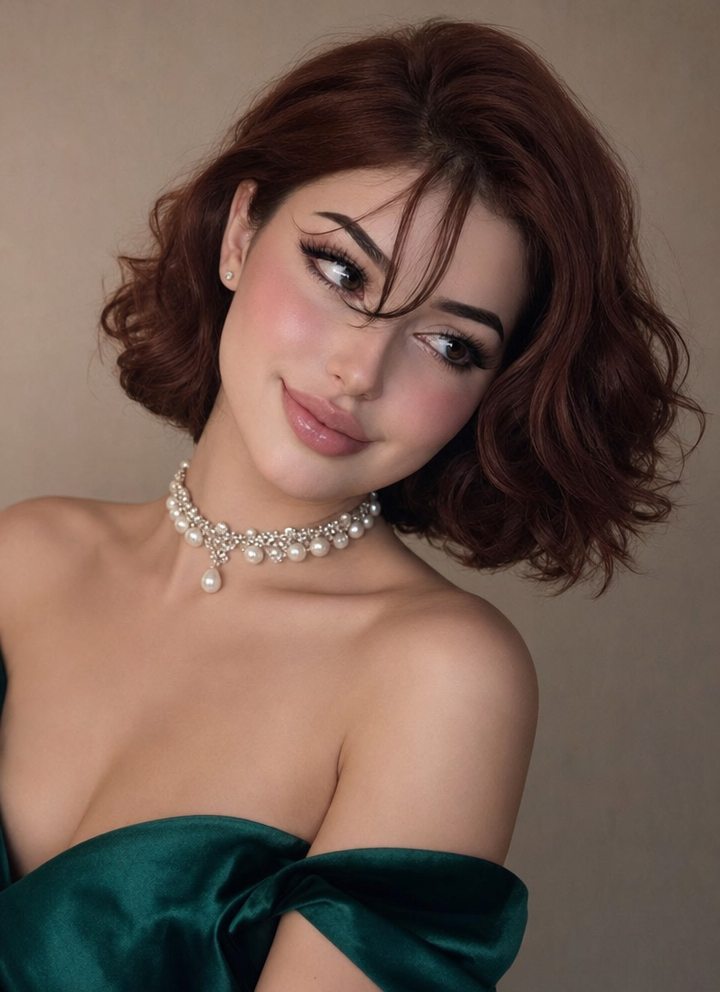
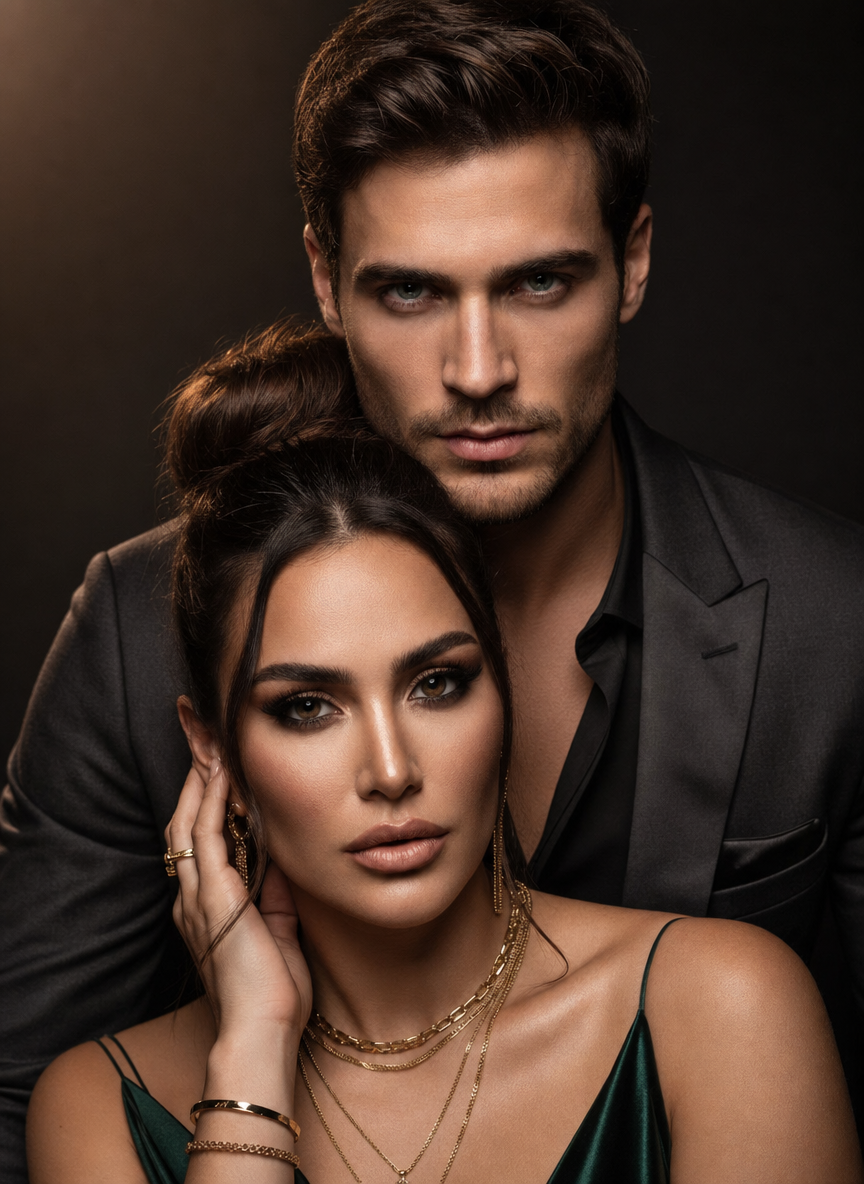
The intimate portrait framing and the instruction that the man stands “slightly to her left (still behind her)” create a layered, close composition rather than a symmetrical couple shot. “Dark background,” “charcoal outfits with satin accents,” and “deep emerald highlight” establish a controlled black-gray palette with a precise green focal accent, while “warmer, softer key light from upper-left” adds beige warmth to the skin and keeps the contrast cinematic. “Shallow depth of field” concentrates attention on the refined faces and the emerald dress detailing, supporting the “moody, intimate, luxurious” tone.
FAQ
→How do I make the woman more visually dominant in the portrait?
Replace “An elegant couple in a close studio portrait” with “the woman as the primary subject, occupying the foreground and center frame, with the man receding softly behind her.” Keep “the man stands slightly to her left (still behind her),” but add “his face partially turned away and less sharply focused” so the depth and gaze hierarchy favor her.
→How do I change the mood from moody luxury to a brighter, softer editorial look?
Replace “dark background” with “a softly lit warm ivory studio backdrop,” and change “warm, softer key light from upper-left” to “broad diffused daylight-style illumination from front-left with gentle fill.” Replace “high-contrast luxury portrait photography” with “low-contrast luminous fashion editorial photography” to reduce the black-gray density while retaining the tailored styling.
→How do I build a coordinated series of variations from this couple portrait?
Keep the fixed phrases “photorealistic fashion editorial studio portrait,” “tailored charcoal outfits with satin accents,” and “deep emerald highlight,” then swap “dark background” for specific studio sets such as “textured gray plaster wall,” “black velvet curtain,” or “brushed metallic panel.” Change “intimate framing” to “three-quarter fashion framing” or “full-length editorial framing” for each variation while preserving “warm cinematic lighting” so the series retains a consistent visual identity.
Learn the technique behind this
- Why can't AI spell, and how do I get readable text in an image? — Older diffusion models had no character-level representation of text, so they produced letterform-shaped texture instead of words.
- How should a prompt be structured, and does word order matter? — A prompt that behaves predictably names one subject first, then what it is doing, then where, then the light, then the lens or medium, then the style.
- Why does the model ignore parts of my prompt? — Ignored instructions are almost always conflicts, counts, or spatial relationships — three things current models handle badly — rather than the model failing to read you.
Related prompts

Teal fashion editorial in monster-filled lift
Cobalt Boots in Sleek Studio Edit
Silhouette Influencer by Sunlit Window

Sunlit editorial on striped beach towel