Why this works
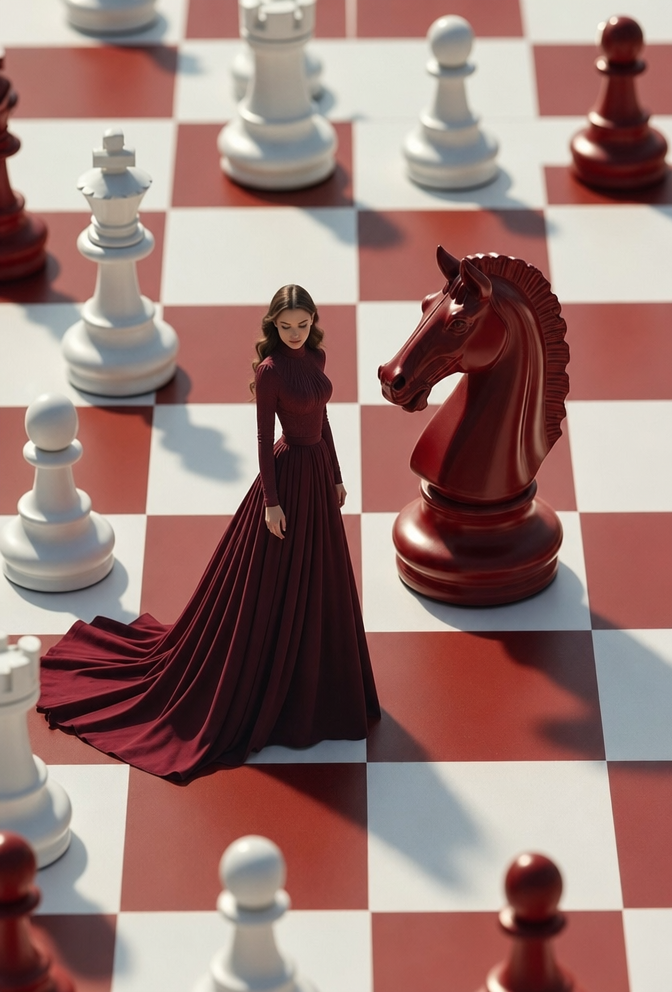
The phrase “giant red-and-white chessboard” plus “oversized chess pieces filling the immediate surroundings” creates the surreal sense of scale, while “full-body view with cinematic depth” preserves the woman as a readable central figure in the wide composition. “Deep burgundy gown,” “red-and-white” geometry, and dominant crimson tones establish a controlled red harmony, and “soft directional lighting with crisp highlights” gives the satin train and glossy pieces distinct edges. “Dramatic, elegant composition,” “cinematic contrast,” and “clean studio-like background” keep the image polished rather than chaotic, with “high detail micro-texture” carrying the couture and reflective-surface realism.
FAQ
→How do I make the woman more central and visually dominant?
Replace “framed by oversized chess pieces” with “chess pieces receding toward the edges, leaving clear space around the woman,” and change “wide-shot” to “centered full-body portrait, medium-wide framing.” Add “the woman occupies the central vertical axis and is the primary focal point” to reinforce her hierarchy.
→How do I change the dramatic mood into something softer and more romantic?
Replace “dramatic, elegant composition” and “cinematic contrast” with “soft romantic fashion editorial composition” and “low-contrast pastel atmosphere.” Change “soft directional lighting with crisp highlights” to “diffused pearlescent light with gentle wraparound shadows,” and replace the red-and-white board with “blush-pink and ivory chessboard” for a lighter palette.
→How do I build a series of variations while keeping the same editorial concept?
Keep “photorealistic surreal luxury fashion editorial,” “deep burgundy gown,” and “high-detail micro-texture” fixed, then swap “giant red-and-white chessboard” for settings such as “an oversized black-and-ivory chessboard in a marble gallery,” “a floating chessboard above a crimson cloudscape,” or “a giant chessboard in a moonlit conservatory.” Preserve “full-body view with cinematic depth” so the subject remains consistent across the series.
Learn the technique behind this
- Why can't AI spell, and how do I get readable text in an image? — Older diffusion models had no character-level representation of text, so they produced letterform-shaped texture instead of words.
- How should a prompt be structured, and does word order matter? — A prompt that behaves predictably names one subject first, then what it is doing, then where, then the light, then the lens or medium, then the style.
- Do negative prompts work, and what should go in one? — Negative prompts work on models that support a separate negative conditioning channel — mainly Stable Diffusion and FLUX-family models.
Related prompts
Cobalt Boots in Sleek Studio Edit
Teal fashion editorial in monster-filled lift

Sunlit editorial on striped beach towel
Silhouette Influencer by Sunlit Window