Why this works
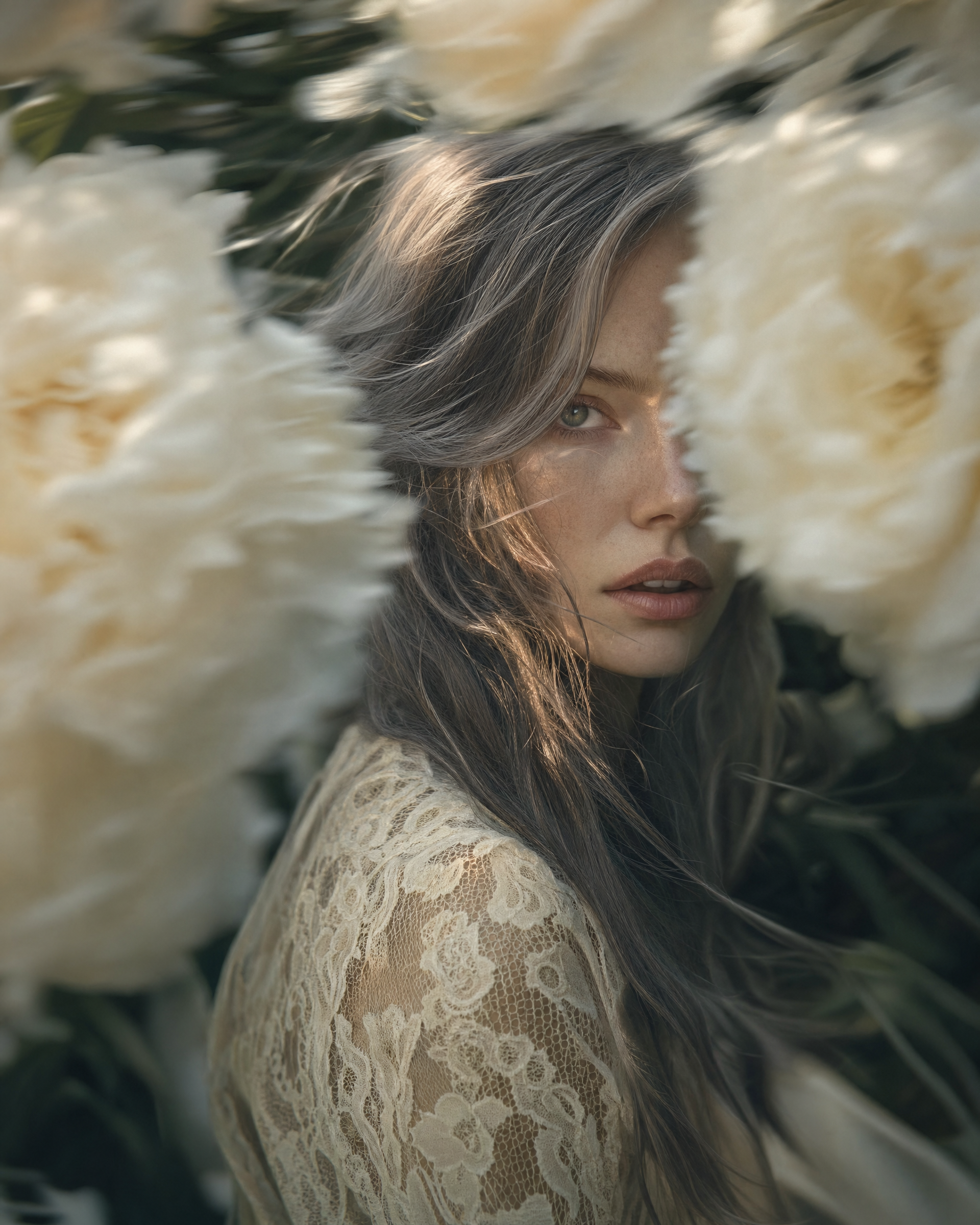
The close-up framing comes from “Dreamy close-up” and “large white peonies” partially covering the face, making the portrait feel intimate while keeping the subject slightly mysterious. “Soft blurred motion,” “shallow depth of field,” and “surreal atmospheric composition” soften the edges around the sharply described “highly detailed skin and hair,” while “muted sage green and cream palette” explains the image’s restrained green-gray harmony. “Cinematic late-afternoon natural light” paired with “fashion editorial lighting” supplies the pale, polished glow that separates the silver-tinted hair and cream lace from the softer background.
FAQ
→How do I make the woman’s face more central and prominent?
Replace “partially obscured by large white peonies” with “one small white peony near her shoulder, face fully visible,” and replace “Dreamy close-up” with “centered head-and-shoulders portrait, direct eye contact.” Keep “shallow depth of field” so the background remains quiet while the face takes priority.
→How do I shift this from dreamy and mysterious to warm and romantic?
Replace “soft blurred motion” and “surreal atmospheric composition” with “gentle romantic softness, clear facial contours,” and change “muted sage green and cream palette” to “warm ivory, blush pink, and honey-gold palette.” Swap “cinematic late-afternoon natural light” for “soft golden-hour window light” to add warmth without losing the editorial finish.
→How do I create a coordinated series with different flowers and settings?
Keep the fixed visual anchors “photorealistic fashion editorial portrait,” “shallow depth of field,” “highly detailed skin and hair,” and “cream lace dress,” then replace “large white peonies” and the “surreal atmospheric composition” with pairs such as “lavender branches in a misty greenhouse,” “red poppies in a sunlit field,” or “white lilies beside a rain-streaked window.” Match each flower with a new palette while preserving the close-up framing and late-afternoon light.
Learn the technique behind this
- Why can't AI spell, and how do I get readable text in an image? — Older diffusion models had no character-level representation of text, so they produced letterform-shaped texture instead of words.
- How should a prompt be structured, and does word order matter? — A prompt that behaves predictably names one subject first, then what it is doing, then where, then the light, then the lens or medium, then the style.
- Which aspect ratio should I use, and how does it change the image? — Aspect ratio determines what the model composes, not how it's cropped afterwards.
Related prompts
Teal fashion editorial in monster-filled lift
Cobalt Boots in Sleek Studio Edit
Silhouette Influencer by Sunlit Window
Sunlit editorial on striped beach towel