Why this works
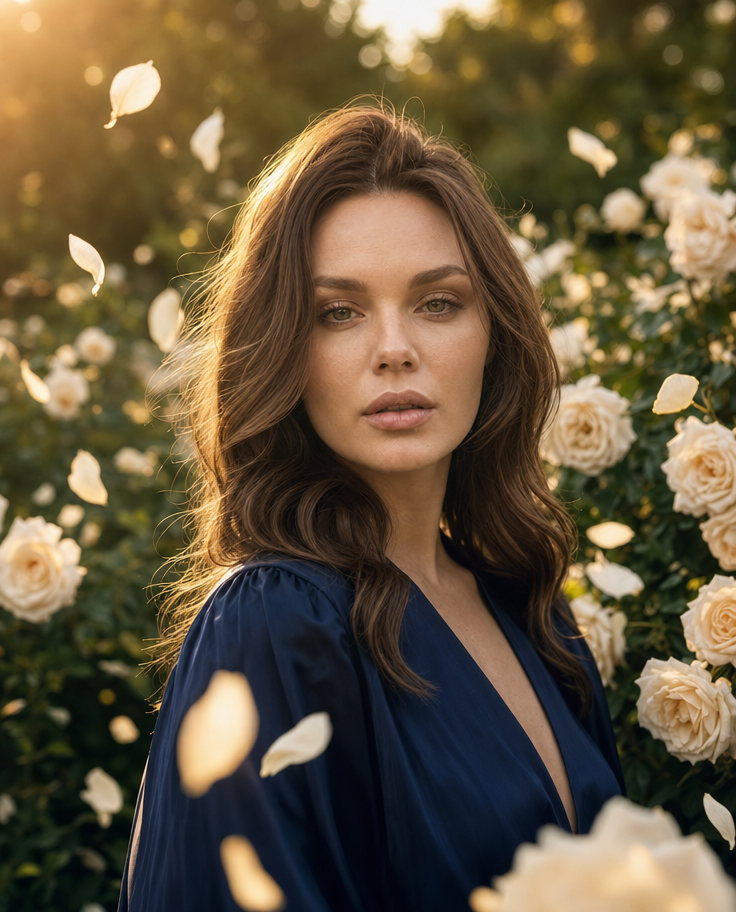
The close portrait framing is carried by “luxury fashion editorial portrait,” the standing woman as the sole subject, and the “85mm lens, f/1.8” combination, which keeps her face and satin dress dominant while pushing the cream roses into “creamy bokeh.” The palette holds together because “deep navy satin dress,” “blooming cream roses,” and “golden-hour sunlight with soft warm haze” establish a blue, white, beige, and gold harmony. “A few rose petals drifting past her in the air,” “subtle film grain,” and “romantic wistful mood” add the requested ethereal melancholy without competing with her expression.
FAQ
→How do I change this prompt to make the portrait feel darker and more melancholic?
Replace “golden-hour sunlight with soft warm haze” with “cool overcast twilight with muted blue-gray shadows,” and replace “romantic wistful mood” with “somber, introspective mood.” Keep “deep navy satin dress” and “subtle film grain” to preserve the editorial character while reducing the warm gold.
→How do I make the cream roses and drifting petals more central than the woman?
Replace “portrait-closeup” and “85mm lens, f/1.8” with “waist-up environmental portrait, 50mm lens, f/2.8,” then change “a few rose petals drifting past her in the air” to “a dense cascade of rose petals surrounding her face and shoulders.” Replace “creamy bokeh” with “layered, detailed roses in the foreground and background” so the garden reads clearly.
→How do I build a matching series with different dress colors and seasons?
Keep “Photorealistic luxury fashion editorial portrait,” “85mm lens, f/1.8,” “shallow depth of field,” and “subtle film grain” unchanged as the visual anchors. Swap “deep navy satin dress” for “burgundy velvet gown,” “ivory silk dress,” or “emerald satin dress,” and replace “blooming cream roses” plus “golden-hour sunlight with soft warm haze” with pairings such as “autumn copper foliage with low amber sunlight” or “spring white blossoms with pale morning haze.”
Learn the technique behind this
- Why can't AI spell, and how do I get readable text in an image? — Older diffusion models had no character-level representation of text, so they produced letterform-shaped texture instead of words.
- Which camera and lighting terms actually change an AI image? — Focal length, aperture, light direction and time of day change the image reliably because they correlate with real photographic patterns in the training data.
- Why does AI get hands and faces wrong, and how do I fix it? — Hands fail because they're small in frame, extremely variable in pose, and self-occluding — the model has less usable signal per pixel than for any other body part.
Related prompts

Teal fashion editorial in monster-filled lift
Cobalt Boots in Sleek Studio Edit
Sunlit editorial on striped beach towel
Silhouette Influencer by Sunlit Window