Why this works
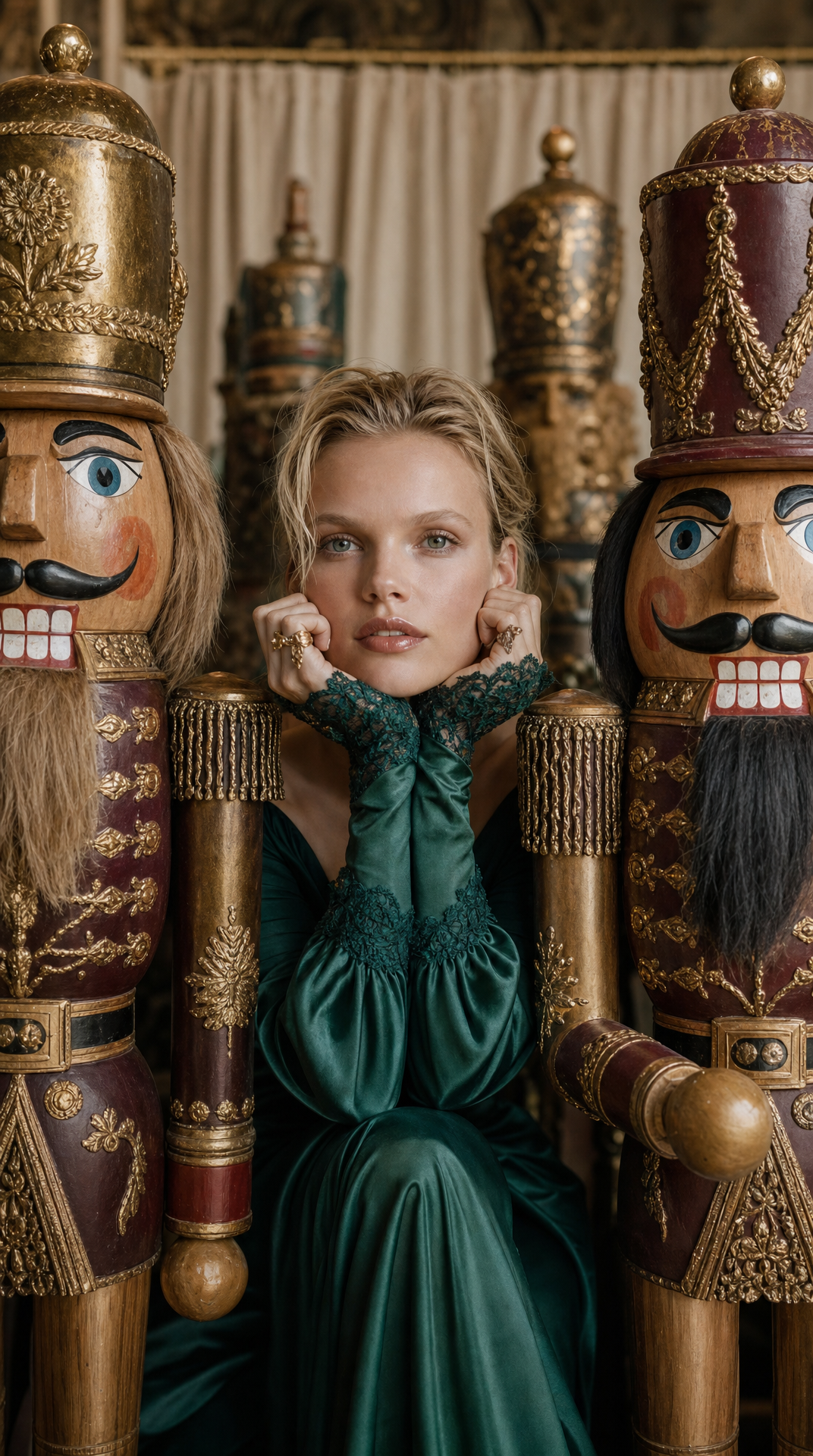
The phrase “posed between two oversized nutcracker soldiers” supplies a strong symmetrical frame, while “hands resting near her cheeks” keeps the woman as the expressive focal point within it. “Deep emerald satin,” “gold and burgundy uniforms,” and “pale beige draped curtain” create a controlled luxury palette, with the generated image’s gold, green, and dark accents reinforcing the festive contrast. “Soft natural studio lighting” preserves the satin sheen and carved-wood detail without overpowering the “shallow depth of field,” and “Vogue-style editorial composition” turns the whimsical setup into a polished portrait-full-body fashion image.
FAQ
→How do I make the woman more visually dominant than the nutcrackers?
Replace “between two oversized nutcracker soldiers” with “standing in the foreground, with two slightly smaller nutcracker soldiers placed behind her,” and add “her face and emerald satin dress in sharp focus, soldiers softly receding.” Keep “hands resting near her cheeks” if you want the same recognizable pose.
→How do I change the image from luxurious and elegant to darker and more dramatic?
Replace “Soft natural studio lighting” with “dramatic low-key lighting with a narrow warm spotlight,” and change “pale beige draped curtain backdrop” to “deep charcoal velvet curtain backdrop.” For a stronger tonal shift, replace “glossy nude lip color” with “deep burgundy lip color” while retaining “gold and burgundy uniforms.”
→How do I build a coordinated series of variations from this prompt?
Keep “photorealistic editorial fashion photograph,” “Vogue-style editorial composition,” “portrait-full-body,” and the “two oversized nutcracker soldiers” framing unchanged. Create separate versions by replacing only “deep emerald satin dress” with colors such as “ruby red velvet gown,” “midnight blue silk dress,” or “champagne satin dress,” then swap “pale beige draped curtain backdrop” for matching settings such as “dusty rose drapes” or “deep green velvet curtains.”
Learn the technique behind this
- Why does AI get hands and faces wrong, and how do I fix it? — Hands fail because they're small in frame, extremely variable in pose, and self-occluding — the model has less usable signal per pixel than for any other body part.
- Why can't AI spell, and how do I get readable text in an image? — Older diffusion models had no character-level representation of text, so they produced letterform-shaped texture instead of words.
- How do I keep the same character across multiple images? — Text prompts alone won't hold a face across images — a description defines a type, not a person.
Related prompts
Cobalt Boots in Sleek Studio Edit
Teal fashion editorial in monster-filled lift
Sunlit editorial on striped beach towel
Silhouette Influencer by Sunlit Window