Why this works
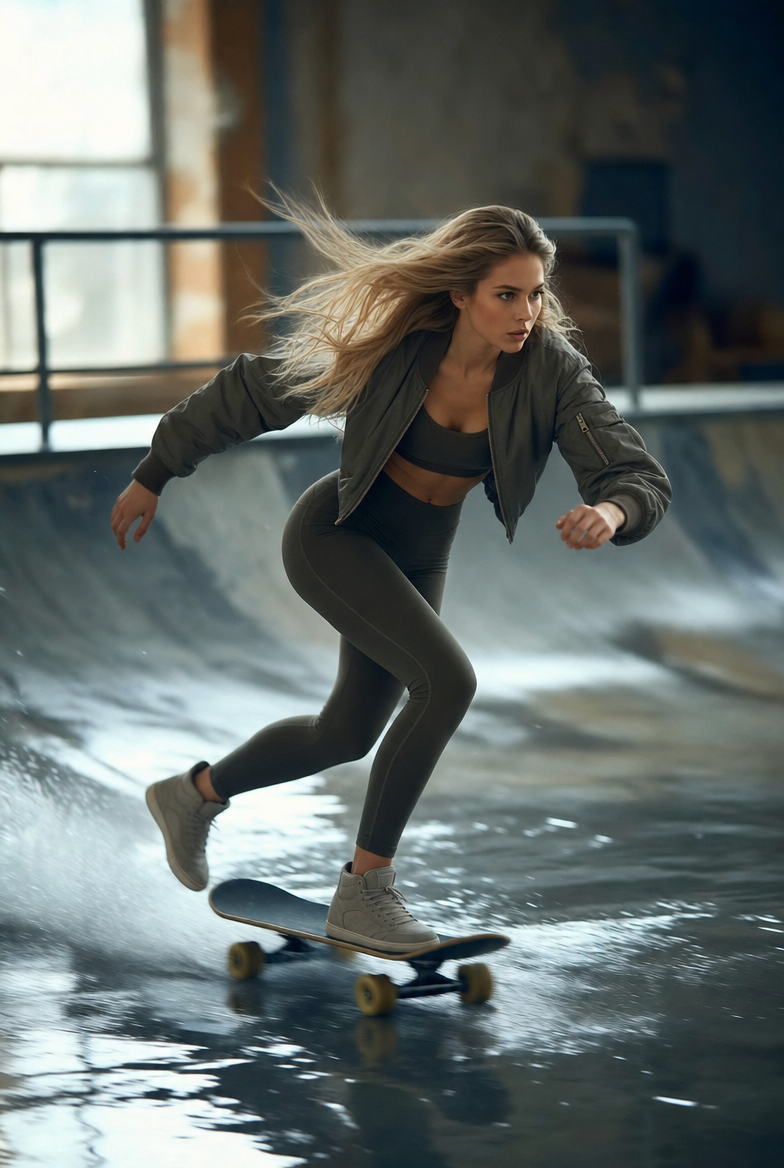
The phrase “mid-motion run-up pose” combined with “dynamic action shot” gives the image its candid-action composition, while the industrial skatepark’s “steel beams and concrete textures” supplies the edgy, architectural setting. “Cinematic late-afternoon warm light” adds slightly golden highlights against the dominant black-and-white wardrobe and surfaces, creating contrast without overwhelming the monochrome palette. “Shallow depth of field” keeps attention on the skateboarder, while “crisp reflections on the wet floor” extends the motion through the glossy ramp and foreground.
FAQ
→How do I make the skateboarder more central and visually dominant?
Replace “mid-motion run-up framing” with “tight low-angle hero framing centered on the skateboarder,” and change “shallow depth of field” to “very shallow depth of field with the face and front foot in sharp focus.” Keep “dynamic action shot” to preserve movement while reducing background competition.
→How do I change the edgy cinematic mood into a darker, more dramatic scene?
Replace “cinematic late-afternoon warm light” with “hard overhead industrial lighting with deep shadows and narrow highlights,” and change “slightly golden” to “cool steel-blue tones.” Retain “steel beams and concrete textures” and “black, white” styling so the darker mood remains grounded in the existing skatepark palette.
→How do I build a series of variations from this prompt without losing its identity?
Keep “photorealistic editorial fashion photography,” “dynamic action shot,” and “crisp reflections on the wet floor” unchanged, then swap the setting phrase “industrial skatepark interior” for variations such as “underground concrete bowl,” “sunlit warehouse skatepark,” or “neon-lit indoor ramp.” Vary the pose phrase “mid-motion run-up pose” with “airborne kickflip,” “low carving turn,” or “landing after a jump” to create distinct action frames.
Learn the technique behind this
- Why can't AI spell, and how do I get readable text in an image? — Older diffusion models had no character-level representation of text, so they produced letterform-shaped texture instead of words.
- How should a prompt be structured, and does word order matter? — A prompt that behaves predictably names one subject first, then what it is doing, then where, then the light, then the lens or medium, then the style.
- Do negative prompts work, and what should go in one? — Negative prompts work on models that support a separate negative conditioning channel — mainly Stable Diffusion and FLUX-family models.
Related prompts
Cobalt Boots in Sleek Studio Edit
Teal fashion editorial in monster-filled lift

Sunlit editorial on striped beach towel
Silhouette Influencer by Sunlit Window