Why this works
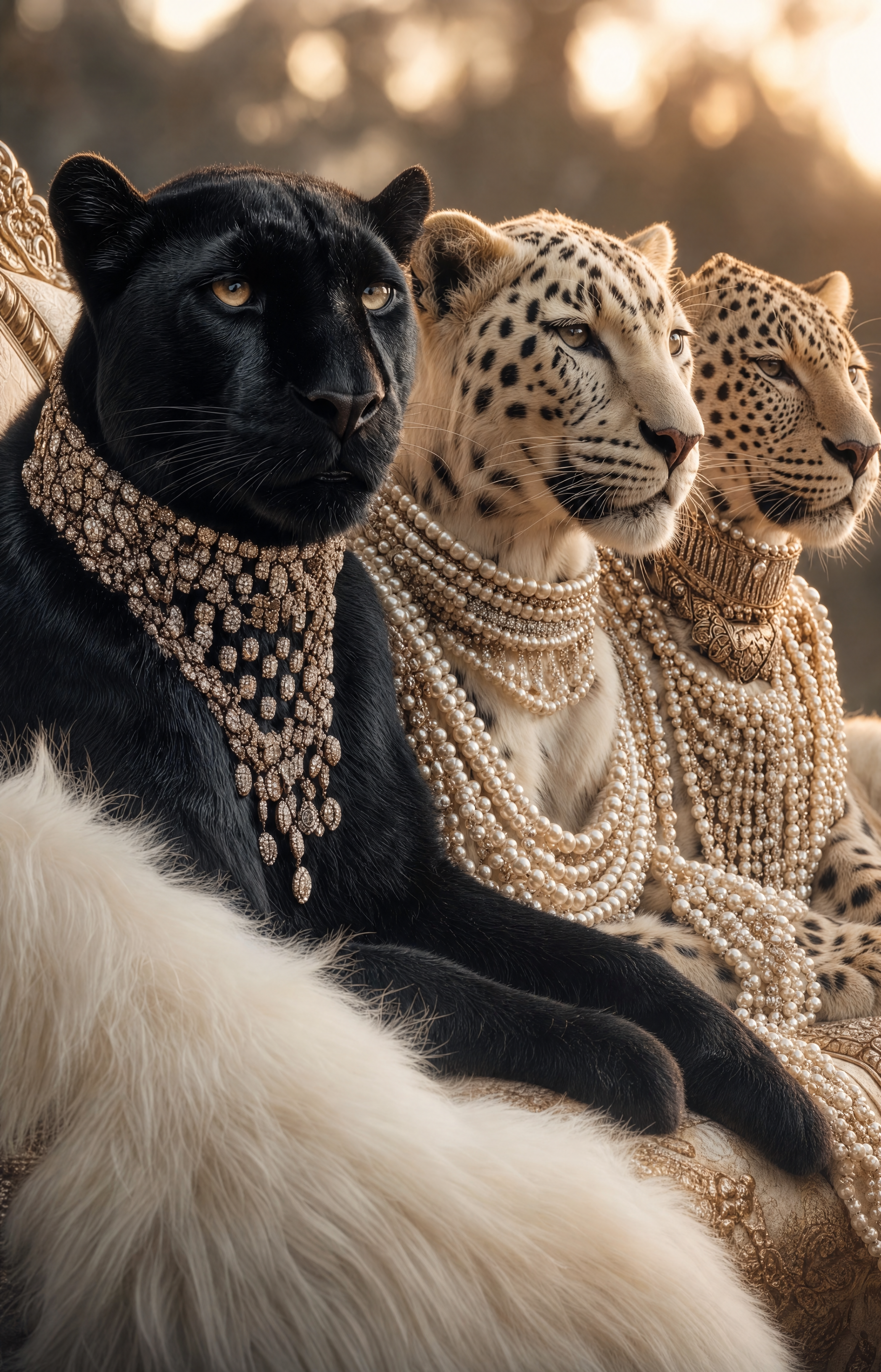
The phrase “black panther in the foreground and two cream-colored leopards behind” establishes a layered portrait-closeup, making the panther the visual anchor while the paired leopards create symmetry and depth. “Soft white fur surface” and “warm, golden hour bokeh backdrop” supply the white, brown, and gold-brown color field, while “pearl-and-diamond necklaces” and “ornate jeweled collars” add sharp reflective accents against the dark fur. “Soft, luminous lighting,” “hyper-detailed fur and jewelry,” and “shallow depth of field” combine to keep the image dreamy yet tactile, with focus concentrated on the forward cat and its accessories.
FAQ
→How do I make one leopard more central and prominent?
Replace “two cream-colored leopards behind” with “one cream-colored leopard seated prominently beside the panther, slightly forward and turned toward camera,” and change “the panther the visual anchor” implied by “in the foreground” to “the panther and leopard share equal foreground prominence.” Keep “portrait-closeup” and “shallow depth of field” to preserve the tight editorial composition.
→How do I shift the image from dreamy luxury to a darker, more dramatic mood?
Replace “warm, golden hour bokeh backdrop” with “deep charcoal studio backdrop with subtle burgundy highlights,” and replace “soft, luminous lighting” with “directional chiaroscuro lighting with controlled specular highlights.” Retain “hyper-detailed fur and jewelry,” but change “opulent, elegant, dreamy mood” to “dark, theatrical haute couture mood.”
→How do I build a series with different big-cat subjects while keeping this visual identity?
Keep the fixed phrases “soft white fur surface,” “photorealistic surreal high-fashion editorial,” “pearl-and-diamond necklaces,” “ornate jeweled collars,” “shallow depth of field,” and “portrait-closeup.” Swap “a sable-black panther in the foreground and two cream-colored leopards behind” for variants such as “a white tiger in the foreground and two melanistic jaguars behind” or “a golden lioness beside two snow leopards,” while preserving “warm, golden hour bokeh backdrop” and “soft, luminous lighting” for consistent color and mood.
Learn the technique behind this
- Why does the model ignore parts of my prompt? — Ignored instructions are almost always conflicts, counts, or spatial relationships — three things current models handle badly — rather than the model failing to read you.
- Why can't AI spell, and how do I get readable text in an image? — Older diffusion models had no character-level representation of text, so they produced letterform-shaped texture instead of words.
- Which camera and lighting terms actually change an AI image? — Focal length, aperture, light direction and time of day change the image reliably because they correlate with real photographic patterns in the training data.
Related prompts

Teal fashion editorial in monster-filled lift
Cobalt Boots in Sleek Studio Edit
Silhouette Influencer by Sunlit Window

Sunlit editorial on striped beach towel