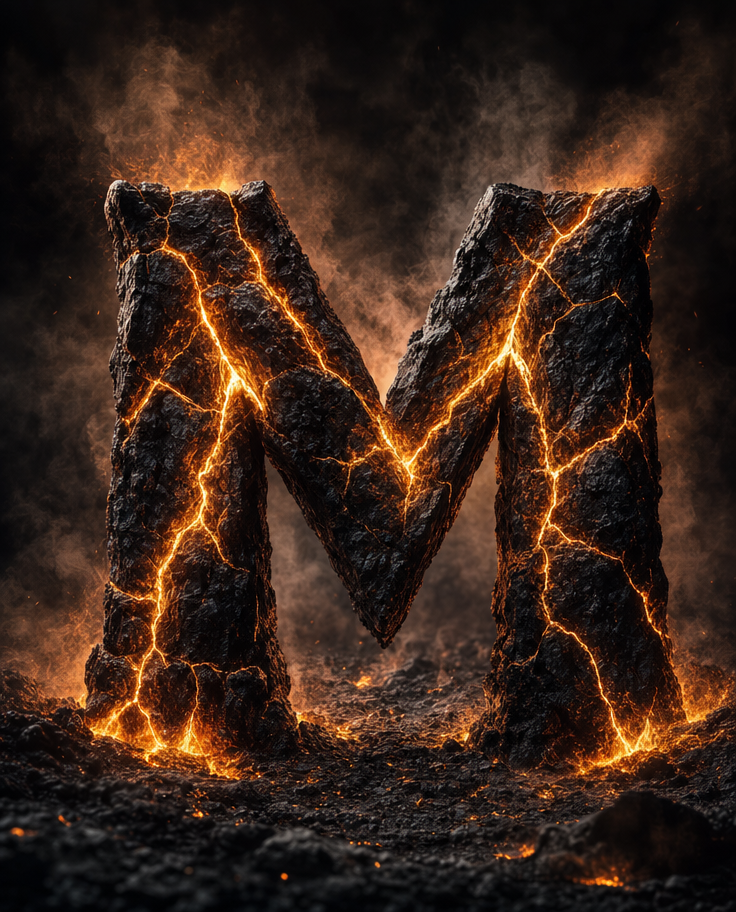
Why this works
The centered, tight front-facing composition makes the basalt “capital letter M” immediately legible, while “sharp micro-textures on the basalt” supplies convincing close-up detail. “Bright amber-orange magma streams” against the “dark background” creates a strong orange-and-black color contrast, and “cinematic high-contrast poster lighting” with a “warmer rim light from the side” gives the centered form a fiery, intense outline. “Smoky volcanic atmosphere with drifting ash particles” and “subtle heat-haze distortion over the letter edges” add depth without competing with the M’s silhouette.
FAQ
→How do I make the lava-filled M feel more ominous and less brightly lit?
Replace “Bright amber-orange magma streams” with “deep crimson-red lava glow with sparse ember highlights,” and change “cinematic high-contrast poster lighting” to “low-key horror lighting with narrow pools of illumination.” Keep “dark background” and “dramatic shadows” to preserve the threatening tone.
→How do I make the letter M fill more of the image and feel monumental?
Replace “Tight, front-facing composition” with “extreme close-up, the letter M filling 90 percent of the frame,” and add “slight low-angle perspective with converging basalt edges.” Retain “crisp detail and strong contrast,” but reduce “drifting ash particles” so the enlarged silhouette remains unobstructed.
→How do I build a matching series using other volcanic letters?
Replace “a capital letter M” with a variable such as “a capital letter [A],” while keeping “formed from jagged dark basalt with glowing molten lava veins” unchanged. Use the same “centered, front-facing composition,” “warmer rim light from the side,” and “dark volcanic backdrop” for every letter, then vary only the letter and its fissure pattern.
Learn the technique behind this
- Why can't AI spell, and how do I get readable text in an image? — Older diffusion models had no character-level representation of text, so they produced letterform-shaped texture instead of words.
- How should a prompt be structured, and does word order matter? — A prompt that behaves predictably names one subject first, then what it is doing, then where, then the light, then the lens or medium, then the style.
- Why does the model ignore parts of my prompt? — Ignored instructions are almost always conflicts, counts, or spatial relationships — three things current models handle badly — rather than the model failing to read you.
Related prompts
Open-Frame Futuristic PC With Blue LEDs

Magenta-Cyan Hands Nearly Touch

Magenta-Cyan Holographic Control Room

Blue holographic cube on server room pedestal