Why this works
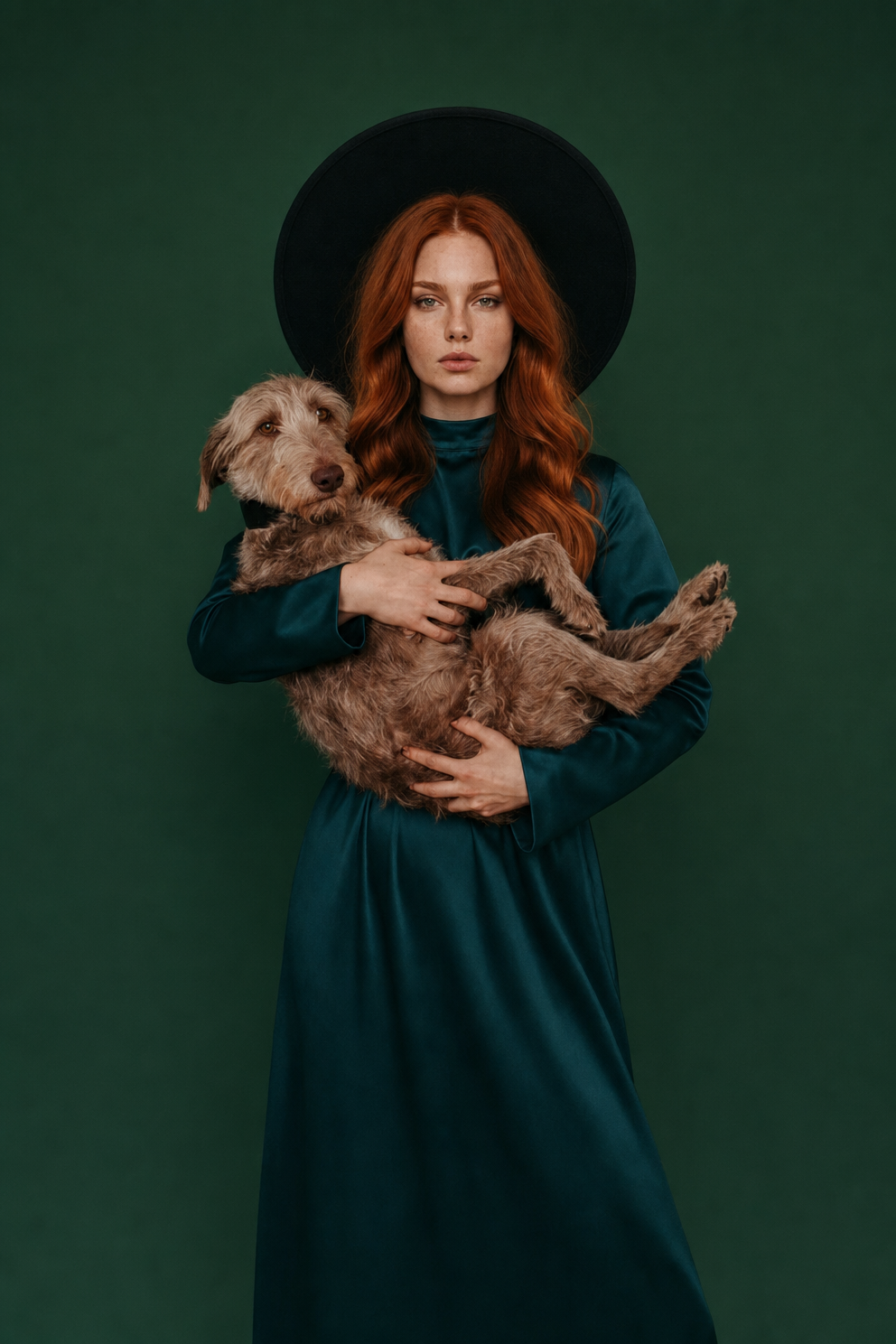
“Centered,” “waist-up framing,” and “direct eye contact” create a controlled, front-facing editorial structure, while the dog held “horizontally across her chest” adds a strong horizontal counterline. The “deep teal satin dress,” “rich emerald-green backdrop,” black felt hat, and the dog’s brown scruffy coat establish a tight teal, green, brown, and black palette; “bold color contrast” makes the subject and dog read clearly against the backdrop. “Clean studio lighting,” “sharp focus,” and “photorealistic detail” keep the fashion portrait precise, while the “slightly surreal minimal editorial feel” comes from the unusual hat placement and the centered human-and-dog arrangement.
FAQ
→How do I make the dog more prominent than the woman’s outfit?
Replace “holding a scruffy medium-sized dog horizontally across her chest” with “the scruffy medium-sized dog filling the foreground, its face near the camera and centered beside her face.” Change “waist-up framing” to “tight chest-up framing that prioritizes the dog’s head and upper body,” while keeping “direct eye contact” for the woman.
→How do I shift this from elegant studio minimalism to a darker, more dramatic mood?
Replace “clean studio lighting” with “low-key directional lighting from one side, deep shadows, and a narrow rim light,” and change “rich emerald-green backdrop” to “deep forest-green backdrop with subtle falloff.” Replace “sleek, elegant silhouette” with “sculptural, severe silhouette,” while retaining the black felt hat and deep teal satin dress.
→How do I build a matching series with different subjects or settings?
Keep the structural phrases “centered,” “direct eye contact,” “waist-up framing,” “clean studio,” and “bold color contrast,” then replace the subject phrase with another pairing such as “a woman holding a white rabbit across her chest” or “a man holding a vintage camera at sternum height.” For a location variation, replace “clean studio” and “rich emerald-green backdrop” with “brutalist concrete interior with a single saturated color wall,” while preserving the same camera and lighting language.
Learn the technique behind this
- Why does AI get hands and faces wrong, and how do I fix it? — Hands fail because they're small in frame, extremely variable in pose, and self-occluding — the model has less usable signal per pixel than for any other body part.
- Why can't AI spell, and how do I get readable text in an image? — Older diffusion models had no character-level representation of text, so they produced letterform-shaped texture instead of words.
- Do negative prompts work, and what should go in one? — Negative prompts work on models that support a separate negative conditioning channel — mainly Stable Diffusion and FLUX-family models.
Related prompts
Cobalt Boots in Sleek Studio Edit

Teal fashion editorial in monster-filled lift
Sunlit editorial on striped beach towel
Silhouette Influencer by Sunlit Window