Why this works
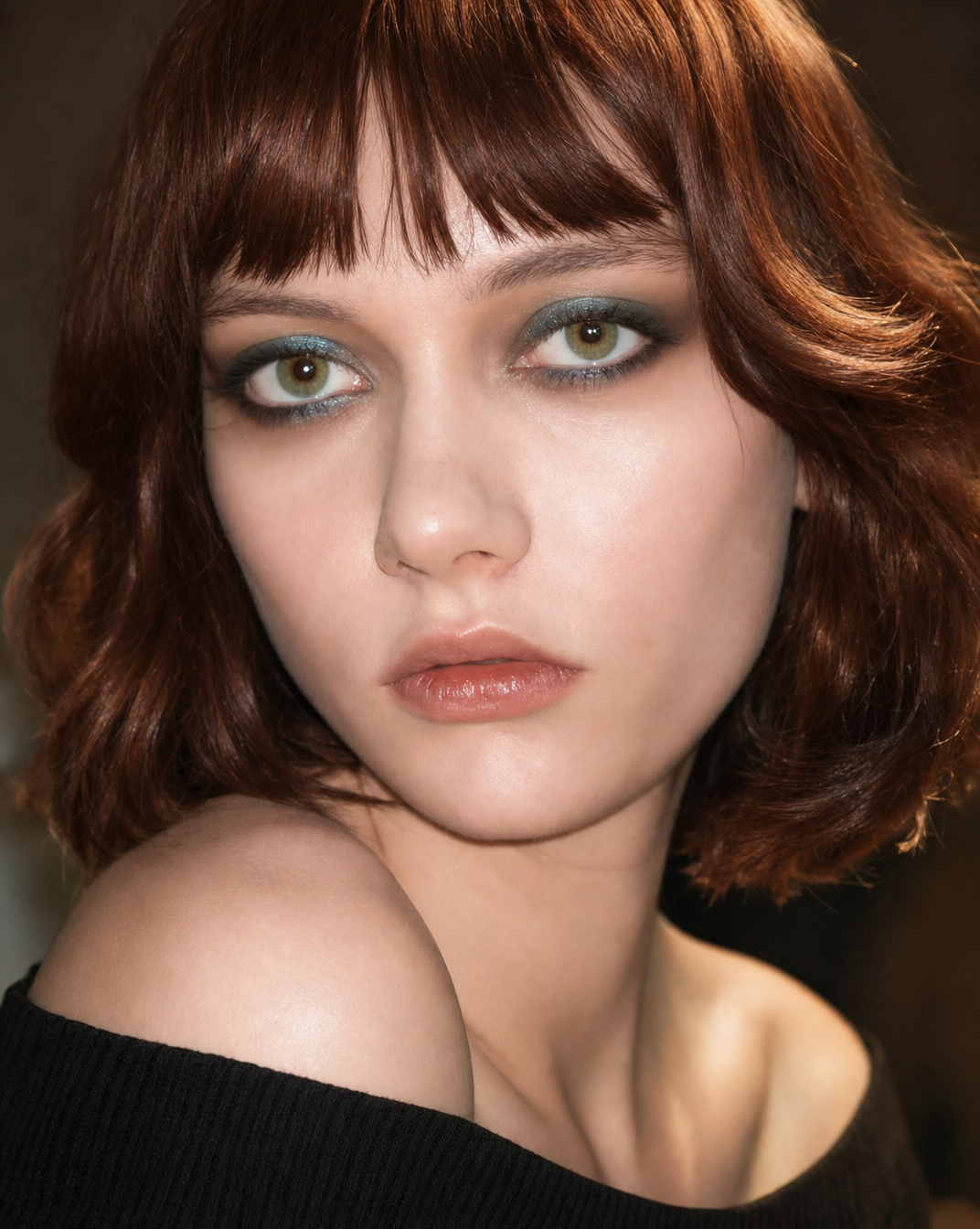
The “close-up fashion editorial portrait” and “intimate gothic mood” make the face and makeup the visual priority, while the “dark neutral background” removes competing detail around the pale subject. “Warm high-contrast on-camera flash lighting” supplies the tan highlights against black and gray surroundings, and “sharp focus” with “shallow depth of field” keeps the eyes, blunt bangs, and realistic skin texture crisp while softening the background. The fitted black off-shoulder top reinforces the restrained black-gray palette and gives the portrait a clean graphic edge.
FAQ
→How do I make the blue-green eyes the central focal point?
Replace “subtle smoked shadow with soft satin shimmer” with “precisely defined blue-green eyes, luminous catchlights, restrained neutral eye makeup,” and add “eyes in the exact plane of focus.” Keep “sharp focus” and “close-up portrait,” but remove some makeup diffusion so the iris color and catchlights carry more visual weight.
→How do I shift this from intimate gothic to a brighter luxury fashion mood?
Replace “dark neutral background” with “warm ivory studio backdrop,” “warm high-contrast on-camera flash lighting” with “large softbox lighting with gentle warm fill,” and “intimate gothic mood” with “polished high-fashion elegance.” Change the “fitted black off-shoulder top” to “structured cream silk off-shoulder top” to move the dominant palette away from black and gray.
→How do I create a consistent series with different hairstyles and outfits?
Keep the fixed anchors “pale young woman,” “blue-green eyes,” “realistic skin texture,” “close-up fashion editorial portrait,” “sharp focus,” and “shallow depth of field.” For each variation, replace only “short auburn wavy bob hair and blunt bangs” with a controlled hairstyle such as “long sleek auburn hair, center part,” and replace “fitted black off-shoulder top” with one garment phrase such as “deep emerald velvet blazer,” while preserving “warm high-contrast on-camera flash lighting” and the “dark neutral background.”
Learn the technique behind this
- Why can't AI spell, and how do I get readable text in an image? — Older diffusion models had no character-level representation of text, so they produced letterform-shaped texture instead of words.
- How should a prompt be structured, and does word order matter? — A prompt that behaves predictably names one subject first, then what it is doing, then where, then the light, then the lens or medium, then the style.
- Why does AI get hands and faces wrong, and how do I fix it? — Hands fail because they're small in frame, extremely variable in pose, and self-occluding — the model has less usable signal per pixel than for any other body part.
Related prompts
Teal fashion editorial in monster-filled lift
Cobalt Boots in Sleek Studio Edit
Sunlit editorial on striped beach towel
Silhouette Influencer by Sunlit Window