Why this works
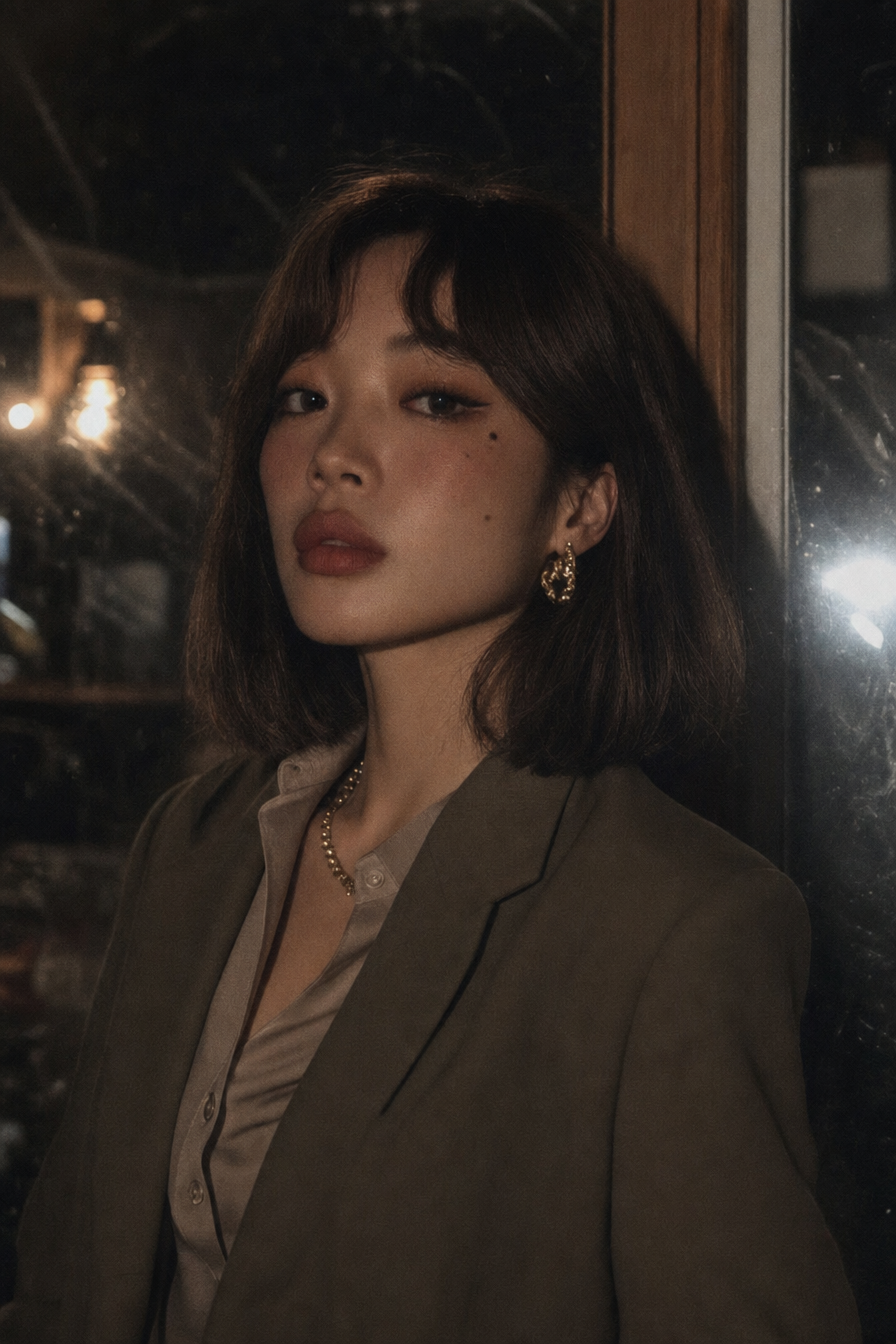
“Portrait-closeup” and the “85mm lens, shallow depth of field” specification keep attention on the model’s face, while “creamy background blur” and “soft bokeh” separate her from the New York interior. The requested “sleek shoulder-length style in deep chestnut brown” and “muted olive and warm taupe” establish controlled color accents, but the generated image’s dominant black and gray preserve the “moody and sophisticated” tone. “Warm dim cinematic lighting with strong cinematic shadows,” combined with “subtle skin texture” and a “vintage film look,” gives the close-up its restrained, tactile editorial finish rather than a polished studio feel.
FAQ
→How do I make the model’s chestnut hair and olive-taupe clothing more prominent?
Replace “muted olive and warm taupe” with “clearly visible muted olive coat and warm taupe knit top,” and add “sleek shoulder-length deep chestnut brown hair sharply separated from the dark background.” Replace “creamy background blur” with “dark neutral background blur” so the black and gray surroundings do not compete with those accents.
→How do I shift this from moody sophistication to a brighter, more approachable editorial mood?
Replace “warm, dim interior lighting with cinematic shadows” with “soft luminous window light with gentle shadows,” and change “moody and sophisticated” to “quietly warm and approachable.” Keep “85mm lens” and “portrait-closeup,” but replace “vintage film look” with “clean natural editorial color” to reduce the heavy tonal weight.
→How do I create a consistent series with different outfits and New York interiors?
Keep the fixed phrases “Asian fashion model portrait,” “85mm lens,” “shallow depth of field,” “subtle skin texture,” and “high-fashion magazine aesthetic.” For each variation, replace “elegant fall ensemble” and “indoors in New York City” with a specific outfit and location, such as “charcoal tailored suit in a SoHo loft” or “olive trench coat in a dim Upper West Side apartment,” while preserving “warm dim cinematic lighting” and “creamy background blur.”
Learn the technique behind this
- Why can't AI spell, and how do I get readable text in an image? — Older diffusion models had no character-level representation of text, so they produced letterform-shaped texture instead of words.
- How do I keep one consistent style across a whole set of images? — Style consistency is more achievable than character consistency because style lives in describable attributes.
- How should a prompt be structured, and does word order matter? — A prompt that behaves predictably names one subject first, then what it is doing, then where, then the light, then the lens or medium, then the style.
Related prompts
Teal fashion editorial in monster-filled lift
Cobalt Boots in Sleek Studio Edit
Silhouette Influencer by Sunlit Window
Sunlit editorial on striped beach towel